
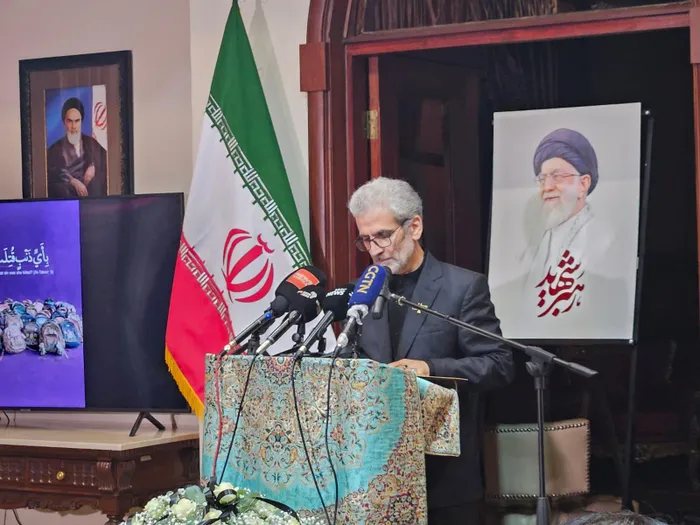
Iran’s ambassador to South Africa, Mansour Shakib Mehr, speaking to the media on Wednesday night in Pretoria.
Image: Iran Embassy
Iran says it will continue its confrontation with the United States and Israel, insisting it is acting in defence of its sovereignty after what it describes as an unprovoked and coordinated attack.
Speaking on Wednesday night, Iran’s ambassador to South Africa, Mansour Shakib Mehr, said the conflict between Iran, the US and Israel had resulted in the death of Supreme Leader Ali Khamenei and amounted to a grave breach of international law.
“The assassination of the Leader of the Islamic Republic of Iran by the United States and the Zionist regime represents a dangerous and unprecedented violation of international norms,” he said. “As Heads of State are considered inviolable and immune under international law, targeting such a figure undermines the very foundations of sovereign equality.”
He alleged that the initial wave of strikes extended beyond military installations and hit civilian areas.
“For example, in the city of Minab in southern Iran, an all-girls elementary school was almost completely destroyed, resulting in the death of nearly 170 innocent children,” he said, calling it a “horrific crime against children.”
The ambassador accused Washington and Tel Aviv of violating Article 2(4) of the United Nations Charter, which prohibits the use of force against another state’s territorial integrity. He said Iran would respond in terms of Article 51 of the Charter, which recognises the inherent right to self-defence.
“In light of these aggressive actions, the Islamic Republic of Iran reaffirms its inherent and lawful right to self-defence,” he said, adding that Iran’s armed forces were “fully prepared to defend the nation.”
The confrontation intensified on 28 February, when Israel and the United States launched what has been described as a large-scale coordinated operation against Iran. The campaign, reportedly codenamed “Operation Epic Fury”, has involved extensive air and missile strikes targeting senior leadership, ballistic missile infrastructure and nuclear facilities, including the Natanz enrichment site.
Iranian state media reported that Khamenei was killed in the early phase of the strikes, and that a succession process is underway.
In response, Iran has launched more than 2,000 drones and 500 ballistic missiles towards Israeli territory, US military bases and sites in neighbouring Gulf states. Hezbollah has opened a second front from southern Lebanon, firing rockets and drones into northern Israel.
Casualty figures continue to rise. Reports indicate that more than 1,000 people have died in Iran since the start of the conflict, while dozens have been killed in Lebanon and at least 11 in Israel.
Tehran has also effectively closed the Strait of Hormuz to commercial shipping, placing a significant share of global oil and gas supplies at risk. The waterway is a crucial route for energy exports from the Gulf, and any prolonged disruption is likely to have significant global economic consequences.
US and Israeli officials have said their objective is to degrade Iran’s military and nuclear capabilities and prevent it from threatening regional stability. Both governments have long maintained that Iran’s nuclear programme and its support for armed groups such as Hezbollah and Hamas pose serious security risks.
The latest escalation comes against the backdrop of years of hostility between Iran and Israel, often fought indirectly through proxy groups and covert operations. The United States, Israel’s closest ally, has imposed sweeping sanctions on Iran, particularly after withdrawing from the 2015 nuclear agreement in 2018.
In his statement, the ambassador said that Iran had been engaged in negotiations with the United States before the attack and was cooperating with the International Atomic Energy Agency.
“This aggression occurred at a time when the Islamic Republic of Iran was once again engaged in negotiations with the US to prove to everybody that it is not pursuing nuclear weapons,” he said. “A military attack in the midst of diplomatic efforts is a betrayal of dialogue.”
He added that inspections of Iran’s nuclear facilities had continued until what he described as “military aggression in June 2025.”
Rejecting the justification of pre-emptive defence, he said: “Their claim that they carried out a military attack on Iran under the title of ‘pre-emptive defence’ is not accepted by any civilised nation.” He further stated that the United States had “entered a war of choice on behalf of Israel.”
US officials have previously argued that any action involving Iran is aimed at protecting American forces and preventing nuclear proliferation. Israel has consistently said it will not allow Iran to develop nuclear weapons capability and reserves the right to act against perceived threats.
The ambassador called on the United Nations Security Council, BRICS countries and members of the Non-Aligned Movement to condemn what Iran describes as aggression.
“We expect the United Nations, the Security Council, and all Member States to fulfil their serious responsibility in preserving international peace and security,” he said, describing the moment as “a historic test for the multilateral system.”
He also appealed to South Africans and the wider international community to voice opposition, referencing Iran’s support for the anti-apartheid struggle and noting that after the 1979 revolution, Tehran severed ties with apartheid-era South Africa.
karabo.ngoepe@inl.co.za