
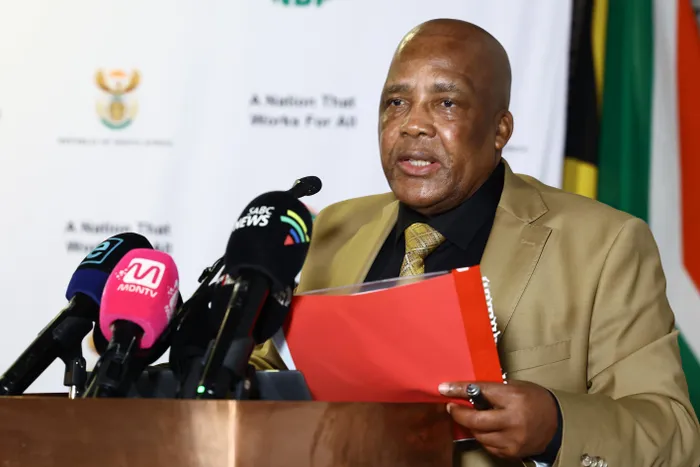
Despite protests from doctors, Minister of Health Aaron Motsoaledi says there is no failure in absorbing new medical graduates, highlighting government-funded internships and community service across urban and rural hospitals nationwide.
Image: GCIS
Minister of Health Dr. Aaron Motsoaledi has defended the government's efforts to place newly qualified medical professionals, responding to growing concerns raised by members of the National Council of Provinces (NCOP) on Thursday.
The Minister assured MPs that there is no failure in absorbing new medical graduates into the workforce, despite ongoing protests from some doctors about placement and retention, particularly in rural areas.
Mostoaledi's comments followed remarks from several MPs, including ANC NCOP member Desery Fienies, who expressed concern about how effectively the department is distributing healthcare professionals to meet service delivery needs across the country, particularly in underserved regions.
In his response, Motsoaledi reassured members that the government has an effective placement system for medical graduates.
He pointed out that all South African medical graduates are legally required to complete internships and community service, with the state bearing the responsibility for their salaries during these periods.
“There is no failure in this system. Every South African who has studied medicine is obliged to do an internship. The state ensures funding for their salaries,” Motsoaledi said.
He explained that while many graduates prefer to work in urban areas like Cape Town and Johannesburg, the department ensures that they are placed in hospitals across the country, including in rural regions.
Motsoaledi was also questioned by Democratic Alliance (DA) NCOP member Mzamo Billy, who raised the issue of ongoing protests by unemployed doctors in KwaZulu-Natal (KZN). Billy highlighted concerns about the delays in placements, particularly in KZN, and the impact this had on the province’s healthcare system.
Motsoaledi admitted that delays had occurred in the past, specifically last year when placements were postponed until October instead of September. However, he assured the House that the system has improved, citing his recent meeting with the Premier and MECs for Health and Finance in KZN.
“I recently spent four hours with the Premier of KZN and their MECs to discuss these issues. I can assure you that the placement process has been streamlined and this year, placements were finalised much earlier,” Motsoaledi said.
EFF NCOP member Mathaphelo Siwisa also raised concerns about the availability of advanced medical equipment in rural healthcare facilities, questioning whether health professionals in these areas are equipped to handle the latest medical technologies.
Motsoaledi acknowledged that while sophisticated equipment, such as MRI machines, is typically only available in larger academic hospitals, the department has focused on providing point-of-care technologies, such as GeneXpert machines for rapid TB diagnosis, in rural clinics.
“We are ensuring that smaller hospitals and clinics have the necessary equipment, like GeneXpert machines, which can help diagnose TB in remote areas. It depends on the level of healthcare technology, but we are making significant strides with these types of machines,” he explained.
Despite these improvements, Motsoaledi was honest about the challenges of retaining healthcare professionals in rural areas, especially in the face of inadequate infrastructure and living conditions.
Freedom Front Plus NCOP member Tamarin Breedt, who represents a rural constituency, also expressed concern about the difficulty in retaining doctors in underfunded areas, citing poor infrastructure and outdated equipment as major barriers to retention.
Motsoaledi agreed, stating that comfortable accommodation and proper working conditions are crucial to retaining healthcare workers in rural settings.
“Small things like good accommodation and food can make a big difference in whether doctors stay in rural areas. If they have proper accommodation and a good working environment, they are more likely to remain in these areas,” Motsoaledi said.
Addressing these concerns, the Minister also explained that while the national government provides funding and support, the responsibility for healthcare infrastructure lies with provincial governments.
“We continuously discuss these issues with provincial MECs. However, the responsibility for maintaining and upgrading infrastructure, as well as for recruitment, lies with the provinces themselves,” Motsoaledi said.
The Minister reaffirmed that while there are challenges, the department remains committed to addressing the healthcare needs of rural areas, particularly by improving infrastructure and working conditions.
“We are committed to ensuring that every medical professional is properly placed and that we continue to invest in the development of rural healthcare infrastructure. Retention, however, requires a collaborative effort with the provinces to create better working conditions,” he said.
hope.ntanzi@iol.co.za
IOL Politics