
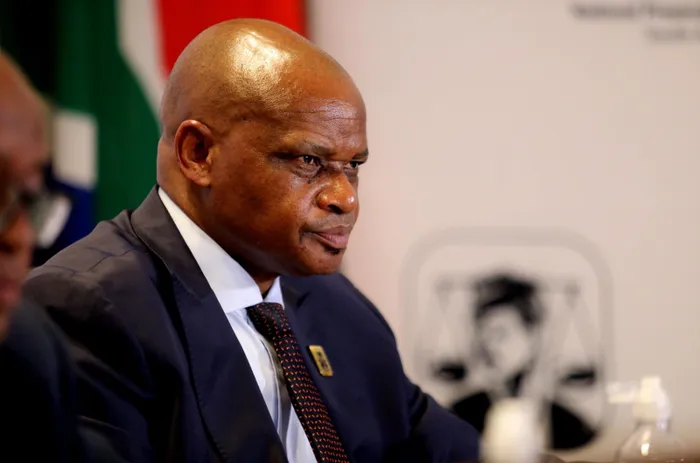
Security strategist Andy Mashaile has welcomed the reform agenda of new National Prosecuting Authority head Andy Mothibi, saying his priorities are “spot on”, but warned challenges lie ahead for him.
Image: Oupa Mokoena / Independent Newspapers
The low staff morale, negative reputation of the Investigating Directorate Against Corruption (IDAC) and corrupt prosecutors are key challenges that lie ahead for new NPA boss Advocate Andy Mothibi’s vision to build a stronger prosecuting authority, warns security strategist Andy Mashaile.
National Director of Public Prosecutions (NDPP) Mothibi on Thursday provided a detailed outline of how the NPA will shape its work under his leadership.
President Cyril Ramaphosa appointed Mothibi in January following public interviews of six candidates who were ultimately overlooked.
Mothibi replaced Advocate Shamila Batohi, who concluded her seven-year term.
Mothibi said his office is prioritising action on findings from the Madlanga Commission and will not wait until the commission completes its work.
He assured that the NPA will move decisively against individuals identified in the commission’s first interim report, as well as those expected to be named in the second report due in May.
Mothibi delivered his first media briefing since his appointment on Thursday, outlining his vision for the NPA and its strategic direction.
Addressing the Madlanga Commission, he said two prosecutors have already been assigned to work on the findings, with additional prosecutors to be deployed depending on the workload.
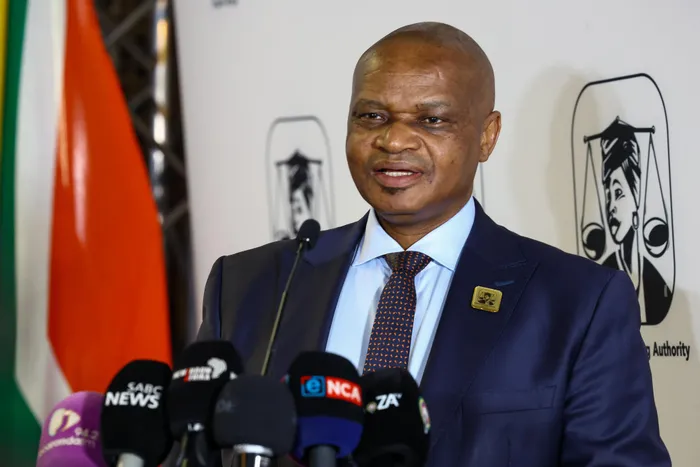
NDPP Advocate Andy Mothibi, has outlined the strategic direction and objectives for the National Prosecuting Authority (NPA).
Image: Supplied / GCIS
The NPA will also focus strongly on organised crime. Mothibi noted that the authority’s strategy against organised crime was approved in August 2024.
“We are now intensifying implementation to deliver impactful interventions and outcomes through meaningful collaboration and more effective use of legislation,” he said.
Mothibi explained that by using racketeering provisions under the Prevention of Organised Crime Act (POCA), the NPA is targeting criminal kingpins, syndicates, money-laundering networks and enablers such as accountants, lawyers and intermediaries.
In addition, the NPA and the South African Police Service (SAPS) have developed a Stabilisation Plan - a multi-dimensional, interdepartmental strategy to address gang violence in the Western Cape.
“This plan has been extremely well received and is now being rolled out in other provinces,” Mothibi said.
An Organised Crime Component (OCC) Firearms Desk has also been established. Firearms remain central to organised crime in South Africa and are the primary tools used in gang violence, cash-in-transit heists and extortion networks.
Mothibi said the dedicated Firearms Desk would improve coordination in tackling illegal firearms.
“If you remove the illegal firearm, you remove the instrument of organised violence. A dedicated Firearms Desk therefore allows the NPA to move from merely prosecuting possession to dismantling supply networks and criminal enterprises, thereby curbing violence,” he said.
He added that his office has already met with the national commissioner of SAPS to align the strategies of the two institutions.
The former Special Investigating Unit (SIU) head said the alignment will enable closer collaboration between investigators and prosecutors, including identifying cases, conducting prosecutor-guided investigations, recovering assets and ensuring effective prosecution.
He said the collaboration will be demonstrated through several initiatives, including the implementation of the Madlanga Commission’s findings, where a task team will investigate and prosecute cases arising from its interim report.
“We will not relent in pursuing South African assets and fugitives from the law,” Mothibi said.
He said at the international level, South Africa will utilise the Interpol Red Notice system and participate in the Interpol Silver Notice pilot programme, which offers enhanced mechanisms to search for, trace and track suspects and assets globally.
Mothibi also highlighted the importance of asset recovery in the fight against crime and corruption, noting that confiscating the proceeds of crime is a key indicator of anti-money-laundering effectiveness.
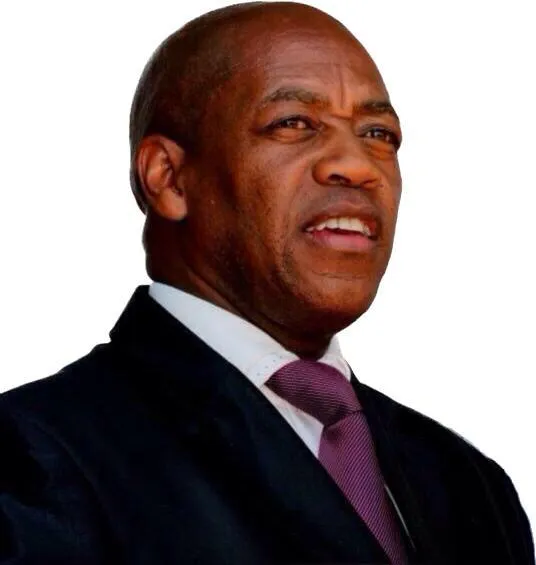
Security strategist Andy Mashaile says Andy Mothibi’s plan to strengthen the National Prosecuting Authority is the right step, but warns internal challenges could slow progress.
Image: Supplied
Key measures include freezing and confiscating criminal proceeds, civil forfeiture proceedings under POCA, preservation orders targeting criminal networks and returning recovered assets to the state or compensating victims of crime.
He pointed out that R15 billion in funds had been frozen in the past five years - compared with R16.2 billion frozen during the previous 20 years.
The NPA has also introduced a Quick Wins Action Plan aimed at identifying and implementing short-term, high-impact initiatives.
Key focus areas include addressing case backlogs, prioritising prosecutions, implementing recommendations from the Madlanga Commission and tackling organised crime and gender-based violence.
Another priority will be filling critical senior positions within the NPA and securing operational and financial independence for the authority.
Mothibi acknowledged that the NPA requires prosecutors with strong financial expertise to handle complex corruption and organised-crime cases and said efforts are under way to recruit professionals with these skills.
Speaking to IOL News, security strategist Andy Mashaile welcomed Mothibi’s plans.
“Advocate Mothibi’s NPA priorities are spot on for the first phase of his rebuilding strategy. The successful achievement of this phase will determine his next move on his strategic chessboard of strategy and tactics,” he said.
“For this phase, the priorities are critical mass elements.”
However, the leadership of the NPA has historically been precarious.
No previous NDPP has completed the full 10-year term allowed by law for those appointed before the age of 65.
Batohi served seven years before reaching the mandatory retirement age of 65 in January 2026.
Mothibi, who is 63, told the media he is confident he can achieve his objectives before retirement.
Mashaile agreed, “These objectives can definitely be achieved within two years of his five-year plan. Achieving them will be crucial to restoring public confidence in the NPA and its mandate,” he said.
However, Mashaile warned that several key challenges lie ahead.
“Key challenges for Mothibi include staff morale, the negative reputation of IDAC, employment process challenges - for example, the head of IDAC’s husband sitting in the same interview process - the weaponisation of IDAC, the need for quick turnaround times in prosecutions, and corrupt prosecutors,” he said.
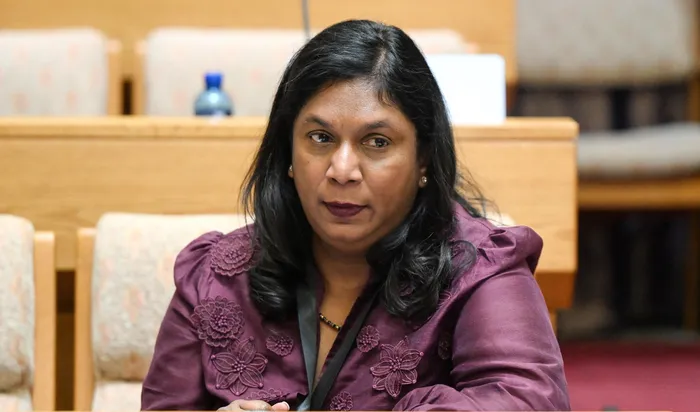
Andrea Johnson faced scrutiny during interviews for the top National Prosecuting Authority post over her past involvement in the hiring process of her husband to the former Directorate of Special Operations.
Image: Phando Jikelo / Parliament of RSA
The Investigating Directorate Against Corruption (IDAC) has faced controversy in December involving its head, Andrea Johnson.
Johnson’s involvement in the hiring process of her husband, Junaid Johnson, to the now-disbanded Directorate of Special Operations 18 years ago resurfaced during her interview for the NDPP position.
A seven-member panel chaired by justice and constitutional development minister Mmamoloko Kubayi interviewed six candidates to replace Batohi.
The interviews took place amid criticism of the NPA’s performance in prosecuting state capture cases.
Johnson’s nomination attracted 209 public comments, many raising concerns about her past role in the hiring process involving her husband.
During the interview, panel member Machini Motloung, representing the National Association of Democratic Lawyers, told Johnson that several submissions had expressed discomfort with her previous remarks to Parliament about the matter.
Johnson said she had been part of a panel that recommended her husband for the position but had declared their marriage and recused herself from interviewing, scoring and deliberating on his candidacy.
“I did physically recuse myself from shortlisting, the actual interview and the adjudication,” she said.
However, she acknowledged that she should have completely recused herself from the process to avoid any perception of irregularity.
“I regret it. I wish someone had raised that it was irregular,” she said.
The matter resurfaced in Parliament after KZN police boss Lieutenant General Nhlanhla Mkhwanazi alleged that rogue elements existed within IDAC while the unit investigated a fraud case involving crime intelligence head Dumisani Khumalo.
Johnson denied the allegations, saying that the investigation into Khumalo was based on complaints received and that IDAC had a duty to investigate them.
She added that the issue relating to her husband’s hiring process was raised publicly for the first time in 18 years during parliamentary proceedings.
“In hindsight, I accept I could have done better and differently. I accept that how it looks is not good,” Johnson told the panel.
She urged the panel to consider her full public service record, which spans more than three decades.
Johnson was among six candidates shortlisted for the NDPP position, alongside Nicolette Bell, Adrian Mopp, Xolisile Khanyile, Hermione Cronje and Menzi Simelane.
simon.majadibodu@iol.co.za
IOL Politics