
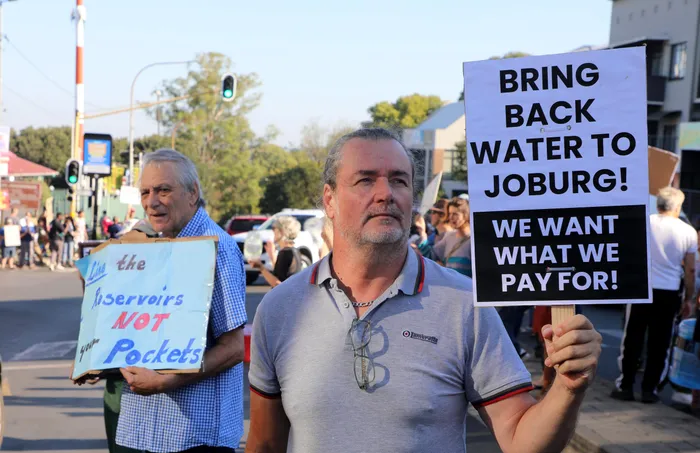
Joburg residents have been subjected to numerous water cuts that are affecting daily life. BOSA wants the government to address challenges or face court action.
Image: Timothy Bernard / Independent Newspapers
Build One South Africa (BOSA) is preparing to take the government to court over what it describes as a worsening water crisis that is infringing on citizens’ constitutional rights.
Speaking during a Human Rights Day debate in Parliament, BOSA deputy leader Nobuntu Hlazo-Webster said the party would seek legal intervention to compel the state to act, warning that millions of South Africans are being denied access to a basic right.
“Section 27 of our Constitution guarantees that everyone has the right to have access to sufficient water. This right is not aspirational — it is legally enforceable,” she said.
Hlazo-Webster pointed to the landmark Constitutional Court ruling in Mazibuko v City of Johannesburg, which affirmed the state’s obligation to take reasonable steps to progressively realise access to water.
“Today, across the country, too many citizens are grappling with water shortages and supply interruptions. If the taps aren’t completely dry, then water throttling is implemented.”
She drew a sharp comparison with the country’s ongoing electricity crisis, accusing the government of presiding over a new form of systemic failure.
“If load shedding was the gift from the previous administration, then water shedding is the gift from this administration,” Hlazo-Webster said.
BOSA argues that a lack of clear accountability within government structures is at the centre of the crisis. Hlazo-Webster said responsibility for water delivery is being passed between different levels of government, leaving residents without answers.
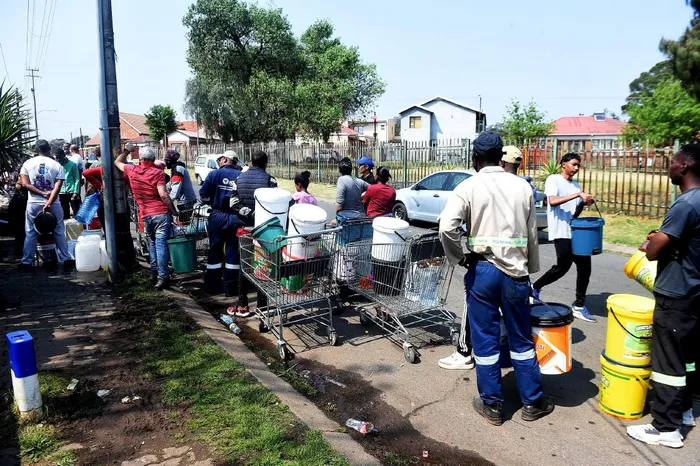
People around Gauteng have had to rely on water trucks to survive the water situation in the province.
Image: Itumeleng English / Independent Newspapers
“The Minister of Water says it’s the job of municipalities. Municipalities say it’s the water boards. The deputy president says it’s the Water Task Team, while the president points to the National Water Crisis Committee,” she said.
“We can understand why citizens are frustrated and why no one is directly accountable.”
Johannesburg, she added, has become the “epicentre” of the crisis, with prolonged outages linked to ageing infrastructure and mismanagement.
Hlazo-Webster confirmed that BOSA will approach the courts for “direct relief” if the government fails to act, with details of the legal challenge expected to be announced ahead of Human Rights Day.
“This year, BOSA is standing in the gap on behalf of citizens, and we will be approaching the courts,” she said. “If government will not act, the courts must instruct it to do so.”
She also urged the administration of President Cyril Ramaphosa not to oppose the litigation.
“We appeal to the president and his government not to waste taxpayers’ money by opposing this legal action. All efforts should be directed towards supplying clean water to every citizen.”
The legal threat comes as South Africa continues to pursue regional water cooperation agreements aimed at securing a long-term supply.
Last weekend, Water and Sanitation Minister Pemmy Majodina met with Eswatini’s Minister of Natural Resources and Energy, Prince Lonkhokhela Dlamini, to sign a revised treaty governing shared water resources in the Komati River Basin.
Majodina said the agreement builds on decades of collaboration between the two countries.
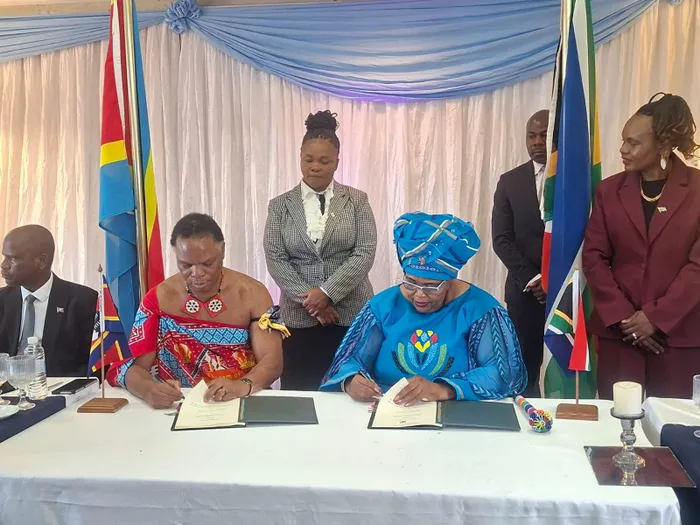
Eswatini’s Minister of Natural Resources and Energy, Prince Lonkhokhela Dlamini, and South Africa's Minister of Water and Sanitation, Pemmy Majodina, sign a revised treaty governing shared water resources in the Komati River Basin.
Image: Supplied / DWS
“This is a project which started 33 years ago because we want to conserve and preserve water within the countries,” she said, noting that South Africa currently receives 60% of water allocations from the shared system, with Eswatini receiving 40%.
Prince Lonkhokhela emphasised the broader developmental importance of water security across the region.
“Water is not just a commodity. Water is like the air that we breathe. Without water, there is no life, no health. Everything starts in disarray,” he said.
He added that cooperation between Eswatini, South Africa, and Mozambique is critical to ensuring sustainable access.
“We are talking about the future, about preserving water for our people. Without peace between countries, there can be no such cooperation,” he said.
karabo.ngoepe@inl.co.za