
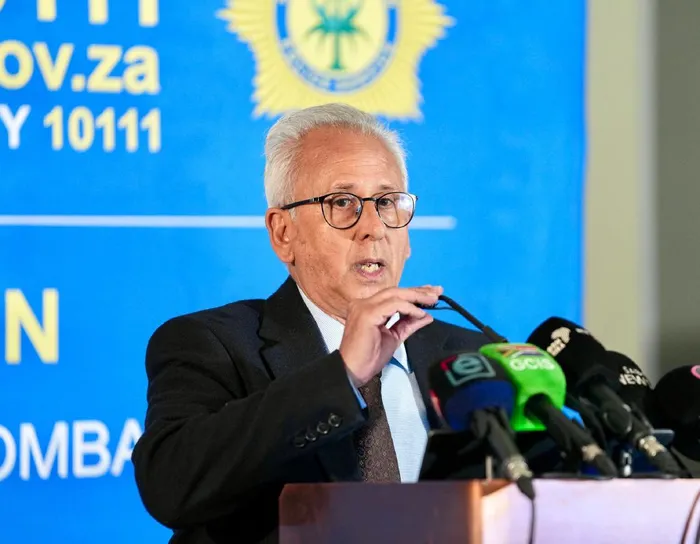
Acting Police Minister Firoz Cachalia says R25 million was allocated to procure dogs over the last five financial years.
Image: Supplied
The police are facing a pressing challenge in their canine units, with Acting Police Minister Firoz Cachalia providing an update on the organisation's efforts to address a significant shortage of operational dogs.
This comes after a call for canine donations sparked debate about planning and resource management within the SAPS.
Cachalia clarified that the appeal for public assistance does not indicate a failure of comprehensive planning or operational leadership.
“The donation of dogs is just one of the measures used to increase the complement of dogs within the SAPS,” he said.
“The SAPS also procure dogs from the local and international market and breed dogs,” said Cachalia when responding to EFF MP Muzi Khoza.
Cachalia’s explanation follows a February report indicating that the SAPS requires about 500 dogs to fully staff its K9 units across the country.
The urgency of this need was highlighted by an appeal from the Eastern Cape, which came shortly after a similar request from the Northern Cape in September.
Khoza enquired from Cachalia about measures being taken to restore the canine units, hold responsible officials accountable, and assurance that the police won’t rely on public charity to fulfil their responsibilities.
He also sought to know the total amount allocated to SAPS K9 units over the past five financial years, and specific failures and cases of mismanagement that led to the shortage that now has the potential to undermine crime detection, drug enforcement, and search operations.
Cachalia responded, revealing that R25 million has been allocated for the procurement of dogs over the last five financial years.
During this time, 291 dogs were sourced from the local market and an additional 20 from international suppliers, with R16 million spent in the last four years for these acquisitions.
Cachalia stated several factors have contributed to the current dog shortage, including chronic medical conditions, injuries, and dogs killed on duty.
Moreover, an outbreak of Parvovirus in the SAPS K9 Breeding Centre in 2019 and 2020 severely disrupted breeding efforts.
“The Covid-19 pandemic brought about a negative influence on the dog-training and pre-training programmes, which led to the increased backlog on capacitating the K9 Units.”
Cachalia said procurement measures were taken to replace the dogs that were disposed; however, due to the age distribution of the current complement of dogs, the rate of disposal is inverse to the replacement rate.
SAPS managed to breed 98 puppies in the 2023/24 financial year, of which only 14 were suitable for training purposes.
With similar output in 2024/25, Cachalia noted the challenges persisting in achieving training readiness for operational deployment.
There were 62 puppies that were bred, with only three found suitable for training purposes.
He said 54 puppies were currently bred and will only be assessed when they reach the age of one.
Cachalia explained that funds were apportioned for the immediate procurement of breeding stock in the 2025/26 financial year, but suppliers were unable to provide enough dogs for the required breeding.
“Measures are in place to acquire a three-year procurement contract for the procurement of operational and breeding dogs. Training efforts have been intensified to ensure that dogs which are ready and suitable are trained and deployed without delay.”
Cachalia added that the SAPS has also intensified its own breeding capacity by staying abreast with the latest available technologies.
“The SAPS Veterinary Services is looking at a more scientific, sustainable, and welfare-based approach to enhance breeding capability, which is expected to sustain the SAPS operational needs.”
The police were also implementing breeding, whereby dogs are bred for suitability and identified for operational purpose.
“The procurement methods such as purchasing and donations are ongoing strategies employed by the SAPS to supplement the breeding programme to capacitate the K9 Units and address the backlog.”
mayibongwe.maqhina@inl.co.za