
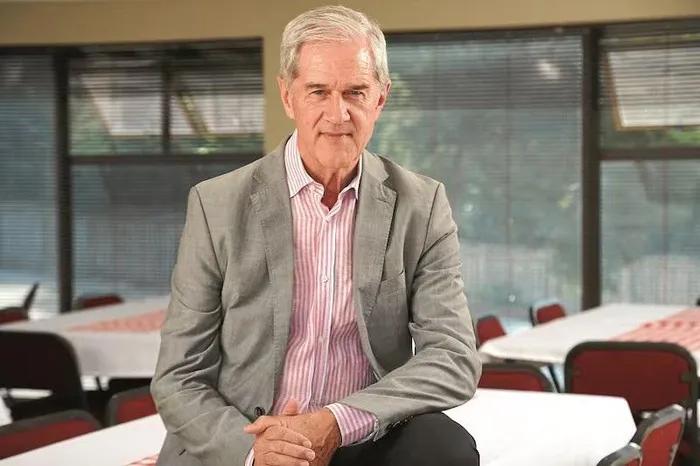
Roelf Meyer’s appointment as US ambassador has drawn mixed reactions, with some praising his CODESA experience and diplomatic skills, while others criticise his apartheid government role and alleged transition compromises.
Image: FaceBook
The appointment of Roelf Meyer as South Africa’s ambassador to the United States of America (US) has sparked political debate, with critics questioning his apartheid-era role in government and others defending his diplomatic experience and ties to the country’s democratic transition.
President Cyril Ramaphosa announced Meyer’s appointment on Tuesday, filling a post that had been vacant since 14 March 2025 following the expulsion of former ambassador Ebrahim Rasool, who was declared persona non grata after criticising the administration of US President Donald Trump.
Following Rasool’s expulsion, Ramaphosa appointed former deputy finance minister Mcebisi Jonas as a special envoy to the United States in April to manage bilateral, trade and diplomatic priorities while the permanent position remained vacant.
However, the US government denied Jonas a diplomatic visa and rejected his credentials, citing past remarks in which he reportedly described Trump as a “racist”, “homophobe” and a “narcissistic right-winger” in 2020.
ActionSA leader Herman Mashaba has criticised the appointment, saying it “exposes the extent of Ramaphosa’s fixation with pandering to white nationalists.”
He said it was “shameful” that such a strategic diplomatic position had been given to a “78-year-old enforcer of apartheid,” adding that the decision reflected what he described as a “vacuous style of leadership.”
Mashaba further argued that the appointment signalled “a retreat into comfort and proximity to white nationalists,” and questioned South Africa’s foreign policy direction under the current administration.
The uMkhonto weSizwe Party (MK Party) said it did not reject individuals “on the basis of race or past political labels alone,” but stressed that “historical responsibility and political accountability cannot be ignored” in diplomatic appointments.
It said the appointment was “profoundly insensitive and politically tone-deaf,” particularly during the month commemorating Solomon Kalushi Mahlangu, adding that “the blood of our heroes demands historical honesty, not selective amnesia.”
The party said Meyer’s role as a former apartheid minister and CODESA negotiator could not be separated from his appointment, calling it a “diplomatic and political miscalculation” that reflects continuity with “the politics of compromise rather than the courage of transformation.”
The Economic Freedom Fighters (EFF) also strongly rejected the appointment, calling it “politically tone-deaf” and “a deliberate insult to our democratic struggle.”
The party said Meyer’s history as a senior apartheid official made him unfit for diplomatic office and argued that the government was “rehabilitating former apartheid functionaries” while undermining the legacy of the liberation struggle.
The EFF called for the immediate withdrawal of the appointment and for the selection of a representative who “embodies the true revolutionary values of our country.”
Meanwhile , EFF Member of Parliament Carl Niehaus described the appointment as “not merely a poor diplomatic choice” but “a shameful, pathetic, and deeply humiliating act of surrender.”
He argued that Meyer played a central role in shaping the political settlement during the CODESA negotiations and said his apartheid-era background could not be separated from his diplomatic appointment.
Political analyst Goodenough Mashego said the appointment should be viewed through the contested legacy of South Africa’s transition.
“What is being said a lot is the fact that he is a former negotiator at CODESA with Cyril Ramaphosa,” he said.
“Depending on whether you believe what we have today is working or not, he is one of the architects of this car that is not moving, or the architect of this car that is moving for you,” he added.
Mashego further said the decision may have been politically motivated to manage relations with Washington. “This is a bad move. It’s a bad move because number one, it’s intended to appease Americans, which it’s not going to do,” he said.
UKZN political analyst Zakhele Ndlovu said the debate over Meyer’s appointment was “neither here nor there,” arguing that competence should outweigh political history.
However, he questioned whether external pressure influenced the decision, asking: “Was he pushed to appoint Meyer or a person acceptable to the Trump administration?”
He added that there was a sense that Ramaphosa may have been pressured into the appointment to appease the United States.
In contrast, other analysts and political parties welcomed the appointment, saying Meyer’s experience and diplomatic skills make him suitable for the role.
Political analyst Prof Theo Neethling said the appointment was grounded in trust and long-standing political relationships dating back to the CODESA negotiations.
“The president would not appoint someone he does not trust. He trusts Roelf Meyer because, since the days of CODESA they have continued to trust one another and have maintained a good personal relationship,” he said.
Neethling added that Meyer understands South Africa’s socio-economic diversity and has the necessary diplomatic temperament for the role, describing him as “well-articulated, acts diplomatically, and is careful and thoughtful about what he says.”
He further said Meyer’s international experience in conflict resolution and global networks make him well suited for Washington, arguing that he would not allow ideology to undermine diplomatic engagement.
Political analyst Professor Siphamandla Zondi of the University of Johannesburg said the appointment was meant to place a senior and experienced figure in a complex diplomatic environment.
“I think the appointment is meant to find a person with a senior stature, political experience and politically able to manage the fractious relationship with an erratic USA administration that is dogged by the myth of a white genocide in South Africa,” he said.
Zondi added that Meyer’s role in South Africa’s constitutional transition positioned him to defend the country’s democratic framework.
“Roelf Meyer is one of the authors of the new constitutional dispensation and is now saddled with the task to defend its edifice against right wing forces in the USA,” he said.
He further said Meyer’s negotiation experience and diplomatic skills were central to the appointment, noting that while
Meyer may have preferred a younger figure, he had accepted the responsibility and was now expected to assist in repairing bilateral relations.
He said the debate over the appointment reflects domestic political contestation rather than questions of competence.
The African National Congress (ANC) welcomed the appointment, with secretary-general Fikile Mbalula saying: “Roelf Meyer good appointment congratulations!!!”
hope.ntanzi@iol.co.za
IOL Politics