
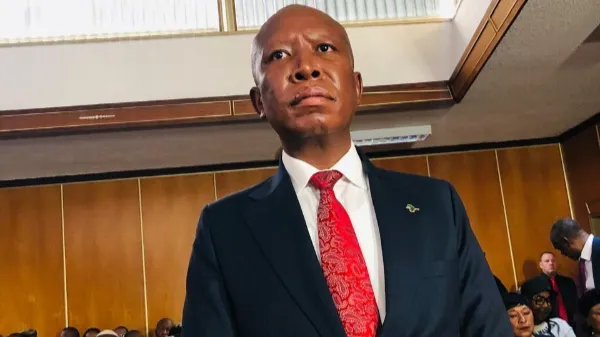
Economic Freedom Fighters leader Julius Malema says the government must send student financial aid directly to universities instead of through the NSFAS.
Image: ABONGILE GINYA
Economic Freedom Fighters leader Julius Malema says the government must send student financial aid directly to universities instead of through the National Student Financial Aid Scheme (NSFAS).
Malema addressed the issue while speaking to the party’s student command on Monday.
His remarks come after NSFAS was placed under administration again following another period of instability and governance concerns.
Higher Education Minister Buti Manamela announced it last Monday, adding that the decision was taken to stabilise NSFAS.
This effectively means the student financial aid scheme’s board has been dissolved, and the entity will be temporarily run by an administrator.
The move follows the recent resignation of two board members, including acting chairperson Mugwena Maluleke.
Maluleke resigned just five months after his appointment, having replaced another chairperson who also stepped down.
NSFAS has faced years of instability, including delays in the disbursement of student allowances, leaving many students hungry.
The challenges have also affected landlords and accommodation providers, often resulting in students being evicted because of non-payment.
Almost every year at the start of the academic year, the same challenges persist, leading to student protests.
Addressing the party’s Central Youth Elections Task Force, Malema said the party’s youth league was advocating for changes for students at higher education institutions across the country.
“You are the ones who are fighting that NSFAS must allocate the allowances on time and pay rental on time because you don't want to see the children of the poor being chased out of accommodation because somebody at NSFAS got drunk and forgot to pay the rentals and the allowances of children.”
He called for the government to send student financial aid directly to institutions.
“But we are the ones who are saying, let's do away with NSFAS and provide money straight to universities because they are the ones who registered these people. They know how many of those people are there who need this money.”
“And the people at the university, if anything goes wrong, are able to go to their offices because they are with us on campus. We're able to say, "but you did not pay this, you did not pay that, it's your responsibility to do one, two, three.”
“But if it is NSFAS, we're unable to go to NSFAS. How can we go to NSFAS because we don't even have money? So where are we going to get transport to go to NSFAS? So we need the money, and it is not impossible. Why? All the high schools are given money by the government. All of them.”
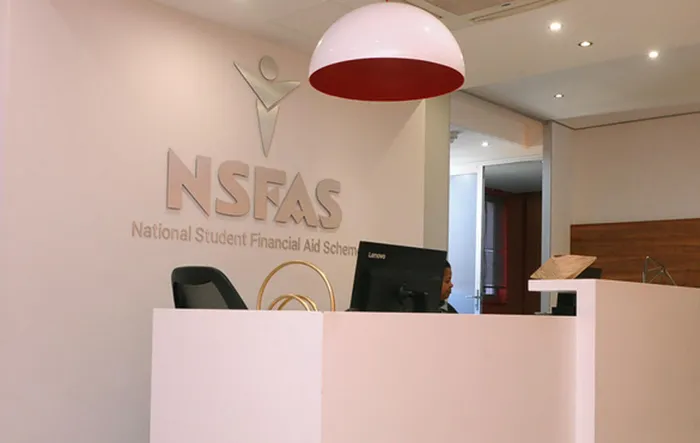
The government has placed NSFAS under administration again following renewed governance and operational challenges at the student funding scheme.
Image: Independent Newspapers Archives
Malema said there was no NSFAS system for high schools.
“There's no NSFAS for high schools. Every high school has a bank account verified by the Department of Education. Money is sent there.”
“That's why there was that principal in Eastern Cape who was using a credit card of the school to buy KFC. That's how much money they have. So much money given directly to them.”
“We're talking (about) high schools here. How many high schools? More than 7,000. The government is able to send money directly into their accounts.”
“When we talk about universities and TVETs, they don't come anywhere close to where the high schools are. I mean, if we talk about Limpopo, there are four universities there. Four. So how can you fail to give four universities money if they say it's so complicated?”
“And those people are able to use the money to make sure that the school is run smoothly. So you should not be misled by an argument that seeks to suggest that this money will be misused and so on and so forth.”
Malema comments come as NSFAS continues to face instability challenges.
Manamela said the move to put NSFAS under administration followed “a prolonged period of governance challenges, legal concerns and operational weaknesses” that threatened the stability and credibility of NSFAS.
He said the decision was taken in terms of Sections 17A to 17D of the NSFAS Act of 1999 after “careful consideration of the legal, governance, financial and operational circumstances” affecting the institution.
Manamela appointed former South African Reserve Bank and South African Revenue Service executive Professor Hlengani Mathebula as administrator.
He said Mathebula brought extensive governance, financial and institutional leadership experience across the public and private sectors, as well as academic leadership in higher education.
His mandate includes stabilising governance structures, addressing audit failures, fixing ICT systems, improving student funding operations, resolving appeals backlogs and strengthening institutional controls.
In a statement on Monday, NSFAS announced that private accommodation payments for universities were released on Thursday, May 7, 2026.
“Accommodation providers banking with First National Bank (FNB) receive funds immediately upon release, while providers with other banks may experience minor processing delays subject to interbank processing timelines,” NSFAS spokesperson Ishamel Mnisi said.
He said that during the current quarter, NSFAS had made three major disbursements to accommodation providers amounting to more than R1.1 billion and benefiting more than 100,000 students.
“To date, 95% of accommodation providers listed on our solution partner portals have had their banking details successfully verified and are now included in direct payments for 2026.”
He said NSFAS was conducting one-on-one engagements with the remaining providers to ensure full integration into the direct payment system.
“NSFAS will issue a monthly disbursement schedule to all accredited accommodation providers, and we strongly encourage all providers to ensure that students' funding status is confirmed and that valid, signed lease agreements are in place, as these are prerequisites for payment.”
According to him, NSFAS was legally mandated to bring the payment functionality for accommodation providers in-house from the start of 2026.
Mnisi said the approach had resolved several critical issues, including delays by institutions in confirming students, which affected payment cycles, the misclassification of students as transport allowance recipients, and uncertainties regarding accommodation accreditation.
He said NSFAS recognised the operational pressures faced by accommodation providers, including rising utility costs and municipal challenges.
“As a result, the Scheme remains committed to working collaboratively with sector associations and solution partners to resolve these outstanding issues by finalising the 2026 rental rates, and implementation of a predictable, transparent payment system.”
simon.majadibodu@iol.co.za
IOL Politics