
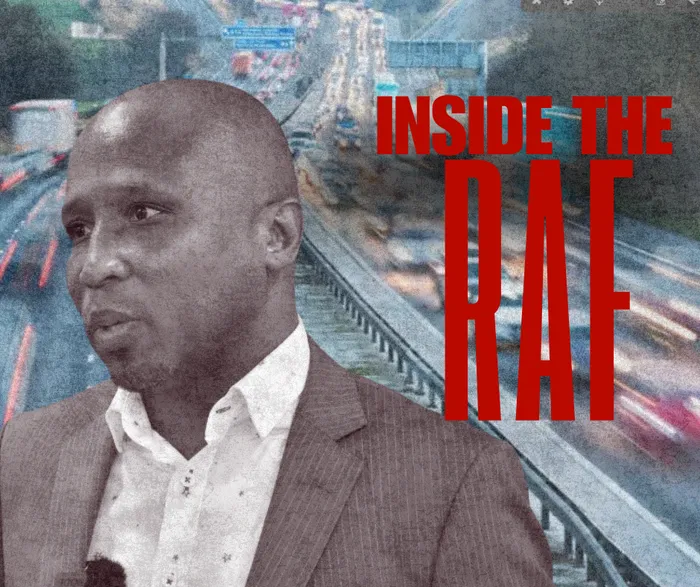
Collins Letsoalo was hailed as the ideal “cleaner” when he became CEO of the Road Accident Fund (RAF) in September 2019, a technocrat tasked with fixing one of South Africa’s most troubled state entities. Six years later, he is suspended, under investigation, and at the center of a political and legal storm — raising the question: was this bold reform run amok, or a clash between accountability and power?
Image: IOL Graphics
Collins Letsoalo was hailed as the ideal “cleaner” when he became CEO of the Road Accident Fund (RAF) in September 2019, a technocrat tasked with fixing one of South Africa’s most troubled state entities.
Six years later, he is suspended, under investigation, and at the centre of a political and legal storm — raising the question: was this bold reform run amok, or a clash between accountability and power?
This was not Letsoalo’s first assignment at a troubled organisation. A seasoned public-sector executive, he had previously been tasked with turning around failing state institutions and held senior positions at both the Passenger Rail Agency of South Africa (Prasa) and the Road Traffic Management Corporation (RTMC).
In 2016, Letsoalo was appointed acting CEO of Prasa but was dismissed months later amid controversy over a 350% salary increase — from R1.3 million to nearly R5.9 million. He insisted a board letter approved it, while the board denied authorisation. Public outrage led to his contract termination in February 2017, with the Auditor-General recommending repayment.
Letsoalo denied any wrongdoing, arguing that the increase was approved and that his dismissal was politically motivated. He claimed he was punished for exposing what he described as “a web of corruption and looters” within the agency.
According to Letsoalo, he uncovered entrenched problems,including high absenteeism, the collapse of engineering functions, a lack of performance contracts, sexual harassment, conflicts of interest, and nepotism.
He clashed with board members and executives whom he described as “pathological liars” more interested in supplier payments than in organisational performance.
Letsoalo maintained that he never awarded himself a salary increase and blamed the Prasa board for the allegations, claiming his removal was orchestrated through secretive meetings led by former chairperson Popo Molefe.
When Letsoalo took over at the RAF in 2019, the fund was sinking under the weight of ballooning claims and legal fees. He vowed to break what he called a “legal mafia” — lawyers and middlemen profiting from the chaos. He scrapped long-standing attorney panels, moved claims handling in-house, and slashed payments to external firms.
Within two years, the RAF claimed to have saved more than R30 billion through cost-cutting and internal processing. Letsoalo cast himself as a lone reformer in a corrupt system, telling Parliament he was “saving the fund from vultures.”
Despite this, he was appointed RAF CEO in August 2020. Former Transport Minister Fikile Mbalula welcomed him, saying his leadership would bring much-needed stability.
But cracks soon appeared. Letsoalo’s suspension in 2025 followed preliminary findings by the Special Investigating Unit (SIU) linking him to procurement interference, including overturning a bid committee’s decision to award a lease to Mowana Properties, a losing bidder tied to the Government Employees Pension Fund (GEPF).
Parliament’s Standing Committee on Public Accounts (SCOPA) later revealed he had falsely claimed a “top-secret” security clearance. Other allegations included a R79 million lease deal, R10 million spent on personal security, and irregularities in major RAF tenders.
The SIU identified systemic governance failures: weak board oversight, poor reporting structures, and unlawful contract extensions. Among its findings:
The SIU warned that RAF’s lack of oversight “creates opportunities for financial manipulation and misstatement of the fund’s true cash flow.”
In addition, the SIU raised red flags over the RAF’s cash-flow management.
It found that the fund had allegedly delayed or blocked payment of legitimate claims, a violation of its legal obligations, and that such practices worsened court backlogs. By 2024, trial dates for RAF cases in Gauteng were reportedly being scheduled as far ahead as 2029, with hundreds of summonses going unanswered.
The SIU further noted that some law firms’ payments were arbitrarily frozen, prejudicing claimants and accumulating costly interest.
It also discovered that the RAF opened alternative bank accounts to shield funds from attachment, failed to reconcile its books regularly, and left significant sums unaccounted for, risks that the SIU warned could amount to financial misrepresentation and erode public trust.
By May 2025, Letsoalo was placed on special leave, and by June he was formally suspended after refusing to appear before SCOPA. His legal challenge to overturn the suspension failed — Judge Graham Moshoana ruled that his application had “no factual or legal basis.”
Transport Minister Barbara Creecy confirmed in August that his contract had expired and that the RAF board had been dissolved “for failing to act in the fund’s best interests.”
By October, the SIU had briefed Parliament on alleged procurement interference and governance violations.
The fallout over Letsoalo’s suspension triggered sharp political reactions.
The Economic Freedom Fighters (EFF) called his removal a “witch-hunt,” claiming he was punished for exposing entrenched corruption. “Letsoalo is being targeted for his anti-corruption stance and for exposing collusion in the judiciary and legal networks draining the RAF,” said EFF spokesperson Sinawo Thambo.
The Democratic Alliance (DA) dismissed the oversight process as a “political circus,” accusing Parliament of shielding vested interests. “This was not about transparency — it was about protecting those benefiting from the chaos,” said DA MP Thami Mabhena.
The MK Party went further, describing the appointment of a new RAF board as “State Capture 2.0.” spokesperson Nhlamulo Ndhlela claimed the board was “hand-picked to return the RAF to the control of corrupt lawyers and to reverse Letsoalo’s reforms.”
The image of the courageous reformer finally collapsed under the scrutiny of Parliament’s Standing Committee on Public Accounts (SCOPA). The enhanced oversight inquiry revealed a pattern of executive decisions that seemed to prioritise Letsoalo’s authority and comfort over governance best practice.
SCOPA turned its focus to the RAF in October 2025 after whistleblowers and the SIU flagged procurement irregularities worth hundreds of millions.
At the centre of SCOPA’s inquiry were two massive marketing and communications contracts worth R500 million each, awarded to MediaMix360 and Dzinge Productions. Testimony revealed that Letsoalo rejected renewing the RAF’s long-standing partnership with the Government Communication and Information System (GCIS) , despite internal reports confirming GCIS was cheaper and more transparent.
Former RAF manager Hlami Mathye testified that Letsoalo ignored the Bid Adjudication Committee’s recommendation to retain GCIS.
“An analysis showed GCIS remained the cheapest route,” she said, “but the CEO instructed that RAF go on its own tender instead.”
By June 2025, R576 million had already been spent , far ahead of schedule and in violation of Treasury regulations. SCOPA chair Songezo Zibi called it “a massive deviation,” warning that it fundamentally altered the contract’s value.
''Once you exhaust R500 million, you cannot legally continue using the contract. It fundamentally alters the tender’s value.”
Zibi also questioned whether the RAF was “taken for a ride,” noting that Dzinge’s original bid was only R16 million per year, yet the department was spending at ten times that rate.
MPs were outraged after discovering invoices listing items like “one bucket hat” for R11,500 and “one sports bag” for R37,900.
RAF spokesperson McIntosh Polela claimed these were “typos,” saying the amounts referred to bulk orders, but MPs dismissed the explanation as “a governance disaster.”
Polela admitted the RAF often relied on the “reputation” of suppliers rather than independently verifying invoices, prompting Zibi to reprimand him for “contemptuous” responses. “You’re spending South Africans’ money,” Zibi said. “You cannot approve invoices on reputation.”
Letsoalo has refused to appear before Parliament, arguing that SCOPA had no constitutional authority to investigate the RAF and that oversight should fall under the Portfolio Committee on Transport.
In letters to SCOPA, Letsoalo challenged the legality and impartiality of the inquiry, noting that many allegations occurred before his tenure, which ended in August.
He also accused SCOPA chairperson Zibi of bias and pre-judgment, suggesting Zibi should recuse himself. Letsoalo insisted he would only testify if all allegations were supported by sworn affidavits and if he had access to the full evidence beforehand.
“I will only address allegations backed by sworn statements, not rumours or anonymous claims,” he said.
SCOPA rejected his conditions. “The committee will not allow any individual to dictate the terms of parliamentary accountability,” Zibi said.
“Our duty is to ensure oversight, make strong recommendations, and protect the public purse, supporting the RAF in fulfilling its mandate.”
In response to IOL questions, Zibi clarified that SCOPA’s inquiry is focused on governance and financial management at the RAF, not on individual blame. He noted that Letsoalo served under multiple boards and ministers, and that the committee is still reviewing evidence from witnesses under oath.
Zibi also emphasised that the inquiry follows public record, committee memoranda, and parliamentary processes, and that conclusions will be made only after the full evidence is considered.
He said the RAF episode reflects broader governance challenges in state institutions and indicated that similar processes may be applied to other entities once the inquiry concludes.
“Governance problems persist in various institutions. Had the committee had more capacity, it would be placing a similar microscope on a few more state entities at the same time… Once the RAF enquiry is completed, the committee will not hesitate to follow a similar process where it is necessary,'' he said.
Despite the controversies, RAF reported real progress in tackling fraud under Letsoalo. Between 2021 and 2024, it blocked R2.6 billion in fraudulent claims, repudiated thousands of suspicious cases, and referred dozens to law enforcement.
Its investigations led to 32 arrests, including attorneys accused of exploiting the system.
Letsoalo defended these efforts, saying fraud ‘’continues to represent a significant risk to the RAF’s assets, service delivery, efficiency, and reputation,” Letsoalo said in a statement last year.
“It robs claimants and dependents of the deceased of their livelihood.
“We will continue to pursue any party, internally or externally, that engages in fraudulent activity.”
Political analyst Goodenough Mashego believes Letsoalo’s saga reflects a broader failure in South Africa’s state-owned enterprises (SOEs). “We recycle the same people across entities,” he said. “Even when they don’t solve problems where they are, they get moved elsewhere.”
He argued that politically appointed boards often limit CEOs’ independence. “If a CEO’s actions threaten political interests, they’ll be removed, no matter how well-intentioned.”
Mashego said the RAF’s crisis exposes deeper structural flaws.
“SOEs were created to keep the population employed and to contribute to taxation. Post-1994, they cannot continue playing the role they were playing, of keeping people employed. That is why there is a need for robust private sector participation.
“The RAF needs to be exclusively for South Africans. If it assists South Africans, that’s the performance of the CEO. Reform needs to be implemented at the legislative level to give CEOs the tools to work effectively with the money appropriated to them by Parliament,'' said Mashego.
Attempt to reach Letsoalo for comment were unsuccessful.
IOL News