
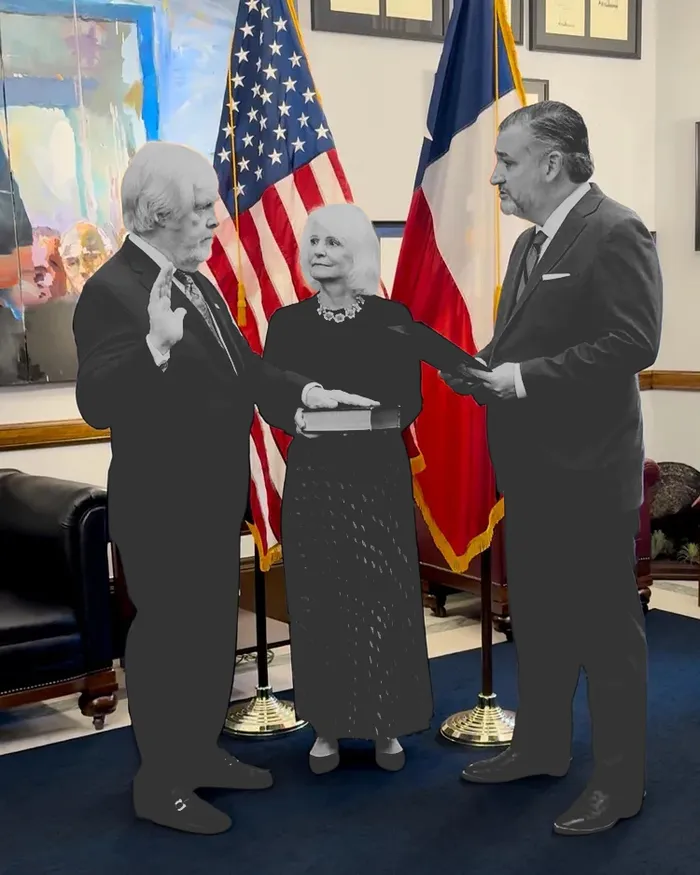
Leo Brent Bozell sworn in as US ambassador to South Africa. The mental slavery of the belief that the USA is a 'superpower' need to be discarded, writes Shabodien Roomanay; it is a projection of Hollywood that portrays and sustains this gigantic myth that keeps the entire world to be standby for the USA.
Image: US Embassy in South Africa / IOL Graphics
Pretoria's acceptance of Brent Bozell as US ambassador, despite his explicit intent to undermine South Africa's foreign policy, represents a profound diplomatic and moral capitulation that validates American power over South African sovereignty.
When the United States declared South Africa's ambassador to Washington, Ebrahim Rasool, persona non grata in March 2025 for criticising the Trump administration, it established a clear precedent: ambassadors who publicly criticise their host government's leadership are no longer welcome.
Yet, less than a year later, South Africa has accepted a US ambassador whose Senate testimony openly declared a mission to dismantle core pillars of South Africa's foreign and economic policy, including its genocide case against Israel at the International Court of Justice. This stark hypocrisy reveals a government that has relinquished its moral standing for perceived geopolitical pragmatism.
Brent Bozell III was confirmed by the US Senate on December 18, 2025 and sworn in on January 9, 2026. His testimony before the Senate Foreign Relations Committee, and subsequent analyses, outline a confrontational agenda directly at odds with South African policy.
Direct Opposition to South Africa's ICJ Case Against Israel: Bozell explicitly stated, "I would press South Africa to end proceedings against Israel before the International Court of Justice," dismissing the case as "lawfare". This is a direct attempt to undermine a legal action South Africa has framed as a moral imperative rooted in international law.
Strategic Realignment Against BRICS Partners: He vowed to combat South Africa's "geostrategic drift" toward America's "competitors, including Russia, China, and Iran". This confronts South Africa's core foreign policy of non-alignment and its strategic economic partnerships within BRICS, framing them as adversarial choices.
Domestic Policy Interference: Bozell signalled intentions to intervene in South Africa’s internal affairs by fighting policies like Black Economic Empowerment (BEE) and Expropriation without Compensation (EWC), framing them as deterrents to US investment. He also declared a "special focus on Afrikaners," promising regular engagement with this community irrespective of the South African government's approval.
Brent Bozell's political positions on South Africa, formed during the anti-apartheid struggle in the 1980s, should now be central to his controversial role as the US Ambassador-Designate under the Trump administration.
| Time Period | Key Stance/Position on South Africa | Context/Actions |
| 1980s (Apartheid Era) | Opposition to the ANC; labeled it as "terrorist". | President of the National Conservative Political Action Committee; proud member of the "Coalition Against ANC Terrorism". |
| 2013 | Criticised media for "mythologising" Nelson Mandela. | Made sarcastic comments on Twitter (now X) following Mandela's death. |
| October 2025 | Outlined policy-driven demands for US-South Africa relations. | At Senate confirmation hearing, stated he would pressure South Africa to drop the ICJ genocide case against Israel and address its ties to Russia, China, and Iran. |
| December 2025 – Present | Confirmed as Ambassador-Designate; awaits credential presentation. | Senate confirmed him along party lines (53-43). Sworn in but cannot perform duties until presenting credentials to President Cyril Ramaphosa |
Naturally, Bozell's appointment has been met with significant criticism and occurs during a low point in bilateral relations. The Economic Freedom Fighters (EFF) party has called on the government to reject his nomination, accusing him of championing white supremacy. Analysts expect a frosty reception from the ruling ANC, given his historical opposition to the party.
South Africa's Department of International Relations has explicitly rejected the premise of the Afrikaner refugee program, calling it based on a ‘false narrative’.
Let’s remember that South Africa has the right under the Vienna Convention to reject an ambassador without giving a reason. The government could delay accepting his credentials, leaving him in a state of 'protocol limbo' and unable to function officially.
Besides, Bozell has been mired in deeper background and controversies. Bozell was a vocal critic of Donald Trump during the 2016 Republican primaries, calling him a ‘charlatan’ and ‘huckster’. He later became a strong supporter after Trump won the nomination.
His son, Leo Brent Bozell IV, was convicted for his role in the January 6 US Capitol riot and later pardoned by President Trump. He comes from a deeply conservative family; his father was a noted conservative writer.
The hypocrisy of accepting Bozell is underscored by the fate of South Africa’s own ambassador to the US, Ebrahim Rasool. In March 2025, US Secretary of State Marco Rubio declared Rasool persona non grata and expelled him from the United States.
The cause? Rasool participated in a webinar where he accused the Trump administration of ‘mobilising supremacism’ and trying to ‘project white victimhood’.
His comments, while undiplomatic, were political criticism of a foreign government’s internal posture. In contrast, Bozell’s stated objectives constitute direct policy attacks on the host nation's sovereign decisions.
| Aspect | Ebrahim Rasool | Brent Bozell | The Hypocrisy |
| Core offense | Criticised the Trump administration's domestic political rhetoric, calling it "mobilising supremacism". | Declared intent to pressure SA to drop its ICJ case, realign foreign policy, and oppose domestic laws. | Criticism of internal politics vs. direct assault on sovereign policy. |
| Consequence | Declared persona non grata and expelled from the United States. | Credentials accepted by the South African government without protest. | The US enforced a harsh standard it knew South Africa would not reciprocate. |
| Host Nation Response | US took swift, decisive action to remove the diplomat. | SA's acceptance signals weakness and sets a precedent for future interference. | South Africa validated the power imbalance, surrendering diplomatic leverage. |
This is tantamount to capitulation, not diplomacy. By accepting Bozell, the South African government has made a calculated decision to avoid confrontation with a perceived more powerful state, drowning in debt estimated at $40 trillion) and where almost 54m of its citizens are living below the poverty datum line. A nation where about 1,239 African Americans per 100,000 languish in prisons as opposed to white adults at 231 per 100,000.
South Africa has a moral high ground, despite the rampant corruption and political and economic mismanagement, that it needs to protect. Instead, it is sacrificing principle for unnecessary pragmatism.
Following Rasool's expulsion, South Africa's ambassadorial post in Washington has remained vacant for nearly a year, with the appointment process mired in political limbo. The US, meanwhile, has proceeded to install its controversial envoy without delay. This imbalance demonstrates where the real power lies. As some analysts noted, meaningful diplomacy is unlikely until South Africa bends on key issues like its ICJ case and its relations with Iran, China, and Russia.
Then there is the silent endorsement of interference. Accepting an ambassador who openly lists interference in domestic policy and international legal pursuits as his job description is a de facto endorsement of that interference. It grants Bozell a platform within the country to lobby against the government's own positions, particularly the ICJ case which has significant domestic and Global South support. Surely this is not only ridiculous but unacceptable.
A major consequence of his presence on South African soil is the erosion or loss of moral authority. South Africa's case against Israel at the ICJ was built on a foundation of moral authority and a singular commitment to international law. By accepting a chief diplomat whose primary mission is to destroy that case, Pretoria undermines its own claim to that authority. It communicates that its principles are negotiable under pressure. This is now a victory for power politics and global bullying.
Effectively, the Trump administration has successfully placed a political activist, not a career diplomat, into inner sanctums of Pretoria with a mandate to aggressively advance US interests at the direct expense of South Africa’s stated policies. South Africa’s meek acceptance, especially in light of the Rasool affair, confirms that the US can set rules it does not need to follow. Trump and his acolytes must be having a good laugh. These black people need to know their place?
Washington must indeed be smiling. It has proven that South Africa, despite its moral posturing, will not dare to challenge American might. The message is clear: sovereign equality in the international system is an illusion for weaker states, and moral high ground is swiftly abandoned when faced with power. In failing to declare Bozell persona non grata, the South African government has not preserved a relationship, it has certified its own subordination.
It is time to cut the cord. The tariffs bluff has backfired on Trump. The mental slavery of the belief that the USA is a “superpower” need to be discarded. It is a projection of Hollywood that portrays and sustains this gigantic myth that keeps the entire world to be standby for the USA.
If South Africa, and other nations, do not plot and live in its own future, the USA will force South Africa to live in a future designed for it by the USA and its acolytes.
Lest Trump sends his nuclear equipped aircraft carriers to fetch Ramaphosa & Company too.
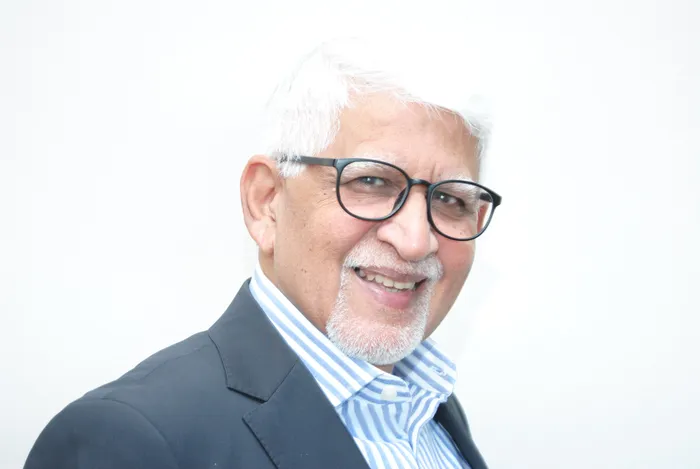
The mental slavery of the belief that the USA is a “superpower” need to be discarded. It is a projection of Hollywood that portrays and sustains this gigantic myth that keeps the entire world to be standby for the USA, writes Shabodien Roomanay.
Image: Supplied
* Shabodien Roomanay is the board Chairman of Muslim Views Publication, founding member of the Salt River Heritage Society, and a trustee of the SA Foundation for Islamic Art.
** The views expressed do not necessarily reflect the views of IOL or Independent Media.