
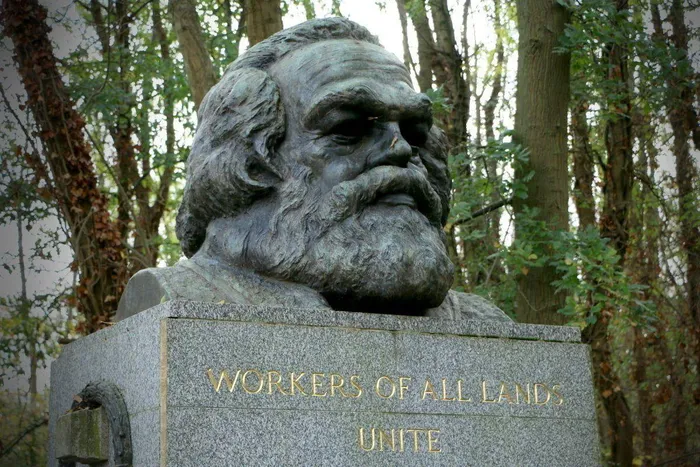
A tomb of Karl Marx in London, Engalnd, bears the uniting phrase: 'Workers of all lands, unite'.
Image: Supplied
On this Workers’ Day, May 1, 2026, as the sun rises over the townships and rural villages of our beloved South Africa, I stand shoulder to shoulder with millions of workers across the globe and echo the most famous rallying cry in the history of revolutionary thought: Workers of all lands, unite!
Karl Marx and Friedrich Engels inscribed these immortal words at the close of The Communist Manifesto, published precisely on February 21, 1848 in London. In the crucible of the Industrial Revolution, when factories devoured human labour and the bourgeoisie extracted surplus value from the sweat and blood of the proletariat, Marx understood that the emancipation of the working class could never be confined by national borders. It demanded international solidarity. One hundred and seventy-eight years later, that phrase rings with undiminished urgency. It is not a relic of 19th-century Europe; it is the battle standard for the global struggle against exploitation in the 21st century.
Today, the exploitation Marx described has not vanished; it has mutated and intensified under the twin banners of neoliberal globalisation and resurgent imperialism. The world’s workers remain chained. According to the latest global reports, nearly 850 million people still live in extreme poverty, while the top one per cent hoard more wealth than the bottom 90 per cent combined. In Africa, Latin America and Asia, millions of workers labour in informal economies without contracts, pensions or basic protections. In South Africa, the unemployment rate hovers above 40 per cent for youth, land remains concentrated in the hands of the white minority, and the wage gap between Black workers and their white counterparts echoes the apartheid wage structure. This is not accident or misfortune. It is the logical outcome of a capitalist system that treats labour as a commodity to be bought cheaply and discarded when no longer profitable.
The Economic Freedom Fighters (EFF) locate this reality within the broader Marxist-Leninist and Fanonian tradition. Frantz Fanon, whose searing analysis in The Wretched of the Earth we proudly claim as intellectual foundation, taught us that decolonisation is incomplete without economic emancipation. Political independence, he warned, can become a mere changing of the guard if the new elites simply inherit the colonial economy and collaborate with imperialism to keep the masses in chains. Fanon’s call that “each generation must, out of relative obscurity, discover its mission, fulfil it, or betray it” opens our own Founding Manifesto. Our generation’s mission is clear: the attainment of economic freedom in our lifetime – not only for South Africa, but for Africa and the oppressed peoples of the world.
Nowhere is the contemporary relevance of Marx’s call more evident than in the brazen actions of the United States under President Donald Trump. In 2026, we witness the revival of the Monroe Doctrine in its most aggressive form. Having engineered the removal of Nicolás Maduro in Venezuela and imposed a stranglehold on Venezuelan oil exports, the Trump administration has turned its sights on Cuba. Cuban workers and peasants, who for decades have built a society based on socialist principles – free healthcare, education and dignity in the face of blockade – now face renewed economic warfare. Trump’s oil embargo, tariffs on third-country suppliers and open declarations that “Cuba is ready to fall” are not mere foreign policy. They are acts of class warfare aimed at crushing any alternative to neoliberal capitalism. By starving Cuba of energy and isolating Venezuela, Washington seeks to prove that any attempt by workers to seize control of their resources and destiny will be met with imperialist violence.
This is the same empire that has historically toppled progressive governments from Chile to Grenada, from Allende to Maurice Bishop. Trump’s rhetoric – “a new dawn for Cuba,” “we can do anything we want with it” – exposes the naked class interest behind American exceptionalism. Socialism, in the eyes of Wall Street and the White House, is an existential threat not because it fails, but because it succeeds in showing that workers can organise production for human need rather than private profit. The EFF condemns these attacks unequivocally. We stand in solidarity with the Cuban and Venezuelan people, just as we stand with every worker resisting exploitation from the townships of Johannesburg to the platinum mines of Rustenburg, from Havana to Caracas, from the garment factories of Dhaka.
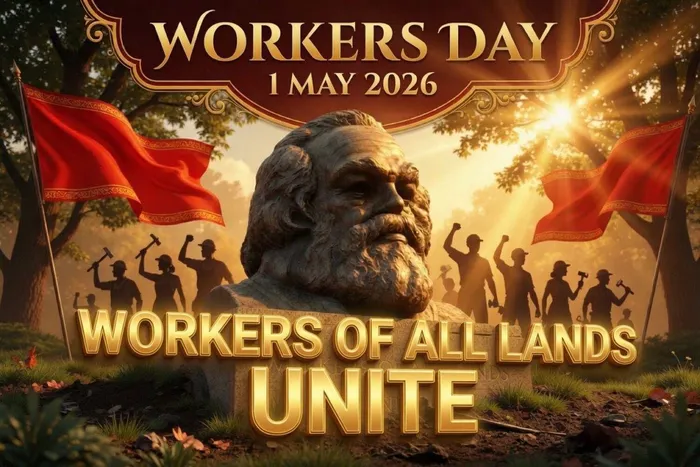
Workers' Day is celebrated on May 1.
Image: Supplied
Our response is not rhetorical. It is programmatic – and it is forged in the very crucible of working-class resistance that gave birth to the EFF itself. The party was born directly out of the historic Marikana massacre of 16 August 2012, when 34 mineworkers were gunned down in cold blood by a state that had aligned itself with Lonmin capital against its own people. That massacre laid bare the naked alliance between monopoly capital, the ANC government and the police. It was the spark that ignited the formation of the EFF in 2013, as revolutionary cadres, led by our Commander-in-Chief Julius Malema, recognised that the time had come to build a fighting organisation of the working class and the poor. Marikana was not merely a tragedy; it was the moment when the post-apartheid illusion of “rainbow nation” capitalism shattered, and the EFF emerged as the true inheritor of the radical tradition of Marx, Lenin and Fanon.
Today, on this very Workers’ Day, our CIC Julius Malema is addressing the main EFF Workers’ Day rally at Tlhapi Stadium in Wonderkop, Marikana, North West. Standing on that sacred ground where blood was spilled for a living wage, Commander Malema will once again remind the world that the EFF’s roots run deep into the soil of Marikana. He will reaffirm our unyielding commitment to the seven non-negotiable cardinal pillars that translate Marx’s call into South African and African reality:
These pillars are not utopian dreams. They are the concrete weapons with which we arm the working class to seize the means of production and place them at the service of the people. They embody the spirit of the Communist Manifesto and Fanon’s insistence that true liberation requires the dismantling of the colonial economy. When we nationalise the mines and banks, we declare that the wealth beneath our soil and the credit that circulates in our economy belong to the workers who create it. When we expropriate land without compensation, we restore the birthright stolen by settler colonialism. When we demand free education and healthcare, we affirm that no child of a worker should be denied opportunity because their parents are poor.
On this Workers’ Day we celebrate not only the historic struggles of the past – the 1886 Haymarket martyrs, the 1950 May Day rallies against the Group Areas Act, the 1976 Soweto uprising, the 1980s stay-aways that brought apartheid to its knees – but the living struggle of today. We salute the farmworkers of the Western Cape who demand decent wages, the mineworkers of the North West who refuse to die in profit-driven shafts, the domestic workers and taxi operators who keep our society running while earning a pittance. We salute our sisters and brothers in Cuba who maintain their revolution despite the blockade, and the Venezuelan workers who defend their Bolivarian process against external aggression. And we draw strength from the fact that our Commander-in-Chief stands today at Marikana, honouring the 34 fallen and declaring that their sacrifice will never be in vain.
The path forward is one of international working-class unity. Workers of all lands must unite against the common enemy: a global capitalist class that uses borders to divide us while capital flows freely to exploit wherever labour is cheapest. In South Africa we fight for economic freedom; in doing so, we light a beacon for the continent and the world. The wind of political liberation once blew from north to south across Africa. Now the wind of economic emancipation must blow from south to north, carrying the message that another world is possible – a world where land, mines and factories serve the many, not the few.
As we march today under the red, black and green of the EFF, let us remember that our struggle is part of a historic continuum. From Marx’s Manifesto to Fanon’s call to arms, from the Cuban Revolution to our own cardinal pillars, the thread is unbroken: the working class must organise, educate and mobilise to end exploitation. The achievement of economic freedom in our lifetime is not optional; it is the historic mission of our generation.
Workers of all lands, unite! You have nothing to lose but your chains. You have a world to win.
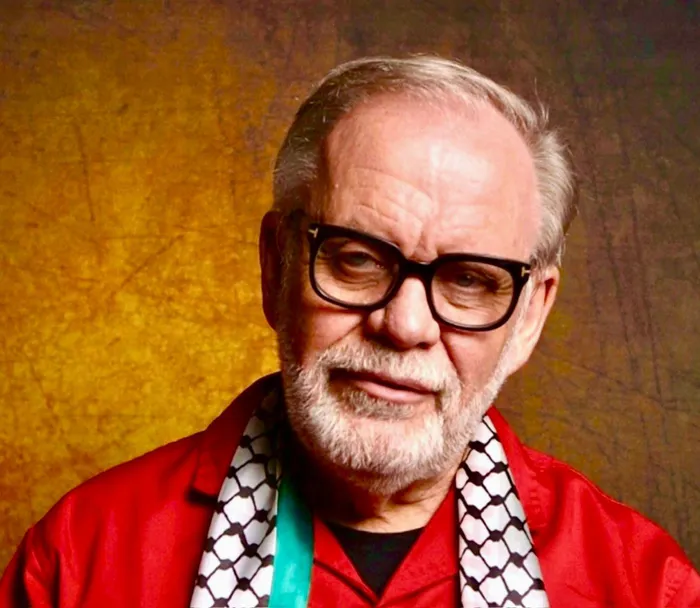
Carl Niehaus is a former South African Ambassador to the Netherlands and currently serves as an EFF Member of Parliament.
Image: Supplied
* Ambassador Carl Niehaus is an EFF Member of Parliament (MP).
** The views expressed do not necessarily reflect the views of IOL or Independent Media.