
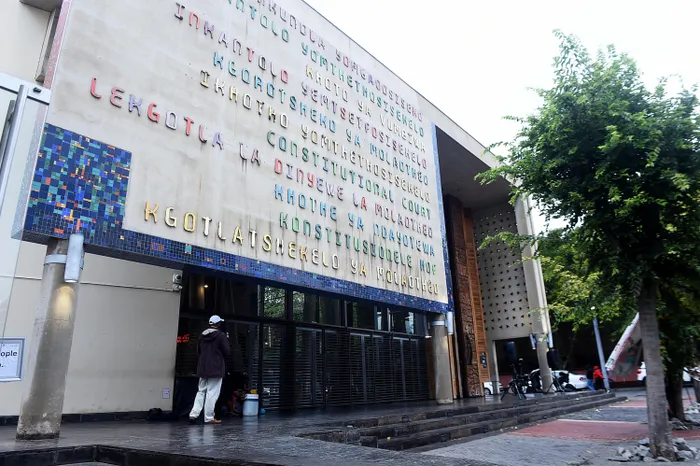
The Constitutional Court in Johannesburg. Thirty years into democracy, the concentration of corporate, political, and institutional power operates on a scale and level of coordination that differs significantly from the transitional context in which many of these institutions were originally conceived, writes Christopher Rutledge.
Image: Itumeleng English / Independent Newspapers
I was recently honoured to present a submission to the Forum for Institutions Supporting Democracy (FISD), a forum made up of member organisations established under Chapters 9 and 10 of the Constitution, together with PanSALB and ICASA. The forum brings together institutions constitutionally mandated to support constitutional democracy, accountability, governance, and human rights in South Africa.
The discussion focused heavily on the implications of the Constitutional Court judgment in SAHRC v Agro Data, but the broader engagement evolved into something much larger: a difficult national conversation about whether South Africa’s constitutional accountability architecture is still capable of meaningfully protecting vulnerable communities under conditions of deep structural inequality.
My own intervention was grounded in the lived realities of mining-affected and marginalised communities.
Too often, these communities are spoken about only in terms of environmental destruction, displacement, poverty, or exclusion, as though these are abstract social conditions rather than lived realities that produce profound and lasting human harm. But even that framing remains incomplete.
What many communities are actually confronting are powerful corporate actors that are deeply intertwined with political and state power itself.
In South Africa, mining capital and state formation evolved together historically through systems of land dispossession, labour control, extraction, and racialised accumulation. The result is that many communities today do not simply confront isolated corporations operating outside the state. They confront networks of economic and political power that are frequently interconnected through regulatory systems, political influence, legal infrastructure, financial concentration, and institutional access.
This is precisely why the Agro Data judgment generated such concern.
The broader constitutional tension becomes particularly striking when viewed alongside recent Constitutional Court rulings affirming the coercive and binding administrative powers exercised by state institutions such as the Department of Home Affairs in immigration matters, while simultaneously limiting the practical enforcement authority of institutions such as the SAHRC that were specifically established to protect human rights and constrain abuses of power.
Both forms of authority remain subject to judicial oversight. However, the contrast raises difficult constitutional questions about where the Court appears most institutionally comfortable concentrating practical power under conditions of profound inequality.
This creates a deeply uncomfortable constitutional tension.
On the one hand, the Court appears cautious about granting stronger enforcement powers to a human rights institution designed to protect vulnerable people from abuse.
On the other hand, it appears more willing to affirm coercive or binding authority exercised by state institutions whose powers constitutional democracy was specifically designed to limit and subject to oversight.
Of course, both institutions remain subject to judicial review and court oversight. But that is not the central issue. The real issue is the constitutional philosophy reflected in these judgments.
Why does the Court appear more institutionally comfortable limiting the enforcement capacity of rights-protecting institutions than limiting the practical authority of state institutions capable of causing harm?
That inconsistency matters enormously in a society marked by profound inequality. Because constitutional rights do not operate in a vacuum. They operate within material power relations. And this is where the issue of “fragmented accountability versus concentrated corporate and political power” becomes critical.
What I argued at FISD is that South Africa’s accountability systems are structurally fragmented in ways that systematically advantage those who already possess concentrated institutional power.
Corporations and politically connected actors often operate through highly coordinated systems: legal teams, lobbying structures, regulatory influence, financial resources, technical expertise, public relations machinery, and institutional access to state processes.
Communities, by contrast, are forced to pursue justice through fragmented pathways spread across: courts, regulators, parliamentary committees, administrative appeals, environmental processes, criminal investigations, civil litigation, Chapter 9 institutions, and departmental complaints systems.
In theory, this appears comprehensive. In practice, it often becomes paralysing.
A mining-affected community facing environmental contamination, forced displacement, police repression, or failed rehabilitation may spend years moving between institutions that each possess only partial jurisdiction, partial authority, or limited enforcement powers.
Meanwhile, corporations continue operating, environmental harm deepens, social fragmentation intensifies, and communities exhaust their financial and emotional resources simply trying to navigate procedural systems.
This is what I mean by fragmented accountability. Power is concentrated upward. Accountability is dispersed downward.
And the deeper problem is that constitutional doctrine often still assumes a relatively level institutional playing field that simply does not exist in reality. One of the recurring themes emerging from the FISD discussions was growing concern that South Africa’s constitutional order risks becoming procedurally sophisticated while materially ineffective for large sections of society.
Participants repeatedly raised concerns around: declining public trust in democratic institutions, perceptions that Chapter 9 institutions are increasingly “toothless,” rising litigation costs, institutional overlap and inefficiency, weak enforcement capacity, and growing public disillusionment with constitutional democracy itself.
Importantly, the discussion was not anti-constitutional. It was rooted in concern about whether constitutional institutions are adapting adequately to modern forms of concentrated power.
Several participants noted that many Chapter 9 institutions were designed nearly three decades ago under very different political conditions. At the time, there was perhaps greater optimism that constitutional culture, democratic norms, and institutional cooperation would mature organically over time.
But South Africa today faces a very different reality: deepening inequality, declining institutional trust, corporate concentration, political patronage, regulatory capture, democratic fatigue, and increasing social instability.
Under such conditions, the effectiveness of purely facilitative or recommendatory powers becomes increasingly questionable.
What emerged most strongly from the FISD engagement was not necessarily consensus, but a growing recognition that South Africa may need to rethink aspects of its constitutional accountability architecture entirely.
This includes growing discussions around: stronger coordination between Chapter 9 institutions, enhanced systemic investigations into structural rights violations, greater use of strategic public litigation, improved and enforceable accountability mechanisms, closer parliamentary engagement, and a shift away from purely individualised complaints toward systemic investigations into patterns of harm and exclusion.
Increasingly, there is also a growing argument that South Africa may ultimately need to confront the question of constitutional amendment itself, to clarify that Chapter 9 institutions were never intended to function merely as symbolic or advisory bodies, but as meaningful constitutional safeguards capable of protecting rights under changing social and political conditions.
Thirty years into democracy, the concentration of corporate, political, and institutional power operates on a scale and level of coordination that differs significantly from the transitional context in which many of these institutions were originally conceived. The concern emerging from these discussions is that constitutional institutions designed primarily around moral persuasion, facilitation, and soft power may no longer be sufficient against increasingly entrenched forms of structural power.
The argument, therefore, is not for unchecked authority, but for ensuring that institutions constitutionally mandated to protect democracy and human rights possess the practical capacity necessary to fulfil that mandate meaningfully under contemporary conditions.
Because ultimately, constitutional democracy cannot survive on procedural legitimacy alone while material conditions continue deteriorating for millions. People do not experience constitutionalism through legal doctrine. They experience it through whether institutions are capable of protecting their dignity, livelihoods, safety, land, water, freedoms, and humanity in practical terms.
And that, ultimately, was the deeper issue confronting everyone gathered at FISD, and which should concern us all.
* Christopher Rutledge is a South African human rights activist and the Executive Director of Mining Affected Communities United in Action Advice Office, and part of a national network representing communities impacted by mining.
** The views expressed do not necessarily reflect the views of IOL or Independent Media.