
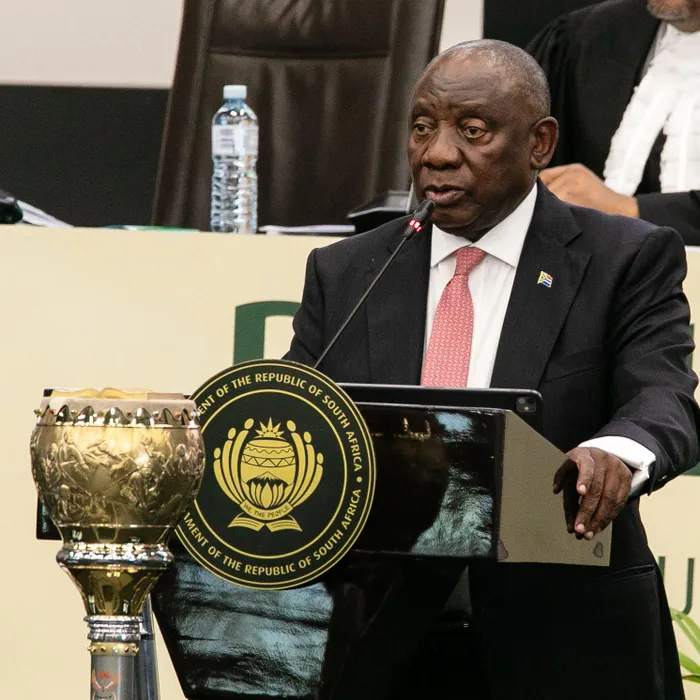
Despite his affable persona, President Cyril Ramaphosa faces serious allegations and political scrutiny. As the Phala Phala scandal unfolds, questions arise about his accountability and the future of his presidency.
Image: Zwelethemba Kostile / Parliament of RSA
I like our president. He is likeable. A little goofy, with that silly smile and clumsy dance moves when he tries to be a people’s president — but he tries. He's humble. He doesn’t flaunt his wealth or sport designer brands. Just a down-to-earth, affable president.
But those dark clouds lingering over him just won’t go away. And that is the problem.
The memory of Marikana and cries of “blood on his hands” still linger. His presidential grandstanding and promises of a new dawn were meant to usher in a fresh beginning. After all, coming out of the Zuma era, Ramaphosa looked like Batman swooping in to save the country.
“He’s a billionaire! He’s not corrupt! He won’t steal!” echoed practically everyone.
White monopoly capital celebrated, while the corrupt shook their heads in defeat — but regrouped quickly. The players changed. The game continued.
Then came Phala Phala.
Stolen cash — $580,000 allegedly taken from his Limpopo farm, Phala Phala. Tucked under a mattress like our grannies used to do (except theirs was small change in comparison).
Shockingly, however, the theft only became public in 2022 after former spy chief Arthur Fraser laid criminal complaints against Ramaphosa over the matter. Ramaphosa insisted the money came from a buffalo sale to a foreign buyer.
What followed was a political circus.
Instead of opening a police case immediately, members of Ramaphosa’s security team allegedly conducted an unofficial investigation to recover the money, including operations linked to Namibia.
Were state resources used for a private matter?
A later report by the Independent Police Investigative Directorate (IPID) found alleged misconduct by members of the Presidential Protection Unit, including an “off-the-books” investigation and the use of state resources without a formal case being opened.
In 2024, prosecutors said there was no reasonable prospect of prosecution, while earlier investigations by oversight bodies did not find sufficient evidence to prove wrongdoing by Ramaphosa personally.
The ANC, through its parliamentary majority at the time, blocked any possibility of impeachment proceedings against him.
Then came the Government of National Unity (GNU) — and whispers of a deal between the DA and the ANC. The cosy relationship between Ramaphosa and then-DA leader John Steenhuisen did not go unnoticed by other parties.
Was Steenhuisen protecting Ramaphosa?
Whispers they remained. And Phala Phala appeared to become Ramaphosa’s smallanyana skeleton in the closet. But the EFF played ghostbuster and refused to let the matter go. The party chipped away, and finally, a breakthrough.
With South Africa’s Constitutional Court ruling that Parliament acted unlawfully in 2022 when it blocked an impeachment process against Ramaphosa, does this reopen the door for impeachment proceedings to continue?
Ramaphosa is appealing that ruling.
And the question is: why?
Shouldn’t a president be the yardstick of moral authority — our example, our number one citizen — expected to uphold the law, offer transparency in office, and be the first to subject himself to scrutiny, especially when called upon?
Why would Ramaphosa, a key architect of our Constitution, now seek to challenge a Constitutional Court ruling?
What is he trying to hide?
Why not allow the process to unfold so he can have his day to explain — and finally put the matter to rest once and for all?
If Parliament once again decides to vote on the matter, things are different this time. The ANC no longer enjoys the comfort of a majority in Parliament.
The DA also has a new leader — Geordin Hill-Lewis — who, unlike Steenhuisen, appears less starstruck by Ramaphosa. And he is not a member of Parliament, so has no direct vested interest to protect.
Despite all of that, Ramaphosa may still have an ace: the Speaker of Parliament, Thoko Didiza — an ANC member.
And, of course, should she have the authority to decide whether impeachment proceedings continue, it could amount to a free pass for Ramaphosa.
Ramaphosa has refused to resign. He argues that he has not been found guilty. But he does have a case to answer.
His integrity — whether he is guilty or not — has been brought into question. He should have allowed the process to continue. He should have subjected himself to an open, objective process and vowed accountability and transparency to South Africans. Instead, his behaviour leaves citizens puzzled.
Why is he challenging this? Why?
The man doth protest too much.
* Zohra Teke is a freelance journalist and contributor.
** The views expressed do not necessarily reflect the views of IOL or Independent Media.