
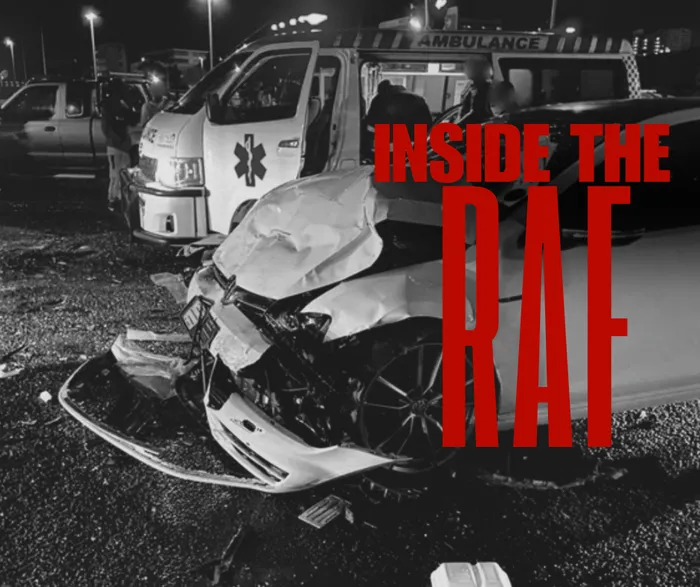
According to parliamentary records, the RAF allocated around R1 billion for communications and advertising over about two years, with around R650 million spent through two media companies, MediaMix360 and Dzinge Productions. It also spent R231 million on staff bonuses and R1.8 million on executive protection.
Image: IOL Graphics
The Road Accident Fund (RAF) pulls in more than R48 billion from the fuel levy annually, but thousands of road crash victims are still waiting for their payouts.
The fund’s finances are in serious trouble. It now reportedly owes more than R518 billion, while holding assets worth only R33 billion.
According to parliamentary records, the RAF allocated around R1 billion for communications and advertising over about two years, with around R650 million spent through two media companies, MediaMix360 and Dzinge Productions. It also spent R231 million on staff bonuses and R1.8 million on executive protection.
However, this is not all. The Standing Committee on Public Accounts (SCOPA) members were also left scratching their heads after hearing that the fund, which is meant to assist victims of road accidents, reportedly spent R48,300 on a single bucket hat from Dzinge Productions.
Spokesperson McIntosh Polela maintained that although the invoice indicated a quantity of one hat, it actually represented multiple units.
Other questionable expenses included golf shirts at R8,180 each, podcasts costing R110,313 per episode, and thousands of branded water bottles at R85 each.
According to the AGSA, the RAF identified more than R95 million in irregular, wasteful, and fruitless expenditure that could have been available for legitimate RAF purposes, including paying claims to road accident victims. This includes
On the irregular expenditure, the AGSA said, “The full extent of irregular expenditure could not be determined as management has not assessed the population to identify similar instances.”
All this, as thousands of victims are left in limbo. The RAF’s 2023/24 annual report shows a dramatic drop in claims. The number of claims registered fell from 303,695 in 2019/20 to 79,377 in 2024, a decline of almost 74%. Personal claims, representing injured road users, dropped even more sharply, from 102,086 in 2020 to 18,286 in 2024, down 82%.
Wayne Duvenage, CEO of OUTA, says that the problem is systemic " We see too many instances of disregard for state funds, from board member fees, excessive number of meetings, unnecessary and/or overpriced travel tips, unnecessary supplier contracts, over-priced tenders, excessive staff numbers, undeserved bonuses and general spending trends that are not contained".
He added that weak boards and compliant members often fail to challenge CEOs or CFOs, allowing billions to be spent irregularly, a direct breach of the Public Finance Management Act (PFMA), which requires state institutions to manage funds responsibly.
"The fact that CEOs of state entities are being re-appointed for extended terms, despite repeated AGSA qualified audits and other corruption issues highlighted by civil society, says a lot about the weakness of state entity boards".
The Auditor-General also identified material irregularities caused by weak internal controls, including unauthorised banking changes and inadequate verification systems, resulting in millions in financial loss.
"The recurrence of these errors indicates that preventative controls within the claims processing and payment systems are not functioning effectively. If these control weaknesses are not addressed, there is a high risk of continued financial losses through future incorrect, duplicate, or excessive payments".
Duvenage warned that this systemic mismanagement has real consequences for ordinary South Africans.
"We have seen how people involved in road accidents are unable to receive their rightful benefits, not only because RAF doesn’t conduct their affairs properly, but also because their systems are weak, allowing for the abuse of their processes".
He further called on the government to strengthen oversight, ensure independent and competent boards, and hold leadership accountable for financial mismanagement.
The Special Investigating Unit (SIU) has also revealed it has launched an ongoing investigation into the RAF, focusing on duplicate payments, irregular procurement, and financial mismanagement.
“The investigation focuses on the losses incurred by the State caused by duplicate payments made to several firms of Attorneys as at 01 March 2021, which also includes unlawful acts of appropriation.”
The SIU also raised concerns about non-cooperation from RAF officials.
"The investigation team has experienced several delays and non-cooperation from the RAF in that: the information requested is provided mostly out of the period stipulated; some of the requests to date have not been responded to; there were instances where the SIU had to resort into opening a criminal case against the RAF executive for failure to adhere to a lawful subpoena issued by the SIU in terms of the SIU Act.”
IOL Business
mthobisi.nozulela@iol.co.za