
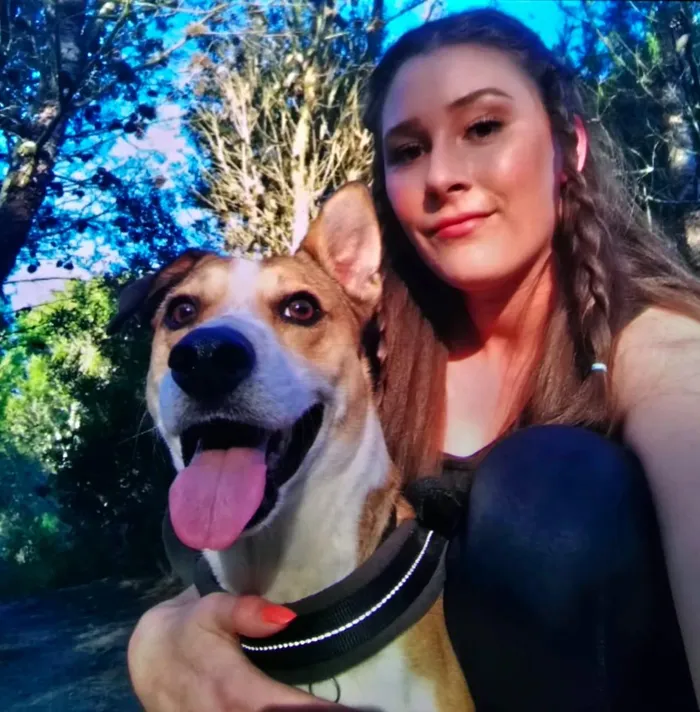
Monique Barnard, 30.
Image: SUPPLIED
For the past three weeks, every time Hettie Barnard has looked for Toby, the dog has been standing at the front door, waiting for her daughter to come home.
But every time Barnard sees that hopeful four-legged figure, she is reminded that her eldest, Monique, will not be coming back.
And it was not because Monique was out and about working with animals or teaching English online to foreign children, as she often did, returning home in the afternoon — it was because she died last month.
Barnard, of Gqeberha, was the one who found Monique, 30, with a rope around her neck on November 19, and since that day, she said, nothing has ever been the same.
“It is something I am still trying to make sense of,” a heartbroken Barnard said, adding that Monique lived in her own apartment on the same property as her.
She said that when she saw her daughter hanging, she faced the daunting task of cutting the rope.
“But it was too late," Barnard said.
"I go over everything again and again, just trying to see if there was something I should have noticed."
She said that on that fateful morning, Monique received a message saying she could not be helped with her depression anymore.
"The person sending the message said she was not equipped to deal with self-harm threats," Barnard said.
"My child wanted help and that message really crushed her ... previously she has deleted her social media, she did not like what happened on social media.
"You never imagine losing your child like this. You never think it will be your child. And now I have to try to live with that, one day at a time."
She said she missed Monique's voice.
"Or just seeing her walking around like she used to. Toby sits by the door, waiting for her like he always did — it breaks me.
"She loved dogs, she loved animals and kids. She would save any and all animals if she could.
"One time, she even saved a penguin ... she was truly an amazing person and her dad, sister, grandparents and myself loved her unconditionally."
Barnard was speaking out to urge parents to look for small changes in their children, such as withdrawing from friends, losing interest in activities they once loved, or showing signs of anxiety or fear.
Another recent tragedy involved Sesethu Enhle Mboza, a second-year Nelson Mandela University (NMU) student.
Mboza reportedly died by suicide following an alleged sexual assault about four weeks ago.
Her death marks the fifth student death at the university over that period.
NMU Vice-Chancellor Professor Sibongile Muthwa said: “We grieve alongside them [family members of the deceased] and hold them close in our thoughts and prayers during this time of profound sorrow.”
And while reporting on suicides is not standard practice, these two cases are an exception due to their nature and because they form part of IOL’s ongoing series Don’t Look Away, which explores online bullying, suicide, mental health, and gender-based violence.
Higher Health said over 800,000 people die by suicide worldwide each year, while in SA alone, 23 people take their own lives every day.
The country’s suicide rate is about 23.5 deaths per 100,000 people.
Suicide is among the leading causes of death for young people aged 15-29 in SA.
The SA Depression and Anxiety Group said men were four times more likely to die by suicide than women, with nearly 80% of recorded suicides being male.
According to Statistics SA, studies on young people show that bullying, combined with other risk factors — like substance abuse, traumatic events, previous suicide attempts — correlates with higher suicide rates.
Newly compiled data has revealed that 11,194 incidents of bullying have been reported in public ordinary schools between October 2024 and September.
Cyberbullying was listed as a significant component of the problem.
Basic education minister Siviwe Gwarube provided this information in response to a parliamentary inquiry by the EFF’s Lencel Komane.
Komane had asked about the number of reported incidents of bullying and abuse by pupils against other learners in the past 12 months, and the steps the department was taking to help schools address the issue of bullying.
According to anti-bullying NGOs, around 57% of SA pupils have been bullied at least once in their lives.
Statistics from Safer Schools show that more than 3.2m learners are bullied yearly, and 67% of victims do not report the abuse because they believe no one will help.
Experts said that social media, or behaviour on social media, can also increase suicidal thoughts.
Arthur Goldstuck, a digital expert, said that receiving a hateful or sad message — in this case, like the one Monique received — hits harder than in-person interactions because it follows you home, onto your phone, and even into your bedroom.
“It erodes self-worth, causes anxiety and depression, and traps victims in a 24/7 loop of cruelty,” he told IOL.
He said there were multiple warning signs parents and friends can look for.
He said this included withdrawal from real-life relationships, obsessive consumption of dark or despair-focused content, sudden changes in sleep patterns, and posting fatalistic or goodbye-style messages.
Algorithms — the systems that decide what content a person sees online — often worsen this, he explained, because they show users more of the posts and messages they already engage with, doubling down on negative or harmful content.
Legal expert Emma Sadlier criticised social media platforms for failing to protect users.
"The platforms fail dismally," she said.
She explained that many of the platforms were owned by companies headquartered in America and fall under Section 230 of the Communications Decency Act, which provides immunity for the content they host.
Sadlier said that if a person's right to dignity was infringed, they can lay a criminal charge.
"A subset of dignity is reputation ... so, if you hurt my reputation as an individual or a company, I could sue you for defamation."
Social Media 101 managing director Brent Janse van Vuuren said most platforms offer tools like reporting, blocking, muting, keyword filters, and limiting who can comment.
"These tools do help create breathing room," he said.
"When someone is being attacked, reducing what they see online and who can reach them is a crucial act of self-protection.
"It gives the nervous system space to settle.
"But these tools are more about coping than prevention."
He said reporting processes can be slow, inconsistent, and frustrating.
"Harmful content often stays up far too long," he said.
"So while users can and should take steps to protect themselves, the bigger responsibility sits with the platforms."
Janse van Vuuren said online bullying was designed to make you feel isolated.
"That is exactly when it becomes dangerous," he said.
"So tell a friend, a partner or a therapist ... you don’t have to carry all of that hurt by yourself, and you should not."
TikTok star Cedric Laguma said cyberbullying was often seen as a "touchy" subject.
"As a social media personality, there is always an element of 'you ask for it'," the 44-year-old told IOL.
"Because I’ve put myself out there, I’ve left my comments on, which means engagement, and engagement is always encouraged, right?
"Unfortunately, not all engagement is good engagement.
"Some people feel that because they’ve got direct access to you, they’ll take the opportunity to try and troll you, break you down, or even bully you.
"I found that, as a content creator, if you match the bully on their level, you can get one of two very extreme responses."
He said on multiple occasions he has "matched people’s energy".
And in "one or two cases", he said, it backfired.
"People perceived me as the bully, though I was the one defending myself," he said.
"But in the end, with me being on social media for about six years, I’ve learned to process it.
"I’ve learned that it’s not personal; the problem people have is with themselves, not with you.
"That has bolstered me against being affected too much by bullying.
"But I would say initially, it really did get to me. If I have any advice for the guys out there, it would be: do not take it personally."
Another content creator Yasien Fredericks said trolling should never be condoned.
He said though he read the comments quite often he did not allow them to affect him.
Fredericks said other creators should rise above the negativity and avoid getting pulled into nasty exchanges.
“It is also my responsibility to understand their point of view and their opinions," he said.
"I don’t need to respond and when I am on social media, I do what I need to do, post my videos, log off, and then live my life.”
Social media manager and influencer Ismaeel Bagus said though he has been becoming good at brushing things off, especially online hate not everyone can do that.
"I think also with some modern methods installed in apps these days, it makes it easier," Bagus said.
"So I have my comment filters for words that will automatically hide those comments.
"It’s not like I would post something to entice someone; I’d post a random video, going about my life, and people will find something to point out.
"I see a lot of comments about people’s sexuality, body, looks, which I feel is, sad to say, the 'normal' things people comment on.
"And it really is usually your blank profiles or ghost accounts, but some people are brave, commenting hateful things from their personal social media."
He added: "These comments used to get to me; I took them personally.
"But just like in a workplace, you need to learn not to take things personally, especially when it’s coming from someone you have never met."
Θ If you or someone you know is struggling with depression or being bullied, contact 0800-567-567 for free telephone counselling, information, crisis intervention, and referrals to resources nationwide — available seven days a week, 365 days a year.
IOL News