
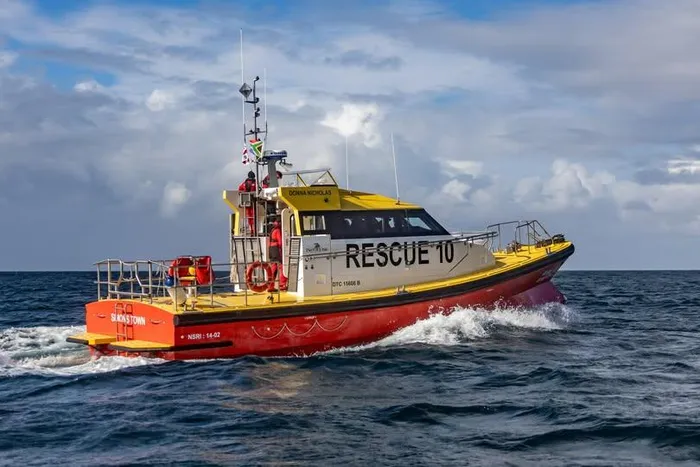
An NSRI rescue craft patrols coastal waters as emergency teams respond to multiple drowning incidents linked to a powerful spring tide along South Africa’s coastline.
Image: File Picture
A series of tragic drowning incidents, missing swimmers and dramatic rescues marked the first day of the New Year along South Africa’s coastline, as exceptionally dangerous sea conditions driven by a powerful spring tide battered popular beaches.
At least four people have been confirmed dead, with several others still missing as search operations continue.
The National Sea Rescue Institute (NSRI), assisted by lifeguards, SAPS units and medical teams, responded to multiple emergencies from early morning through late evening on New Year’s Day.
Coastal regions remain on high alert following an urgent national advisory issued by the NSRI, warning that a full-moon spring tide — commonly referred to as a “super tide” — is generating vicious rip currents and unusually volatile surf conditions.
What should have been a day of celebration turned tragic at several beaches. In the most severe incident, a group of swimmers was swept out to sea at Pennington Beach on the KwaZulu-Natal South Coast. Lifeguards managed to rescue three people, but two 21-year-old men were later confirmed deceased. Search operations are ongoing for two additional young men who remain missing.
In Langebaan, a 26-year-old man from Burundi was found floating unresponsive in the water by a kite-boarder and brought to shore. Despite prolonged CPR efforts by bystanders and paramedics, he was declared dead at the scene.
Further north, at St Lucia’s Jabula Beach, a 15-year-old boy disappeared beneath the surf after rip currents dragged three swimmers into heavy breaking waves. Two people were rescued by the NSRI’s JetRIB craft, but the teenager remains missing.
Search efforts are also continuing at several other locations, including Durban South Beach, where a 22-year-old man from the Eastern Cape vanished in the surf, and the Hibberdene/Mfazazane area, where a 33-year-old local man was reported missing late in the afternoon.
The NSRI has attributed the spike in incidents to the current spring tide, a natural phenomenon that occurs when the sun, moon and Earth align, significantly increasing tidal ranges. This results in higher-than-normal high tides and stronger outgoing currents, particularly in the late afternoon.
“The difference between high and low tide is at its maximum right now,” the NSRI said. “This greatly intensifies rip currents and makes swimming and coastal activities extremely dangerous.”
Amid the tragedies, one life-saving rescue offered a measure of relief. In Knysna, lifeguards and NSRI medics successfully resuscitated a 13-year-old boy who suffered a medical emergency while swimming at Leisure Isle. He remains in serious but stable condition in hospital.
Authorities are urging the public to exercise extreme caution over the coming days. Beachgoers are advised to swim only at lifeguard-protected beaches, stay between the flags, avoid coastal hiking paths during high tide, and wear life jackets when fishing from rocks or moving near cliffs.
“The effects of this spring tide will be felt for several more days,” an NSRI spokesperson warned. “People need to respect the ocean and understand that these conditions can turn deadly within seconds.”
Police Search and Rescue teams, supported by NSRI units and lifeguards, continue to search for the missing. Inquest dockets have been opened, and authorities caution that details may change as investigations progress. Condolences have been extended to the families and loved ones of those who have died or remain unaccounted for.
IOL News