
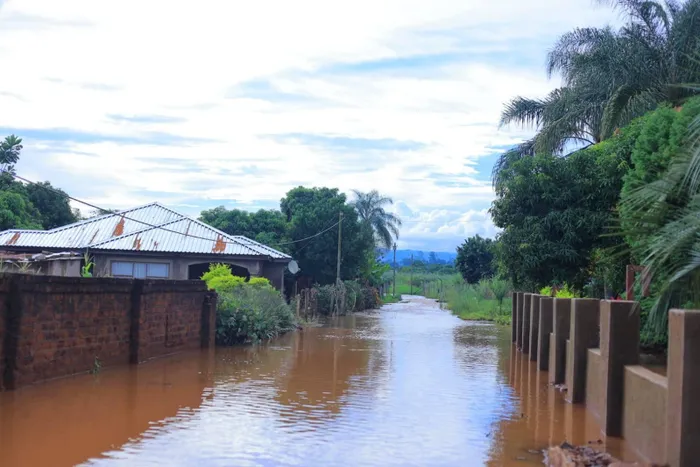
South Africa’s infrastructure vulnerability stems from under-design, maintenance backlogs, and outdated engineering practices, according to experts. Pictured is a trail of destruction in Limpopo following recent heavy rains that led to widespread flooding, impacting communities and infrastructure.
Image: Office of the Premier: Limpopo Provincial Government / Facebook
South Africa’s historical reliance on a 1:50 or 1:100-year floodline, a flood that will, on average, recur once every 50 to 100 years, derived from legacy hydrological models, is no longer defensible under contemporary climate conditions, an expert says.
Professor Hangwelani Hope Magidimisha-Chipungu, a Town and Regional Planning expert from the University of KwaZulu-Natal, said that intensifying rainfall regimes, sea-level rise, and altered catchment behaviour as seen in KwaZulu-Natal, Eastern Cape, and the Western Cape disasters require a dynamic, risk-informed setback regime rather than static lines.
South Africa has experienced localised flooding in various provinces, including in Limpopo and Mpumalanga, leaving a trail of destruction and loss of lives.
Magidimisha-Chipungu said: “A modernised approach should introduce rolling setback lines that are reviewed every 5–10 years through municipal Spatial Development Framework (SDF) updates. Application of risk bands instead of single lines, high hazard exclusion zone, conditional development zone, and managed adaptation zone.”
She added that while many metros and intermediate cities are beginning to incorporate Nature-Based Solutions (NbS) into IDPs and Climate Adaptation Strategies, the implementation remains uneven.
“Some notable key interventions include wetland rehabilitation. This is restoration of floodplain wetlands in eThekwini, Cape Town, and Buffalo City, and in some instances, reconnection of rivers to natural floodplains to reduce downstream peak flows,” she said.
Some cities, she stated, implement permeable paving and green parking systems, although there is limited availability of this in SA.
In some instances, some of our cities are now warming up to the Sponge City Concept, which involves the conversion of underutilised land into retention parks and detention basins. Multi-functional sports fields are designed as temporary flood storage, Magidimisha-Chipungu stated.
She pointed out that the country’s infrastructure vulnerability stems from under-design, maintenance backlogs, and outdated engineering practices.
Legadima Leso, spokesperson for the national Department of Cooperative Governance and Traditional Affairs (CoGTA), stated that in South Africa, there has been a general underinvestment in improving existing infrastructure as compared to building new infrastructure.
He highlighted that the principle of resilience building is embodied in all international principles that inform disaster management, and the ‘build back better’ provision in the Sendai Framework envisions all rebuilding being performed in a manner that results in improvement.
The Sendai Framework for Disaster Risk Reduction (2015–2030) is a 15-year, voluntary, non-binding UN agreement adopted in March 2015 in Sendai, Japan, aimed at preventing new risks, reducing existing risks, and building resilience.
“In terms of the South African Disaster Management Act (2002, amended 2015), there is alignment with Sendai principles, but it does not prescribe percentages for resilience vs. restoration, as this cannot be determined upfront in the case of a disaster. The legislation has catered for this.
“The National Treasury’s Disaster Response Financing Strategy (2025) places the emphasis on principles of flexibility, allowing funds to be used for both immediate restoration and longer-term resilience, but avoids rigid earmarking,” Leso stated.
He said that the current challenges to building back better include fiscal constraints, community, and political pressure.
“Treasury prioritises immediate restoration to minimise disruption. Communities demand fast rebuilding, which caters for like-for-like replacement. There are severe capacity and skills gaps, such as limited technical expertise and planning capacity for resilience-oriented projects. An underinvestment trend prevails, where South Africa has historically invested more in new infrastructure than in upgrading existing systems for resilience,” he explained.
Leso stated that the design and construction of new infrastructure are done in line with the applicable National Building Regulations and Standards, which are designed to incorporate climate resilience.
“It must, however, be stated that building a structure that can withstand all risks all the time is often unaffordable, so engineers make calculated trade-offs to design buildings that would withstand most events but not all.”
Leso highlighted that the classification of a disaster does not guarantee allocation of funding from the disaster grants.
“Affected organs of state, who are responsible for the maintenance and repair of their infrastructure, must first exhaust existing allocations through re-allocation and reprioritisation of funds. Following assessments of infrastructure that cannot be repaired or replaced using the process explained, may be considered for disaster funding from disaster grants within 100 days of the classification and the availability of funds,” he said.
He added that both the departments of Public Works and Cooperative Governance always strive to utilise existing grants to upgrade public assets to build climate-resilient infrastructure post-disasters.
While there may not be a ‘unified Climate Fund’ within or between these two departments, it should be noted that South Africa’s climate-related infrastructure is funded through a blended-finance approach that combines public, private, and international capital to derisk investments, Leso stated.
The Council for the Built Environment (CBE) said that it is currently working with municipalities, the Council for Scientific and Industrial Research (CSIR), South African Weather Services, and the built environment sector to relook at how climate change projections and models are taken into account in response to the recent dramatic climate events that have been taking place.
“The CBE has concluded a Memorandum of Understanding with the South African Local Government Association (SALGA), which is a body that drives the development agenda in local government in South Africa. This MOU will yield concrete programmes that are jointly implemented by CBE and SALGA, that will support local government capacitation, particularly around the areas of climate change adaptation for built environment professionals,” the CBE said.
The council stated that it is working to institutionalise Indigenous Knowledge Systems within professional education, accreditation, and continuing development frameworks across the built environment.
“The CBE is engaging with traditional leadership structures, such as Houses of Traditional Leaders and rural communities, to begin to document and validate local knowledge of flood plains, settlement siting, and ecological management practices.
“The intention is for this knowledge to be integrated into professional practices, particularly for professionals practicing in those areas, ensuring that practitioners understand how pre-colonial land-use patterns and indigenous settlement strategies often mitigated environmental risk,” it said.
The council also stated that it has concluded an MOU with the University of Cape Town, which is advanced in curriculum review, which takes into consideration various types of knowledge, and is working on incorporating it into the curriculum.
Lennox Mabaso, spokesperson for the Department of Public Works and Infrastructure (DPWI), said there is currently no legally ring-fenced percentage within the R350 billion infrastructure pipeline that is exclusively allocated to climate adaptation.
He added that the department is, however, embedding resilience considerations across the full infrastructure lifecycle rather than isolating adaptation as a standalone budget item, which includes planning, design, procurement, construction, maintenance, and asset management.
“DPWI supports the integration of resilience and lifecycle costing principles into procurement processes. Through collaboration with the Construction Industry Development Board (CIDB) and engagement with the National Treasury, the department is promoting procurement approaches that move beyond the lowest upfront cost and instead prioritise long-term value, durability, and reduced future repair costs,” Mabaso said.
He stated that this includes promoting resilient infrastructure procurement guidelines and encouraging the use of innovative, certified building technologies assessed by Agrément South Africa, particularly in climate-vulnerable regions.
The objective is to ensure that infrastructure performance, resilience, and lifecycle accountability form a core part of tender evaluation frameworks, Mabaso explained.
gcwalisile.khanyile@inl.co.za