
Statistics reveal the changing landscape of South African braai costs over the years.
Image: Pexels
The festive season may have brought friends and family around the braai, but South Africa’s beloved hobby is putting a dent in the holiday budget.
New data from Statistics South Africa (Stats SA) reveals that the cost of a classic braai has soared over the past three years.
Stats SA reported that beef rump steak saw the biggest price hike, with a kilogram averaging R166.01 during the 2022 festive season.
“For a time, the price shifted lower before rising again in 2025. In December 2025, a rump steak sizzling on the grill would have set you back an average of R214.45. That is an eye-watering rise of 29% over the three years,” Stats SA said.
“Maize meal (for pap) recorded the second highest increase (+20%), followed by tomato sauce (+16%) and pork chops (+13%).
“On the brighter side, beer (330 ml), onions, and lettuce were cheaper in December 2025 compared with December 2022.”
Stats SA noted the seasonal price fluctuations for onions and lettuce.
Onion prices typically fall early in the year and rise in June/July. Lettuce is generally costlier in the first half of the year.
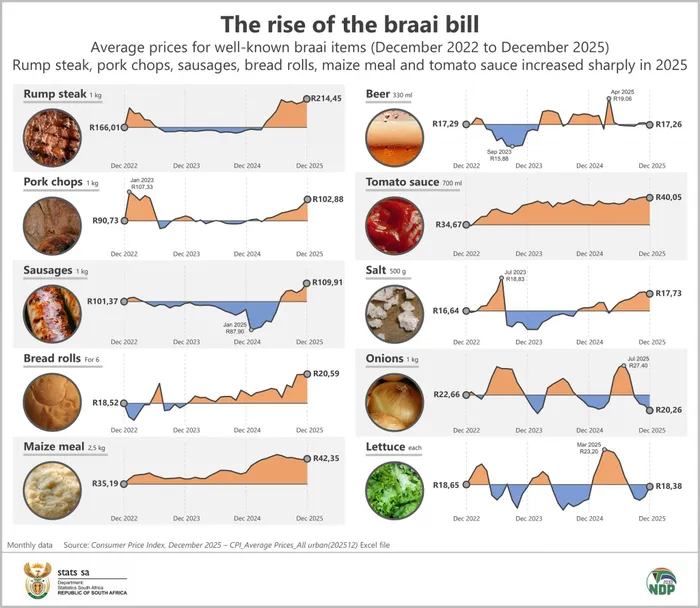
From rump steak to lettuce, a graphic showing the rise of the braai bill in South Africa.
Image: Stats SA
FNB Senior Agricultural Economist Paul Makube said the strength in premium cuts such as beef rump steak was underpinned by a combination of good domestic and export demand.
“The Foot-and-Mouth Disease (FMD) elicited a further uptick in prices in 2025 due to its disruptions to the supply situation in the country,” Makube said.
He said maize meal, having the second-highest increase, was a “surprise” due to the massive correction in maize prices from the second half of 2025, due to the bumper harvest of just over 16 million tons.
However, the country came from a significant drought-induced supply deficit during the 2023/24 production season, which saw maize prices surging above R5,000/ ton. The higher maize meal inflation reflects a delayed pass-through of the lower maize prices at the producer level.
Makube noted that while meat and maize prices rose, braai staples like beer, onions, and lettuce became cheaper.
The improved seasonal availability across most fresh produce perishables helped depress prices, thus providing consumers with a breather in a high-cost environment for animal proteins.
He said that although onions and lettuce are available all year due to the diverse planting environments in South Africa, the July to December period is the peak harvest, thus a potential downside for prices if demand does not significantly outstrip supplies.
Makube highlighted that producers are typically price takers, with consumer prices for braai basket items set further up the value chain, influenced by factors like currency exchange rates, fuel costs, interest rates, and weather patterns.
“The exchange rate has a huge influence on fuel and agrochemical prices (pesticides, herbicides, weedicides), which are important inputs in crop production. Higher interest rates mean farmers’ debt servicing costs are high; the reverse is also true. In a high-cost environment, farmers are inclined to reduce their production levels, thus causing a rise in prices as availability becomes tight,” Makube explained.
“Erratic changes in weather patterns are usually costly for farmers as they either have to replant or forgo yields. Adaptation to climate change, therefore, becomes very critical. Failure to adopt technologies that sustain production overall means a higher cost of food for consumers.”
thobeka.ngema@inl.co.za