
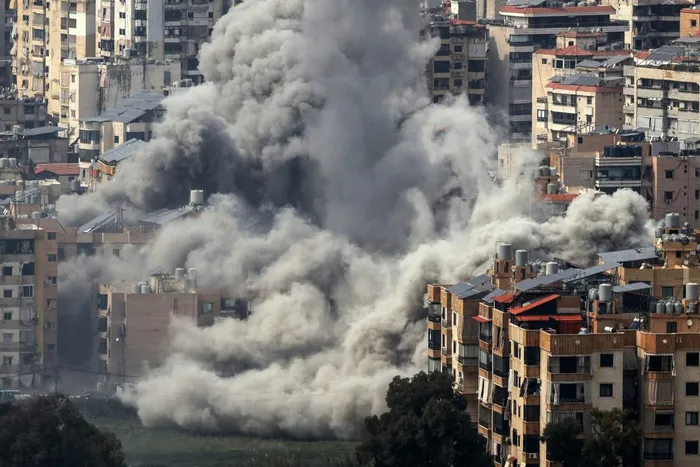
International Relations experts say that the act of armed aggression by the US against Venezuela and Iran breaches all norms of international law and thus requires urgent action from the United Nations Security Council. Pictured is a smoke rising from the site of an Israeli airstrike in Beirut’s southern suburbs.
Image: AFP
The United States’ actions in Venezuela and the coordinated US-Israeli war in Iran reflect an era where powerful states often act based on strategic priorities rather than established legal frameworks, raising fears that might increasingly trump law, especially when institutional checks are weak, experts say.
On 3 January 2026, the United States launched a military strike in the oil-rich Venezuela and captured incumbent president Nicolás Maduro and his wife, Cilia Flores, under Operation Absolute Resolve.
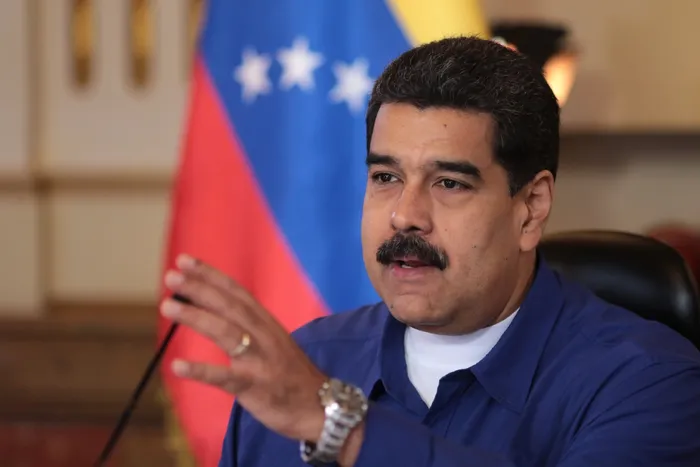
Venezuelan President Nicolás Maduro
Image: Xinhua
On 28 February 2026, Israel and the United States launched joint airstrikes across Iran, killing Iranian supreme leader Ali Khamenei and other Iranian officials, and starting a war with the goal of regime change in Iran. Oil-rich Iran retaliated with missile and drone attacks, leading to widespread regional conflict with substantial casualties and economic disruption.
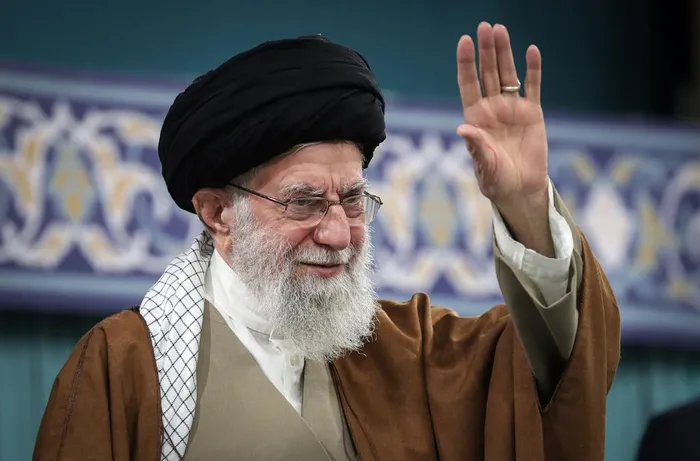
Iranian Supreme Leader Ali Khamenei was killed in the US-Israeli strikes last month.
Image: File
Professor Christopher Isike, an African Politics and International Relations expert from the University of Pretoria, said the events in Venezuela and Iran do not yet mark the formal end of the Westphalian system, which though rooted in a racist ontology of dividing humans into two zones of beings (westerners) and non-beings (non-westerners), was also based on the core principles of sovereign equality and territorial integrity under international law.
Isike stated that actions like Operation Absolute Resolve in Venezuela and the coordinated US-Israeli war in Iran represent a brazen and deep erosion of those norms when great powers act unilaterally without broad multilateral authorisation.
“The United Nations Security Council’s (UNSC) authority has always been undermined by the veto power members wield in their selfish national interests, but these unilateral acts by the US in the last one year have further weakened the Council,” he said.
He added that when permanent members themselves conduct military operations outside their borders without the UNSC’s endorsement, the Charter’s prohibition on unilateral use of force (Article 2(4)) remains legally binding, but enforcement mechanisms rely on member states’ political will.
“The recent strikes outside UNSC authorisation, which have been criticised by many global leaders as violations of international law, underscore the institution’s current limitations in constraining major-power actions and maintaining collective security,” Isike stated.
He said that in practice, no single body currently matches the legal authority of the UNSC; however, other multilateral forums are increasingly relevant in playing specific roles that can enhance global security.
He mentioned that traditional regional organisations such as the European Union (EU), the African Union (AU), the Association of Southeast Asian Nations (ASEAN), the Organisation of American States (OAS), etc., can play important roles in de-escalation and conflict resolution at the regional level.
Groupings such as the G20 and BRICS can offer diplomatic platforms for major-power engagement, although they lack formal peace-enforcement mandates, he said.
“Similarly, Track-two diplomacy and neutral mediators such as Oman, Qatar, Switzerland, UN special envoys, and soft power individuals like the Pope can help facilitate dialogue. The current US-Israel war against Iran underscores the growing role of informal, multipolar mechanisms in global security governance, if you consider the role that Track-two mediators played, although unsuccessfully, in trying to use diplomacy to prevent it,” Isike stated.
He said a 21st-century reinterpretation of the Monroe Doctrine, where the US asserts preeminence over Western Hemisphere security, feeds into global geopolitical competition.
“If the US applies similar doctrines elsewhere, Russia and China are likely to double down on defending their own spheres of influence, and this explains why both countries have been largely silent as the US rampages on. For example, Russia is happy to sit and watch as it has also framed its war in Ukraine as protecting its sphere of influence. Similarly, China asserts territorial claims around Taiwan and the South China Sea,” Isike said.
Each great power uses regional security rationales to justify actions that contravene external interference. This dynamic fuels mutual suspicions, proxy competition, and higher risks of miscalculation, undermining the universality of sovereign equality and increasing global friction, he explained.
Dr Noluthando Phungula, an international relations expert, said the international occurrences of 2026 clearly signal the leaning towards power politics and the fizzling out of the Westphalian system, which underscores non-interference in domestic affairs.
“The first three months of 2026 signal a major, perhaps final, breakdown of the traditional, norm-based Westphalian system, moving the global order closer to a direct, power-based hegemony. Specifically, the USA’s military intervention in Venezuela and Iran, characterised by direct military strikes, the capture and deposition of President Nicolás Maduro, and the assertion of interim foreign administration, represents a watershed moment in contemporary international relations where ‘coercive administration’ becomes a standard tool of great power politics,” Phungula said.
She stated that the act of armed aggression by the US against Venezuela and Iran breaches all norms of international law and thus requires urgent action from the UNSC.
“Following both Venezuela and again US-Israeli strikes on Iran, the UNSC failed to agree on any joint action due to divisions because members were sharply divided. This is perhaps the deciding factor on whether the UNSC has indeed lost its teeth. As is, there has been no resolution,” Phungula said.
She stated that the council functions effectively when there is consensus within superpower states, and this is inherent within its design.
Phungula highlighted that this might be an opportune moment to consider multilateralism and the benefits it may offer in such situations within the international system, as the international political system requires an inclusive multilateralism.
“The United Nations General Assembly Resolution 377 holds that the General Assembly can recommend collective measures when the Security Council fails to act due to vetoes. For example, during the Korean War, it intervened when the UNSC reached a deadlock,” she said.
Phungula highlighted that while numerous groupings, such as regional organisations and mediators, may intervene, a key challenge remains that the legal authority to impose actions and mandate ceasefires remains with the UNSC.
Professor Siphamandla Zondi, a politics and international relations expert at the University of Johannesburg, said the US’s actions in Venezuela and Iran unmask the myths that lie at the heart of this Western order as being principally about Western hegemony and the subordination of others.
He highlighted that the US has violated UN rules more than any state, yet it has continued to serve in the UN and chair its council every year for a long time, which is nothing new.
“The US, wrapped in its hegemonic cloud, is unable to see the origins of the violation of the rules of the council it is chairing. It treats its chairing as an opportunity to defend its illegal actions rather than to strengthen the council and its effects,” Zondi stated.
On the United Nations Charter’s principle of sovereign equality and the prohibition of the use of force, Zondi said, the rules of this order have always applied to all except Western powers, who have acted with impunity and disregard for the rules they invented when their interests are at the forefront.
“The violations we see now, we have been seeing since the 1950s; nothing new. The charge has always been committed only in rhetoric,” Zondi stated.
gcwalisile.khanyile@inl.co.za