
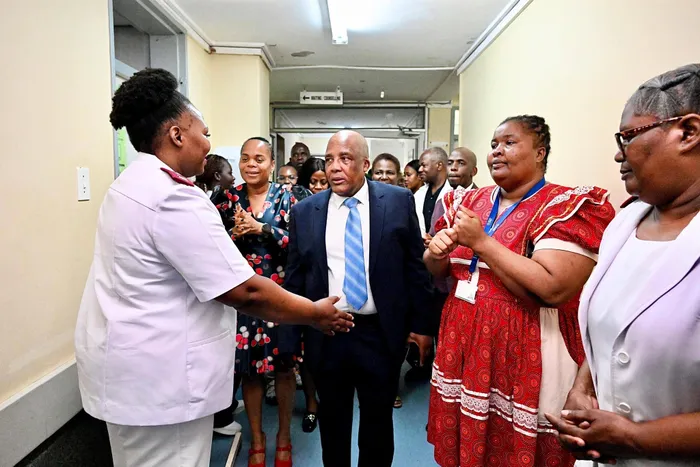
The twins, born cojoined and recently successfully separated at a Limpopo hospital are doing well, and plans are underway to build the family a new home.
Image: Facebook/Office of the Premier: Limpopo Provincial Government
The twins, born cojoined and recently successfully separated at a Limpopo hospital are doing well, and plans are underway to build the family a new home.
According to Limpopo Premier Dr Phophi Ramathuba, provincial government will build them a home before the boys go home.
“One baby has been extubated and is breathing independently, while the other is improving steadily,” she said.
“We are not building an RDP house. We are building a proper home for the family, as the boys also have three siblings,” she said.
She said construction is expected to be completed within three weeks, with support from various partners.
Ramathuba added that the government will continue to support the children, including ensuring access to quality education in the future.
Meanwhile, Health Minister Aaron Motsoaledi has revealed that the separation of conjoined twin boys at a rural hospital in Limpopo would have cost between R3.5 million and R4.5 million in a private facility, as the provincial government plans to build a house for their mother.
Limpopo has made history after conjoined twin boys, born in January at Mankweng Hospital outside Polokwane, were successfully separated in a complex surgical procedure on Tuesday.
The operation, which lasted about eight hours, marked a first for the province.
The twins were born on January 28 to a 29-year-old mother.
Initial assessments showed they were joined at the abdomen.
She was transferred from Maputha Malatjie Hospital after doctors discovered during labour that the babies were conjoined.
The surgery was led by Professor Nyaweleni Tshifularo and began at about 7.45 am, concluding shortly after 3 p.m.
Tshifularo previously said the procedure was highly complex because the twins were joined at the trunk and shared some organs.
Motsoaledi visited the hospital on Friday, and praised the medical team for performing such a groundbreaking procedure at a rural public healthcare facility.
He criticised the perception that quality healthcare is only available in private hospitals.
“There is a belief that outside private hospitals, there is no healthcare at all,” he said. “That narrative is incorrect.”
Motsoaledi referenced his own cataract surgery at a public hospital, saying that thousands of successful procedures are performed daily in the public sector.
He added that complex surgeries were historically conducted in public academic hospitals.
He pointed the first heart transplant in South Africa, which took place in 1967, as well as the separation of conjoined twins at Chris Hani Baragwanath Hospital in 1988.
He also referred to a similar procedure carried out in 2017 at Dr George Mukhari Academic Hospital.
Motsoaledi revealed the cost of the recent operation and highlighted the importance of investing in public healthcare.
“If these babies had been treated in a private hospital, the cost would easily be between R3.5 million and R4.5 million,” he said.
“Where would this family have found that kind of money?”
He added that efforts are under way to strengthen public healthcare infrastructure, including plans to build a new academic hospital in Polokwane.
Ramathuba described Mankweng Hospital as a source of provincial pride, saying that it was not originally designed as an academic hospital but has been adapted to serve as a teaching facility.
simon.majadibodu@iol.co.za
IOL