
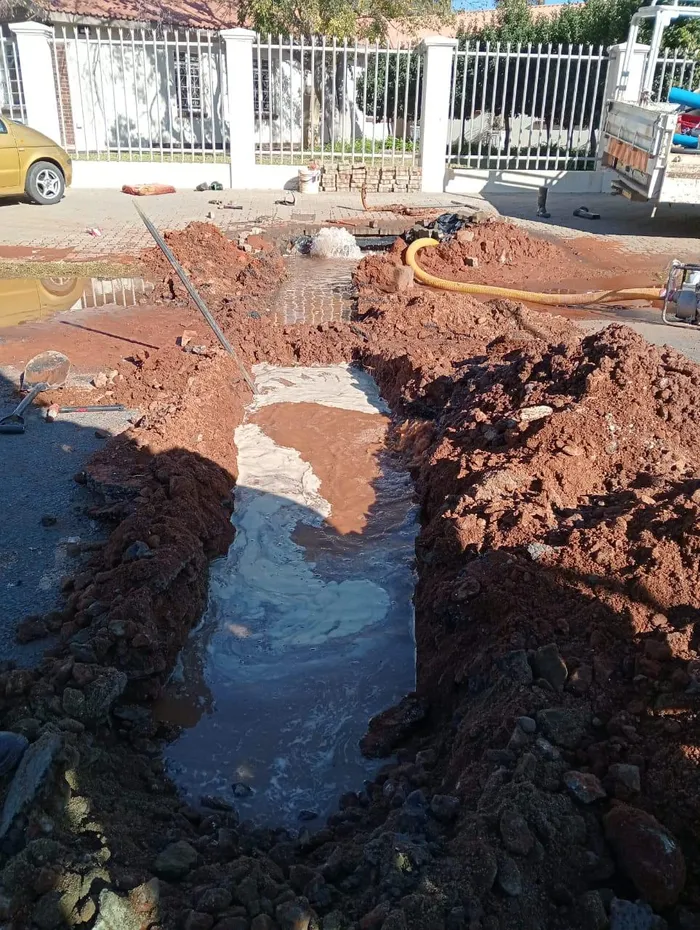
Experts highlight the need for accountability in municipal water management.
Image: Supplied | Sol Plaatjie Municipality
The government must get the basics right, ensure that fiduciary responsibility in municipalities is enforced by law, and punish theft of public funds meant for service delivery, if it is to turn the tide on the maintenance of critical infrastructure, experts say.
The experts weighed in as critical water infrastructure continues to decay in municipalities across the country, despite the Department of Water and Sanitation (DWS) handing over improved wastewater infrastructure.
Notwithstanding these handovers, the 2023-2025 Auditor General Reports highlight that many upgraded water systems fail within 24 months, which results in continued municipal infrastructure decay.
Experts say that criminally charging anyone who dips their fingers in the public purse would deter theft, and municipalities would be able to ring-fence funds to keep critical infrastructure in good condition and prevent unnecessary water supply challenges, and crumbling roads, among others.
Various civic organisations, such as the Johannesburg Water Crisis Centre and opposition parties, have called for the ring-fencing of water revenue to be a legal requirement under the Municipal Finance Management Act (MFMA), to prevent municipalities from ‘weeping’ water grants into general operational costs, such as salaries.
DWS Spokesperson, Wisane Mavasa, said the Department supports the creation of mandatory, audited ‘Water Accounts’ that prevent municipalities from ‘sweeping’ water grants into general operational costs.
Mavasa added that the only government department that could mandate the creation of such accounts by municipalities is the National Treasury; however, it is unclear whether the Constitution allows the national government to compel municipalities to create such accounts.
The Department recently handed over 22 improved wastewater infrastructure projects to Matjhabeng Municipality in the Free State, as part of its commemoration of World Water Day. The Jan Kempdorp municipality in the Northern Cape is also in line to be handed over with refurbished wastewater infrastructure.
Dr Anthony Turton, a multi-award-winning environmental advisor and research associate at the University of Free State, said that in a private or public company, if a director in a fiduciary role steals money, they are criminally liable; however, in a municipality, there is no fiduciary responsibility, so theft is never punished.
He added that the root cause of water system failure is unskilled management that is simply incapable of keeping machinery running.
“There is an incentive to fail, because that means procurement, which opens the doors to corruption. A well-designed system that doesn’t fail is not what the tenderpreneurs want, because that means their revenue streams are limited. Tenderpreneurs want failure, because that generates invoices,” Turton stated.
On what makes it harder for municipalities to maintain refurbished sites, he said, engineering standards are applied across the entire sector; however, refurbished sites are rich pickings because they contain copper. He said, “It is not a standards problem; it is a criminal syndicate problem.”
Turton stated, “I have seen with my own eyes a refurbishment done in Welkom, which was stripped of all copper even before the job was complete. A gang moved in, stole every motor and cable, so the whole project had to start again from scratch. These thieves know that the municipality is obliged to finance the refurbishment, and they wait for the moment and then strip the assets. These syndicates are always directly connected to political power.”
He said that where a municipality has failed, society has a choice to either let the national government intervene by appointing an implementing agent, or face a bleak future without jobs as companies fail because of water service collapse.
Professor David Lockhat, uMngeni-uThukela Water Chairperson in Water Resources Research and Innovation at the University of KwaZulu-Natal, said as a guiding principle, all projects funded through the Municipal Infrastructure Grant (MIG) must be included in municipalities’ Integrated Development Plans and approved by the council.
“So it is well within the ambit of the funding instrument for such ringfencing to occur, but the purpose of the MIG is to provide funding for essential infrastructure such as roads, water, sanitation, and electricity, all of which are critical and under strain in growing metros. And of course, the deal flow in these MIG projects has to be optimised at the local government level so that the funds are utilised well,” Lockhat said.
He added that the national government has recently introduced the Metro Trading Services Reform (MTSR), a performance-linked incentive that aims to mobilise more than R100-billion in infrastructure investment over the coming six years.
The funding will be available to municipalities that meet performance targets, which they have set for themselves under Performance Improvement Action Plans. Funds must be matched from the revenues that the municipalities receive, he stated.
Lockhat added that there is some value in the water boards and municipalities working together.
“In KZN, for instance, uMngeni-uThukela Water was brought in to assist with the repair and operation of various WWTPs after the floods in 2022. This increased capacity was definitely needed, and there could be transfer of good practice from one organisation to another and vice versa. However, this arrangement should be carefully managed to ensure there is long-term carryover of expertise. The roles of the water boards and water services authorities should be clearly defined in such partnerships,” Lockhat stated.
Mavasa stated that the problem of critical infrastructure not being in good condition is caused by municipalities not budgeting sufficiently for maintenance of the infrastructure, which has to be funded from revenue from the sale of water, not from infrastructure grants.
“Municipal infrastructure grants are ring-fenced. They are conditional grants and may only be used for approved projects. The funds are allocated in tranches, and where municipalities fail to meet projected expenditure targets, the funds may be withheld until improved performance is demonstrated,” Mavasa said.
She added that as part of the Grants Policy being developed by the department, this problem will be addressed through a proposed mitigation of not providing any grants to a municipality within 5/10 years of the development/refurbishment of the same infrastructure.
She said municipalities will have to look into their own revenue for the refurbishment and development of infrastructure if it fails within 5 years of its development.
Municipalities must also develop Infrastructure Security Strategies and Plans to protect their infrastructure from theft and vandalism, including insurance for the infrastructure as measures of accountability to protect their assets, she said.
Mavasa stated that DWS will support the Auditor-General in issuing Certificates of Debt to municipal officials who allow these newly refurbished assets to fall into disrepair through ‘willful neglect.’
Ravin Singh, a member of the Johannesburg Water Crisis Committee (JWCC), said communities must be organised, volunteer their skills, and ensure the circulation of credible information between the municipality and the community.
He stated that the JWCC has volunteer engineers and others, as part of the water crisis committee, to guide and point out challenges as they emerge while projects are continuing.
Singh said they have since managed to fix some areas that were without water for a long period of time by tweaking the system.
He stated that working closer with the municipality is not just about volunteering skills.
“If there are problems, communities must alert the City, and be the eyes and ears on the ground. We can’t expect the mayor to be at every development site. The circulation of information will provide oversight in terms of what is happening,” he said.
Singh added that there must be community buy in.
“We have developed a partnership with the City, even in terms of fixing the leaks. We had to knock on their doors multiple times and offer assistance so that we could get services for the community,” he explained.
Singh said the water issue must not be looked at in isolation, but from the broader dysfunction in local government.
“As we fix the water system, we need to fix the function of our local municipalities’ function, the entire system. We need skilled people in local government. We need councillors who are trained and can ask questions, fix the budget, and challenge procurement processes,” he said.
gcwalisile.khanyile@inl.co.za