
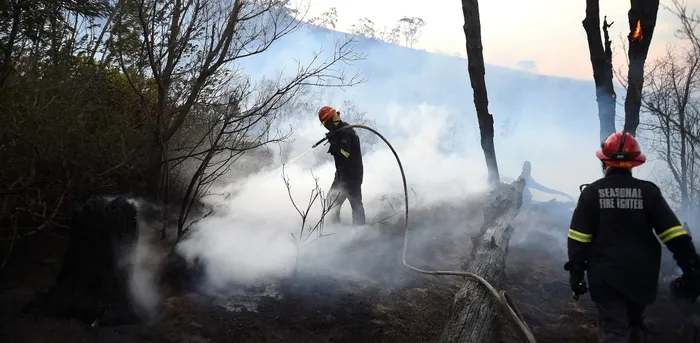
Lion's Head fire We look into what it takes to become a firefighter in South Africa
Image: Phando Jikelo
After the worldwide community observed International Firefighters Day on Monday, it is worth thinking about the hard work our firefighters do and what it takes to become one.
Our days might be looking stormy these days, but that shouldn't make one forget what they do. Becoming a firefighter in South Africa involves a mix of formal training, medical readiness and passing a competitive municipal recruitment process. While training institutions outline the basics, fire departments themselves set strict hiring standards.
To qualify for firefighter training and entry-level roles, applicants generally need to be at least 18 years old, have a Matric certificate, hold a valid driver’s licence, and be physically and medically fit.
According to an EMCARE guide posted on their website, candidates must also be able to work at heights, operate in confined spaces and pass physical fitness assessments required for firefighting training.
Municipal services such as the City of Cape Town Fire and Rescue Service say applicants must also pass medical screenings and meet strict physical fitness standards before being considered for employment.
Firefighting training is the first step toward entering the field.
According to EMCARE, accredited programmes include Basic Fire Fighting, Advanced Fire Fighting and Fire Fighter 1 and 2
These courses cover fire behaviour, rescue techniques and equipment use.
However, departments often expect more than basic fire training.
The City of Johannesburg Emergency Management Services says additional certifications, such as First Aid and Basic Life Support (BLS) are important, as firefighters frequently respond to medical emergencies.
Training standards are often aligned with international guidelines set by organisations like the National Fire Protection Association, which underpin qualifications such as Firefighter I and II.
Getting hired by a fire department is often the most challenging step.
According to the City of Cape Town Fire and Rescue Service, applicants may be required to complete written aptitude tests, Physical Ability Tests (PAT), panel interviews, medical and psychological evaluations and background checks.
It is worth noting that large metros receive thousands of applications, making the process highly competitive.
So where can firefighters work?
Qualified firefighters can find employment in several sectors. This includes municipal fire departments, airport fire and rescue services, industrial fire units (such as mines and refineries) and wildland firefighting programmes
Programmes like Working on Fire focus specifically on veld and forest fires, particularly in high-risk regions like the Western Cape.
Firefighter salaries vary depending on experience and location.
Firefighters often work long shifts—sometimes 24 hours at a time—and must be prepared to respond to emergencies at any hour.
According to EMCARE, firefighters need strong physical fitness and mental resilience. Fire departments also emphasise teamwork and communication, problem-solving under pressure, emotional resilience in traumatic situations and career progression.
Firefighters can advance through the ranks with experience and further training, moving from entry-level roles to senior operational and leadership positions such as Station Officer or Chief Fire Officer.
To our firefighters, thank you.
IOL