
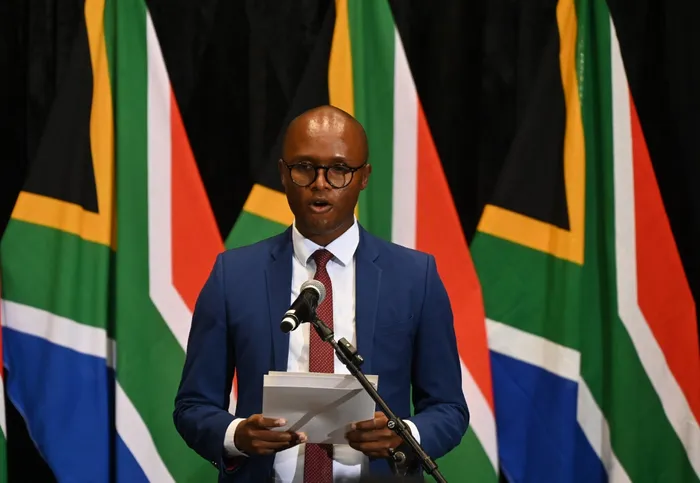
Minister Solly Malatsi.
Image: Ayanda Ndamane/ Independent Newspapers
The failures which resulted in Minister of Communications and Digital Technologies, Solly Malatsi, having to withdraw the Draft South Africa Artificial Intelligence (AI) Policy for having fabricated sources in the reference list have been called embarrassing and damning.
The Department of Communications and Digital Technologies had previously published the draft AI policy for public comments, with the closing date of mid-June 2026.
The draft policy proposed the formation of a new AI governance ecosystem, including a National AI Commission, an AI Ethics Board, an AI Regulatory Authority, an AI Ombudsperson, a National AI Safety Institute, and an AI Insurance Superfund designed to compensate individuals harmed by AI systems in cases where liability is unclear.
However, Malatsi was forced to withdraw the policy after it emerged that the integrity of the policy was compromised as it contained various fictitious sources in its reference list.
Once this news emerged, Chairperson of the Portfolio Committee on Communications and Digital Technologies, Khusela Sangoni-Diko, called out the minister on social media.
“With the integrity of the draft AI policy seriously called into question, here’s an alternative to counter-productive grandstanding. Withdraw it immediately so you don’t face further embarrassment and lose more credibility.
“Subject it to the rigorous review (without using ChatGPT this time) demanded of a national policy on the most transformative technology of the 21st century,” Sangoni-Diko said.
“Re-release for public comment once you have a product you can take full ownership of. Stop looking for a scapegoat (or should we say a scape-bot?)”
Sangoni-Diko was accused by Minister Dean Macpherson of grandstanding for her remarks: “Your post is the very definition of grandstanding.”
To which she replied, “Askies ma kubuhlungu. You DA Ministers, are the very epitome of populism, hence you would know. You are going to learn governance is not pap n vleis. It’s rough now. Instead of concerning yourself about my posts, circle the wagons and prepare your defence on how you are going to get your Minister out of this hot mess.”
Malatsi had also posted that he had asked the director-general to investigate and take action against anyone found to be responsible for any wrongdoing.
By Sunday afternoon, Malatsi said that they had initiated internal questions, which have now confirmed that the policy used fictitious sources.
“This failure is not a mere technical issue but has compromised the integrity and credibility of the draft policy. As such, I am withdrawing the Draft National Artificial Intelligence Policy.
“South Africans deserve better. The Department of Communications and Digital Technologies did not deliver on the standard that is acceptable for an institution entrusted with the role to lead South Africa‘s digital policy environment,” Malatsi said.
“The most plausible explanation is that AI-generated citations were included without proper verification. This should not have happened.
“In fact, this unacceptable lapse proves why vigilant human oversight over the use of artificial intelligence is critical. It’s a lesson we take with humility. I want to reassure the country that we are treating this matter with the gravity it deserves,” Malatsi said.
“There will be consequence management for those responsible for drafting and quality assurance.”
The uMkhonto weSizwe Party (MK Party) has also shared their disbelief and anger over the matter, stating that a national policy of this magnitude does not simply appear overnight.
“It passes through officials, advisors, legal teams, senior management and ultimately lands on the minister's desk. The idea that not a single person, across this entire chain, identified fabricated references is not only embarrassing, it is damning,” the party said.
“It reveals a department asleep at the wheel and completely out of touch with the seriousness of its mandate. South Africans are being asked to believe that a department tasked with leading the country into the digital future cannot even verify its own sources. That is not a small oversight; it is a reckless disregard for credibility, professionalism and public trust,” the MKP said.
“Worse still, the minister's response attempts to soften the blow by blaming ‘AI-generated citations’ as if the problem is the tool and not the incompetence of those using it. Technology does not remove responsibility; it demands more of it.”
They added that a policy which should shape the future of artificial intelligence in the country has been reduced to a careless, copy-and-paste exercise.
“The MK Party rejects this outright. If this is the standard applied to critical policy development, then South Africans must ask, what else is slipping through unnoticed? What other decisions affecting our lives are built on shaky, unchecked foundations?
“The minister cannot simply withdraw the document and promise ‘consequence management’ as if this is a minor internal issue. This is a national embarrassment,” MKP said.
“It requires full transparency, clear accountability and decisive action. South Africa deserves a government that takes its work seriously, not one that experiments with half-baked policies and hopes no one notices.”
theolin.tembo@inl.co.za