
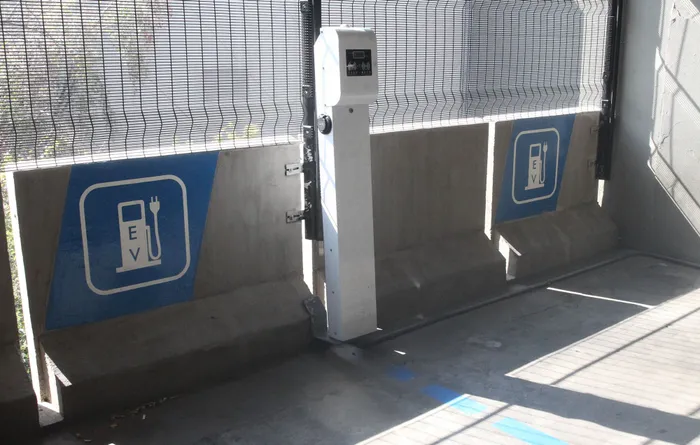
A legal expert outlined the urgent need for EV charging policies in South African homeowners' associations
Image: File
Neither a South African court nor the Community Scheme Ombud Service (CSOS) adjudicator has yet issued a reported ruling on an electric vehicle charging dispute in a body corporate or homeowners’ association - but that silence won’t last.
That is the warning from Johlene Wasserman, Director of Community Schemes and Compliance at VDM Incorporated, who says trustees are already facing pressure to approve chargers in shared parking areas without the legal framework, electrical capacity, or billing systems to support them.
“Every trustee in this country should have an EV charging policy on the agenda of their next meeting. The first ruling on EV charging in a scheme is coming, and no trustee wants their scheme to be the test case,” she said.
Trustees are being asked to regulate technology that did not exist when their schemes were built. “Without rules, even well-intentioned owners create serious risk, and ‘temporary’ extension leads across common property have a habit of becoming permanent,” Wasserman said.
She added that trustees should now consider questions such as who is allowed to install a charger on or near common property and how the electricity will be measured and billed. Other questions that arise are who carries liability when a faulty installation damages the common electrical infrastructure and what must be done about the owner who has already run an extension lead across the parking bay.
Without a policy, these decisions are made inconsistently “which is the single biggest risk, because inconsistent treatment of owners is fertile ground for a CSOS referral or a High Court review".
South African community scheme legislation does not deal with EV charging directly. “The Sectional Titles Schemes Management Act (STSMA), the CSOS Act, and the prescribed rules pre-date the technology". But existing law is not silent either, she said, explaining the STSMA requires trustees to act in the best interests of the body corporate, which in EV disputes will be interpreted through the lens of their fiduciary duty to protect common infrastructure and communal finances.
The Electricity Regulation Act also comes into play, Wasserman said: “A body corporate acts as an electricity distributor, not a licensee, and cannot casually sell on power to an EV owner without sorting out how that recovery will be structured. None of these provisions was written with EVs in mind. All of them apply." A defensible approval starts with a load assessment and a qualified electrician confirming that the installation is compliant, she said.
“Any charger that affects common electrical infrastructure requires written approval, and the terms must be recorded in a signed agreement that sets liability, maintenance, billing, and removal when the owner sells," she added.
Wasserman further explained that billing has to be transparent and based on sub-metering or an equivalent method. Without it, communal electricity costs will spike, and owners will subsidise private charging.
“Extension leads across common property are never acceptable; they create fire and trip risks and raise insurance concerns. And no policy is enforceable until it is formalised through the correct rule-amendment process," she said.
She pointed out that a standard 7kW home charger drawing residential-tariff electricity at R2.50 per kWh, charging a typical EV overnight five nights a week, can add about R2,500 to R4,000 a month to the communal electricity bill - per car. In a scheme with 10 EV owners and no sub-metering, that is around R40,000 a month, or close to half a million rand a year, being absorbed into the levy base and paid by owners who may not even own cars.
Her advice to schemes is to act decisively. "When the first EV charging matter reaches CSOS or a High Court – and it will, within the next 18 months, the schemes that already have written policies, sub-metering, and signed charging agreements will be the ones not in the judgment,” she said.
zelda.venter@inl.co.za