
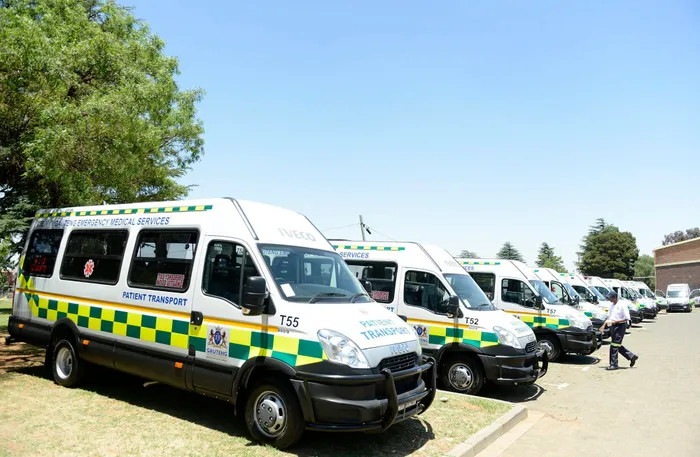
The Rural Health Advocacy Project (RHAP) has revealed that the shortage of ambulances in rural regions compromises patient care.
Image: Dumisani Dube
Limited ambulance availability, coupled with vehicles being busy elsewhere, compromises patient care in rural areas.
This is according to the Rural Health Advocacy Project (RHAP) in its latest policy brief on Tuberculosis (TB) in rural areas.
The report revealed that while patients in rural areas face significant barriers to reaching clinics due to poor road conditions, the problem is worsened by the scarcity of suitable ambulances.
In the Eastern Cape, there has been a shortage of 32% of ambulances, while other provinces, such as the North West, face an even greater shortage of 85%.
The advocacy organisation stated that while the national standard for ambulance availability is one per 10,000 persons, in the Eastern Cape, the ratio is merely 0.68 per 10,000 people.
These delays, according to RHAP, can lead to poor health outcomes for TB patients, as timely treatment is essential for recovery, while transportation shortages further hinder access to critical care, compromising treatment outcomes.
The report stated that while resources are unequally distributed across provinces in South Africa, favouring urban areas and the private sector, this leaves rural populations underserved, as many rely on primary health care clinics for medical services, and face barriers such as low income, lack of medical insurance, and poor education.
“The impact of TB is much higher in rural areas due to the context. Rural areas are generally impoverished, impacting the quality of health care they receive. Evidence of this is notable as only 80% of the rural South African population affected with TB receive a diagnosis and just 53% successfully complete treatment,” read the report.
National health spokesperson Foster Mohale said the department is currently working with provinces to find a solution to this challenge, which cannot be eradicated overnight since some ambulances get involved in accidents while others require regular maintenance to remain roadworthy.
“Though the department acknowledges that there are contributing factors that impact the health care delivery around the country, which differ from one area to another, the issue of road infrastructure is one of them, partly affecting the timely arrival of ambulances at the scene or health facilities. Secondly, the Department had previously acknowledged a shortage of ambulances in the public health sector; some provinces do enter into agreements with private Emergency Medical Services (EMS) to alleviate pressures,” he said.
The organisation stated that the problem is also exacerbated by inadequate healthcare infrastructure, long travel distances, financial constraints, and deep-rooted stigma, all of which hinder timely diagnosis and treatment.
“The lack of essential services like clean water, electricity, and reliable medical care further impairs patient outcomes,” the report stated.
The report stated that although the National Strategic Plan (NSP) aims to eliminate TB, rural communities continue to face significant challenges due to systemic inequities and resource shortages.
“To achieve meaningful progress, policies must focus on expanding mobile health services, improving the supply chain for TB medications, and providing comprehensive social and financial support for affected households. Swift and coordinated action from government, healthcare providers, and community leaders is essential to address these disparities, ensuring that rural populations receive equitable access to TB care and support.”
The report added that rural parts of the country face high unemployment, poverty, and socio-economic instability, such as South Africa's Eastern Cape, where unemployment rates are as high as 44%, the financial burden of TB further devastates families that are already struggling with poverty and socio-economic instability.
“When someone in the household falls sick with TB, it often means a loss of household income on top of the medical costs. In rural communities, financial support is already limited, and while social grants exist, they don’t always help families dealing with TB.
“The economic impact of TB creates a devastating cycle of poverty and illness, with rural provinces like the Eastern Cape recording the highest TB-related mortality rates at 8.3%, followed by Mpumalanga at 8.1%. The economic strain from TB-related illness deepens this poverty cycle, creating ‘poverty-disease traps’ where individuals cannot afford treatment, leading to worsened health and economic hardship,” the report stated.
manyane.manyane@inl.co.za