
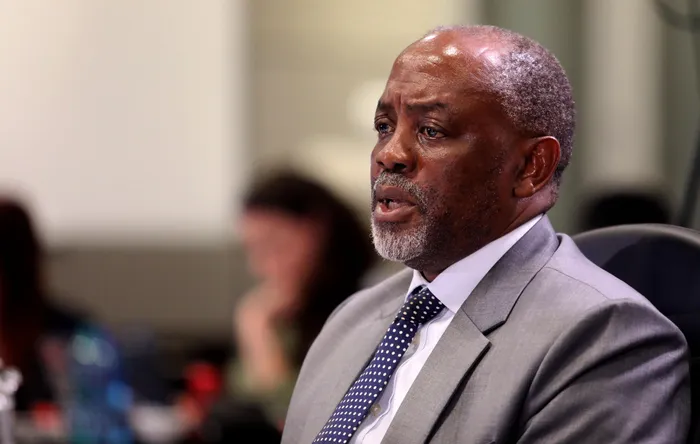
Advocate Menzi Simelane, the former head of the NPA, returned to the TRC Cases Inquiry, chaired by retired Justice Sisi Khampepe, on Tuesday.
Image: Oupa Mokoena / Independent Newspapers
Former National Director of Public Prosecutions (NDPP), Advocate Muzi Simelane, returned to the Truth and Reconciliation Commission (TRC) Cases Inquiry on Tuesday, following his testimony in March this year.
Simelane's morning session, while being cross-examined by Adv Howard Varney on behalf of the Calata and other families of the Cradock Four, focused on his role as the co-chairperson of the Directors-General (DG) Forum during former president Thabo Mbeki's tenure as State president.
The forum has been associated with the TRC, particularly in the context of the Amnesty Task Team (ATT) established by Mbeki.
The commission, chaired by retired Justice Sisi Khampepe, is tasked with establishing why some of the cases referred to the South African Police Service (SAPS) and the National Prosecuting Authority (NPA) for investigation and prosecution by the TRC never reached court.
This comes as allegations have been made that the DGs cluster played a key role in getting former NDPP Advocate Anton Ackerman removed from the TRC cases after he was labelled by some members within and outside the cluster as an "apartheid-era prosecutor".
In his previous appearance before the commission, Ackerman, who was the head of the Priority Crimes Litigation Unit (PCLU) from 2003 until his retirement in 2013, admitted that Simelane did not interfere with his professional duties concerning the TRC cases.
The suspicion against Ackerman stems from allegations surrounding an alleged fabricated letter purportedly signed by Ackerman, which indicated that he was investigating 37 leaders of the ANC for possible prosecution for apartheid-era crimes.
Advocate Varney pressed Simelane, asking if it was appropriate for the Directors-General meeting to discuss the composition of the prosecution team in the TRC cases.
Simelane stated that it was not the cluster that sought his removal, but specific individuals, some outside the cluster.
"What I indicated was exactly what the other DGs would indicate, that their members complain about his past involvement as a prosecutor. Basically, in prosecuting what they would refer to as comrades when they came into the country, they deployed on whatever mission. His role (Ackerman) as a prosecutor was basically prosecuting those who would have been arrested at the time. But they didn't indicate the specificity of who they were, but it was in that context, at least that’s how we all understood it," Simelane said.
Acknowledging the friction generated by these concerns, Simelane elaborated: "No, there was no suggestion that Ackerman was doing anything wrong in the cluster. It was purely based on his history as a prosecutor."
Simelane stated that after further engagements, it was agreed that Ackermann would be moved to another position, where he would not be directly involved with the cluster.
"Once that was done, the cooperation from the departments resumed, and the programme was able to move forward," Simelane elaborated.
His cross-examination continues after the tea break.
siyabonga.sithole@inl.co.za