
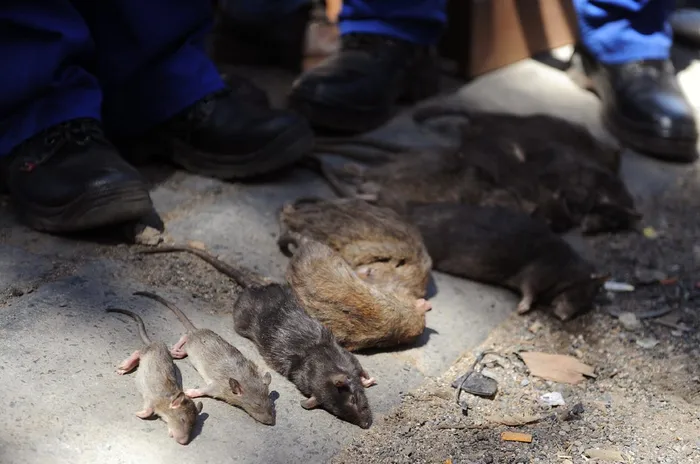
Rodents in Alexandra township, highlighting the risks associated with hantavirus exposure.
Image: Dumisani Sibeko
Concerns about hantavirus, a rodent-borne disease, have brought the persistent problem of rat and mice infestations in densely populated areas like Alexandra township into sharp focus during a recent portfolio committee on Health meeting.
On Wednesday, the National Department of Health and National Institute for Communicable Diseases (NICD) briefed the committee on the investigation’s findings into the hantavirus outbreak, containment measures, and lessons learned to strengthen South Africa’s health security.
Health Minister Dr Aaron Motsoaledi, in his presentation to the committee, indicated that hantavirus occurs in North and South America, but also in Europe and Asia.
He said it is a zoonotic disease, transmitted from wild animals to humans. In this case, the wild animals are rodents (mice and rats). People are infected when they come into contact with the excreta (urine, droppings and saliva) from the rodents.
However, he said, person-to-person contact is rare and occurs under specific conditions, namely, close person-to-person contact for transmission to occur from one human to another.
This prompted committee member Naledi Chirwa-Mpungose to ask the experts about the risk for places exposed to a large number of rodents, like Alexandra township.
She asked the department to provide facts to ease public panic, clarify the current situation regarding human-to-human transmission, and address unanswered questions.
Motsoaledi said as far as he knows, he has never been told of any presence of hantavirus on the African continent, however, he stands to be corrected by scientists.
“From the information I got, South African rats do not carry hantavirus because as I told you, it’s a virus that is found in the Americas even in North and South America. It’s a virus that is found in Europe. It’s a virus that is found in India. I do not know any case which has ever been picked up in South Africa among the rats,” Motsoaledi said.
Senior consultant and former NICD deputy director Professor Lucille Blumberg said they needed to address the rodent issue with the public.
“We have a major rodent problem because of garbage and harbouring; there are lots of areas, and that is a major issue,” Blumberg said.
“I think it’s important to clarify for the public. There’s been limited testing in rodents in southern Africa and in Africa more broadly. It is limited, but we do not have hanta in this part of the world. This is endemic to South America.”
According to the World Health Organisation (WHO), hantavirus cardiopulmonary syndrome (HCPS), also known as hantavirus pulmonary syndrome (HPS), is a zoonotic, viral respiratory disease caused by hantaviruses of the genus Orthohantavirus, family Hantaviridae, order Bunyavirales.
The organisation said that human hantavirus is contracted by contacting infected rodent urine, faeces, or saliva, or contaminated surfaces. Exposure often occurs when cleaning rodent-infested buildings or during routine activities in heavily infested rural areas like forests, fields, and farms, where rodents and exposure opportunities are common.
WHO said transmission can occur when people come into contact with rodent habitats. However, most routine tourism activities carry little or no risk of exposure to rodents or their excreta.
thobeka.ngema@inl.co.za