
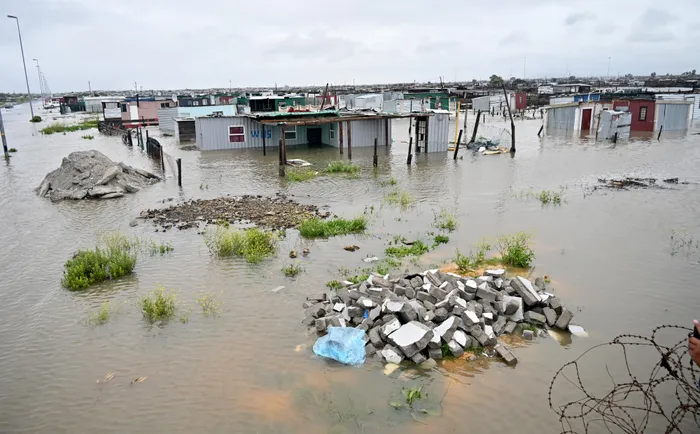
Stringent oversight and robust public accountability are a necessity in emergency procurement, even during the disaster period, according to experts.
Image: Ayanda Ndamane / Independent Newspapers
Transparency and strengthened oversight from external professionals, be it civil society, community associations, or the Auditor-General’s office, are key to curbing tender fraud and corruption during declarations of a State of Disaster, which comes with emergency procurement, where rules are flouted, experts say.
They state that the prevalence of fraud and corruption in emergency procurement processes, especially during the State of Disaster, could be stopped if oversight mechanisms are put in place.
Professor William Gumede, a governance expert from the Wits School of Governance, said the State of Cities Report, commissioned by the government and released every five years, has identified that disasters are often misused as a state capture opportunity.
He added that, because states of disaster require emergency procurement to ensure people do not suffer in the aftermath of a flood or natural disaster, government officials flout tender processes, with no transparency in the awarding of contracts.
“They use this window to award contracts to friends, and to politically connected people, and so on. Even with non-disaster procurement, an emergency procurement when there are no disasters, sometimes, when they sort out an issue, the rules allow for emergency procurement, and that has also been used in the past, very much for state capture,” Gumede stated.
He said there must be a compliance system even though procurement of services and goods under a State of Disaster must be done quickly, as it is an emergency.
“We must still have a system to ensure that the issuing of the contracts is transparent. There must be external oversight, even if it means bringing in the Auditor-General (AG), for example, to sit on it or some independent organisations and individuals to have a look at it, at the issuing stage. The AG, for example, comes after the event or audits after the damage has already been done, and the money is gone. However, if everyone gets involved right from the start, corruption can be stopped,” Gumede said.
He stated that oversight mechanisms must be brought to the fore by bringing in civil society, experts, ratepayers associations, an official from the AG’s office, or individual organisations and institutions, who are external professional people, and are not linked to the municipality, politicians, or sit in any of its committees.
“The problem with the emergency procurement process is that it is not public, and we don’t know which companies or who the contract is awarded to. Only a few people know, and that is where corruption begins. If it is secret and only a few people are in the know about the contract, then it is a recipe for corruption. So, we have to find a way to make emergency or disaster tendering public,” Gumede said.
He stated that many of the disasters would have been prevented had the old infrastructure been maintained and new resilient infrastructure been built.
“So, now we are experiencing a system failure of old (apartheid) infrastructure that has not been maintained, and is now breaking down, for example, Eskom, bridges, some of the dams, etc. Secondly, the new infrastructure built after the 1994 period is also collapsing at the same time as the old infrastructure because of climate change and more flooding,” he said.
Gumede stated that flooding and rain are causing disproportionate destruction because of weak, unmaintained infrastructure.
“With the new infrastructure that is flimsy as well, it means that if we get more storms, we are getting almost immediate disasters. In the past, if we got a storm, it normally wouldn’t be a disaster, because the infrastructure would have dealt with it. Or if the infrastructure were unable to deal with it, it would not have such a big impact,” he said.
He highlighted that the country now has more disasters because the old infrastructure is not holding up, and the new infrastructure can’t deal with severe weather patterns.
Gumede said that this situation opens up more opportunities for emergency disaster procurement.
The new infrastructure is so bad that with any change in weather patterns, it gets destroyed, and wears and tears very quickly. Some of the very old infrastructure lasted a very long time, but it can’t last any longer because it has reached the end of its lifecycle. The worst part is that it could have lasted a little longer if it had been maintained, but it hasn’t, he said.
“That is actually a crisis in itself because the disasters also take scarce money to deal with things that could have been prevented. Once a disaster occurs, we need public money and resources to deal with it, yet some of these disasters are preventable. If we had maintained the facilities or ensured that the new infrastructure was done properly, we would have fewer of these disasters,” Gumede stated.
He said the country must prioritise infrastructure maintenance.
We have to start at the top in maintaining infrastructure, so that if there are adverse weather patterns or floods, we expect the existing infrastructure to deal with these better, he said.
“Secondly, we have to have better oversight over new infrastructure building to make sure that we don’t give it to politically connected companies without capacity. Once the new infrastructure is built, it must be quality tested by independent people before it is signed off.”
He said quality testing is necessary even in communities, for instance, where a pothole is being fixed, or water systems, because you find that some contractors will leave drains open at sites, and the covers are not there. If it is a basement, you will find that it is uneven.
“Then there is a question of who, from the municipality, goes to sites to see whether the contractors have done a good job. Who signs off? There is also a process for signing off on contractors to certify that the job was done properly and is of the highest standard. We need to get that function done,” Gumede stated.
He added that there is a need for the Auditor-General to audit almost every emergency procurement, as a matter of standard.
Gumede said after every disaster, there must be compulsory formal enquiries to see what was at the heart of it, if it is concluded that it was negligence or failure to maintain the infrastructure. Then those responsible can be held accountable.
The recent State Capture and Beyond report revealed that South African disaster declarations have become ‘corridors for corruption’, with the Special Investigating Unit (SIU) identifying R8.9 billion in irregular spending and persistent municipal procurement failures that violate the constitutional rights of vulnerable citizens.
Professor Purshottama Reddy, a Public Governance specialist at the Graduate School of Business and Leadership at the University of KwaZulu-Natal, said when a State of Disaster is declared, generally in a country or geographical area, things move pretty speedily so that the citizenry or residents are not inflicted with harm or suffer in any way.
He added that during that emergency, the decisions made and actions taken had to be done in great haste.
Reddy stated that the requisite policies, procedures, and protocols must be followed; however, they must be done so within the broader context of the disaster and the necessitated emergency action.
“Quite often, the need for urgent action is used as a window of opportunity to deliberately disregard the policies, procedures, and protocols and gain undue financial benefit. This is largely done by the executive public functionaries and those in leadership positions. The onus is then on the remaining public functionaries, even those in opposition political parties and oversight structures, NGO structures, and even the citizenry to raise issues, demand openness, transparency, and public accountability,” he said.
Reddy stated that South Africa has progressive and robust legislation on disaster management; however, the challenge is in implementation.
He said the State Capture and Beyond report highlighted the issue of ‘slow post-disaster reconstruction’, specifically in informal settlements. He highlighted that this gap needs sturdy political will and management.
gcwalisile.khanyile@inl.co.za