
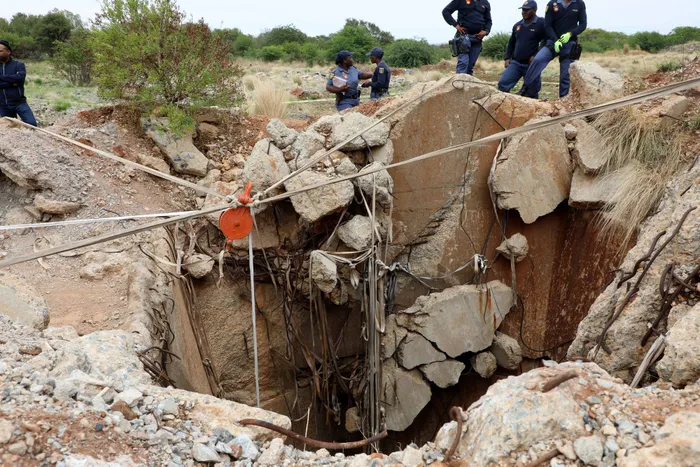
The Mining Affected Communities United in Action (MACUA) demands action against corrupt police officials and syndicates involved in illegal mining.
Image: Timothy Bernard / Independent Newspapers
The Mining Affected Communities United in Action (MACUA) says evidence from the Madlanga Commission and various scandals indicates that police corruption is not about a few rogue officers, but a deeper systemic issue, where police elements are allegedly entangled with politically-linked business networks in the security, logistics, and mining sectors.
This comes after the arrests of SAPS crime intelligence deputy head Major-General Feroz Khan and Gauteng Hawks head Major-General Ebrahim Kadwa for their alleged involvement in an illicit precious metals syndicate, corruption, and defeating the ends of justice.
MACUA said this has confirmed what mining-affected communities have long argued - that illegal mining is not driven only by poor miners underground, but by powerful networks involving corruption, organised crime, and elements within the state itself.
The organisation added that what communities are witnessing on the ground is not merely corruption in the ordinary sense, but the emergence of parallel systems of influence, where access to policing power appears to be unevenly distributed.
The organisation spokesperson, Sabelo Mnguni, said operations such as Vala Umgodi are presented as anti-crime interventions, but in practice, they often function primarily to secure mining territories and suppress informal extraction without addressing the underlying structural exclusion faced by mining communities.
“Many abandoned or under-regulated mining areas exist because mining companies extracted enormous wealth and then left communities behind with unemployment, environmental destruction, and economic collapse.
“Instead of addressing these structural realities or formalising artisanal and small-scale mining, the state has often responded through militarised policing,” he said, adding that communities experience policing not as protection, but as enforcement designed to preserve existing mining and property relations, while criminalising survivalist economic activity.
Mnguni said there have been many instances where community members perceive policing operations as being aligned more closely with corporate interests than with constitutional obligations to protect rights.
He said activists have been arrested, intimidated, subjected to surveillance, or criminalised while raising legitimate grievances against mining companies.
The assassination of whistle-blower Marius “Vlam” van der Merwe in December 2025 also exposed deep-seated police involvement in illegal mining by revealing his testimony regarding elite police collusion with “zama zamas”.
Van der Merwe, a former police reservist who testified as “Witness D” at the Madlanga Commission, was murdered after detailing how high-ranking officers, including those in the Ekurhuleni Metropolitan Police Department (EMPD), protected and participated in illicit syndicates.
Hours before he was gunned down outside his Brakpan home, Van der Merwe sent explicit voice notes to prominent anti-crime activists and journalists.
In this communication, he reportedly stated that he possessed evidence proving senior state and police officials were actively facilitating and protecting illegal mining syndicates at the “highest levels”.
SAPS spokesperson Athlenda Mathe said allegations of police corruption linked to illegal mining activities are treated with the utmost seriousness.
Mathe said the SAPS, working together with the Directorate for Priority Crime Investigation (DPCI) and other law enforcement agencies, continues to investigate allegations involving the leaking of operational information, interference in investigations, and the possible protection of suspects involved in illicit mining activities.
“Any member found to have acted unlawfully will face the full might of the law,” she said, adding that the SAPS reiterates its commitment to dismantling illegal mining networks and ensuring that all individuals involved, irrespective of their position or status, are brought to book.

James Neo Tshoaeli, an alleged kingpin controlling illegal mining at a Stilfontein abandoned gold mine, escaped from police custody in January 2025.
Image: File
Security Strategist Andy Mashaile said police are deeply involved in illegal mining, adding that the Stilfontein escape of Tiger (James Neo Tshoaeli, an alleged kingpin controlling illegal mining at a Stilfontein abandoned gold mine, who escaped from police custody in January 2025) is another example.
“I firmly believe that zama zamas cannot be able to escape the network of law enforcement agencies without the assistance of those who are at the helm and those who make a lot of money from the helm,” he said.
manyane.manyane@inl.co.za