
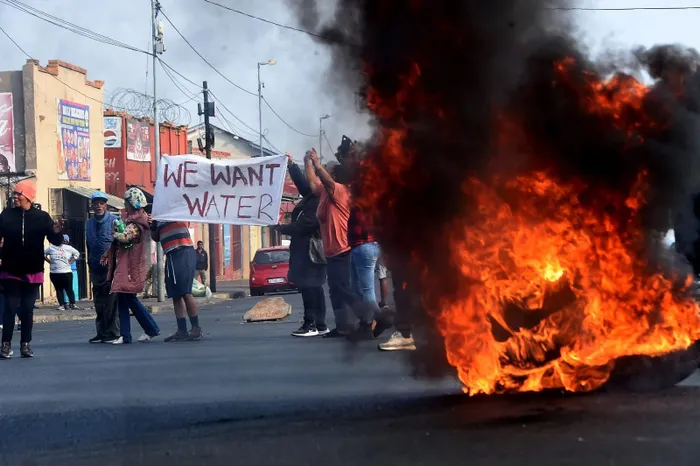
As the public hearings into water challenges in Gauteng get under way, communities are calling for drastic action against water tank mafias and other acts of sabotage in the province.
Image: Itumeleng English / Independent Newspapers
Various civil society organisations gathered at the Constitution Hill for the South African Human Rights Commission's (SAHRC) public hearings on water challenges have urged municipalities to get rid of private water tank service providers and establish a commission of inquiry into some of the water challenges.
Citing corruption, economic sabotage, and vandalism of infrastructure, Dr Ferial Adam of the WaterCan movement was particularly vocal, urging the commission to incorporate water tanker services into municipal structures.
"We can no longer leave water tanker services to the private sector. It has to be inside. It is our constitutional right. The commission should recommend that water tanker services be municipalised," she asserted on Tuesday.
Furthermore, Dr Adam recommended to the SAHRC to establish an independent economic regulator for the water sector, as well as a commission of inquiry to probe water challenges, adding that the failure to establish an independent economic regulator for the water sector is a systemic flaw that undermines accountability and sustainability.
"Thirdly, we request that the commission call for an independent investigation into all water-tanker contracts and tenders in Gauteng over the past five years to identify and prosecute corruption and price-gouging."
Her sentiments for drastic measures to be taken were echoed by Mariette Liefferink from the Federation for a Sustainable Environment (FSE), who called for mining companies and government entities, including municipalities flouting sound water treatment processes, to be held accountable for their negligence.
Liefferink revealed that the province's water system has become worse due to the heavy contamination of water by big business, adding that while Rand Water and Joburg Water are doing their best to treat municipal water, the quality of water continues to suffer due to heavy contamination and the expenses associated with heavy water treatment.
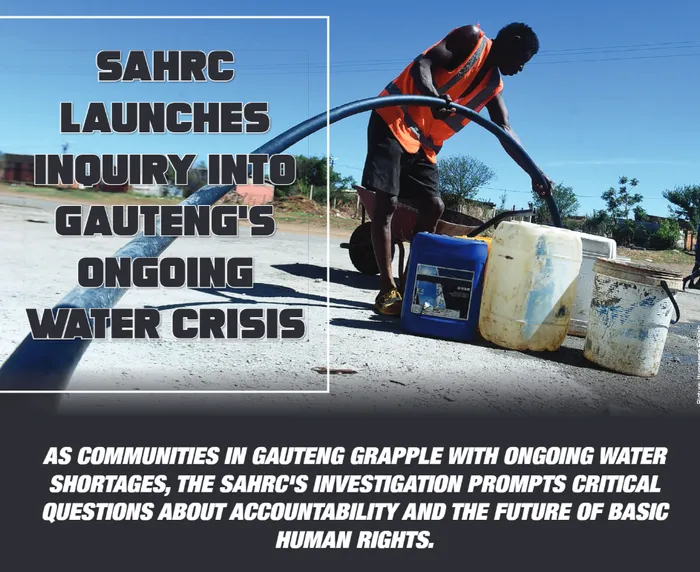
The SAHRC is holding public hearings on water challenges affecting various communities across Gauteng province.
Image: Itumeleng English / Independent Newspapers
She called for harsh repercussions, such as fines and even prison sentences, for those responsible for acid mine drainage and other harmful water practices, underscoring that existing laws already provide avenues for such action.
"The deterioration of water treatment has become so severe that the quality of water has suffered to the point that this has become a normalised situation. It has become increasingly expensive for Rand Water to meet the required standards, and we call on the government to impose fines, prosecutions, and prison sentences on those responsible for acid mine-impacted water," she said.
Dr Henk Boshoff, who is chairing the three-day public hearings, promised that his recommendations will not gather dust but will find themselves in the higher echelons of power in the National Assembly.
"I can assure everyone who is gathered here that this report will not gather dust. In fact, all the reports we have compiled in the past two years have not gathered dust, and have been tabled and acted upon in the provincial and national legislature and other institutions," he stated.
Dr Boshoff indicated that the commission has further noted increasing concerns regarding emergency water supply mechanisms, including growing dependence on private water tanker systems during prolonged outages.
More civil society organisations and government departments are set to present their own submissions, with the public hearings set to continue until Thursday, May 21.
siyabonga.sithole@inl.co.za