
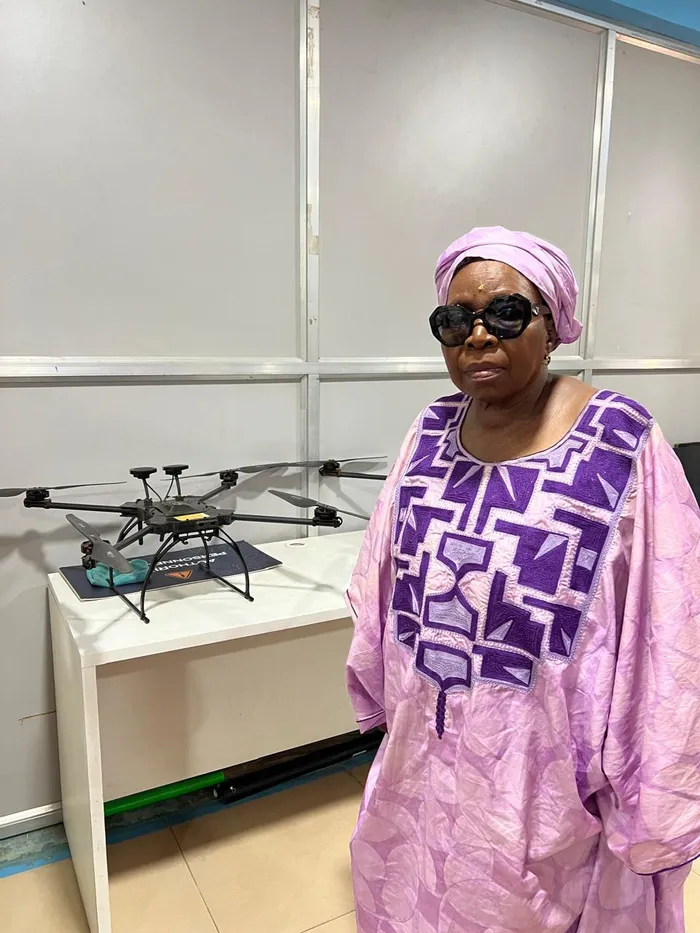
Dr Nkosazana Dlamini-Zuma, during her tour of the Sri Sri Rural Development Programme Trust in India, observed skills training in drone technology, solar power, electric vehicles, and mobile phone repairs.
Image: Supplied
Former chairperson of the African Union Commission, Dr Nkosazana Dlamini-Zuma, has urged African countries to look to India’s development model and adopt technological innovations to address youth unemployment challenges.
Youth unemployment in Africa remains severe, driven by a deep mismatch between rapid demographic growth and the pace of formal job creation.
According to data from the Mastercard Foundation’s Africa Youth Employment Outlook 2026, out of the roughly 420 million young people aged 15 to 35 on the continent, only one in six (approximately 16.6%) holds formal wage employment.
In the continent's most industrialised economies, such as South Africa, the crisis is particularly dire, with youth unemployment (ages 15–24) reaching a staggering 60.9% in the first quarter of 2026
Dlamini-Zuma visited the Art of Living Foundation International Centre in Bengaluru, India, from May 10 to 14.
The visit coincided with the foundation’s 45th anniversary and the 70th birthday of its founder, Gurudev Sri Sri Ravi Shankar.
The celebrations attracted thousands of global visitors, including Indian Prime Minister Narendra Modi, religious leaders, and parliamentary delegations from South Africa, Ghana, Liberia, Sierra Leone, Nepal, and Sri Lanka.
During her stay in India, she also visited the Sri Sri Rural Development Programme Trust to observe vocational skills training in high-impact fields like solar power, drone technology, electric vehicles, and mobile phone repairs.
She commended these empowerment initiatives, noting that acquiring practical skills is vital to addressing critical challenges such as youth unemployment and food security on the African continent.
“Most of these young people who received skills from that centre (Sri Sri Rural Development Programme Trust) are employed immediately after their training. And these skills also allow them to start their own businesses. This is possible for Africa as well, and we need to make a decision and do it,” she said.
Dlamini-Zuma, who established herself as a chief architect and fierce advocate for a continent-wide skills revolution driven by Science, Technology, Engineering, and Mathematics (STEM) education, said these skills will also create opportunities for young people to be in business partnerships with telecommunications companies.
She also praised the Art of Living Foundation for its work in sustainable agriculture, adding that African soil should be utilised to grow indigenous foods.
“They do indigenous and organic farming. They don’t use chemical fertilisers but manure from cow dung, which is what we used to use traditionally,” said Dlamini-Zuma, adding that the food is healthier because it does not have chemicals.
She also commended India's integrative healthcare systems that seamlessly combine traditional therapies, herbal wellness, and guided medical care, and how hospitals successfully merge modern medicine with traditional wellness systems like Ayurveda.
Dlamini-Zuma added that the African continent has much to learn from the foundation’s human-centred development model.
“There is a lot that we can do and collaborate, but if only there were a political will to do so,” she said, adding that she would like to return and spend more time in the country.
High Commissioner of South Africa to India, Professor Anil Sooklal, said South Africa and India have strong historical ties, adding that Dlamini-Zuma, as the former Foreign Minister, was instrumental in cementing and deepening the relationship between the two countries.
Sooklal added that due to the role she played for both countries, it was important for India to invite her.
He said her role was also recalled during the celebrations.
“I was approached to invite her, and she discussed it with me, and she was well-received,” said Sooklal, adding that Dlamini-Zuma also expressed her wish to have another visit to India.
Sooklal added that it was also important that South Africa and India strengthen collaboration at all levels, adding that the country also welcomed Minister of International Relations and Cooperation Ronald Lamola last week, for a major BRICS Foreign Ministers' Meeting in New Delhi.
He said they are also looking forward to hosting Deputy President Paul Mashatile and his delegation to participate in the India-Africa Forum Summit.
manyane.manyane@inl.co.za