
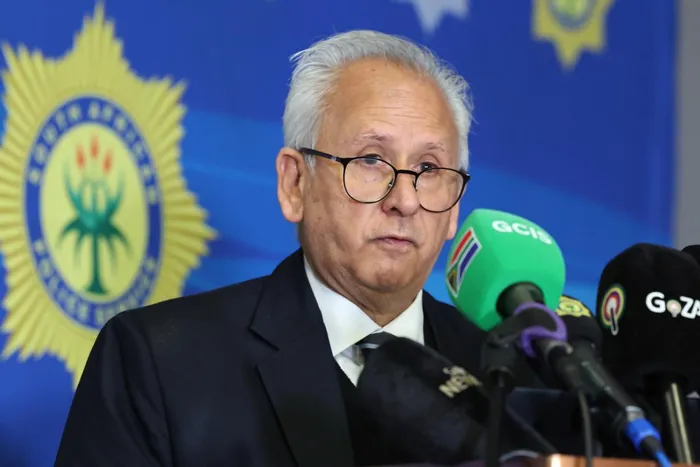
Acting Police Minister Firoz Cachalia on Friday released the crime statistics for the fourth quarter of the 2025/26 financial year and called for war on alcohol-related violence.
Image: GCIS
Acting Police Minister Professor Firoz Cachalia has called for tougher action against alcohol abuse and its contribution to the wave of crime that has swept through the country in recent years.
Despite revealing that serious crime was down during the release of the fourth quarter of the 2025/26 financial year (January – March 2026), Cachalia stated that it remains at an unacceptably high level.
“Violent crimes – referred to by the police as ‘contact crimes’ as there is direct contact between the perpetrator and victim – have declined by 4.6%,” he said.
According to Cachalia, this translated to 7,405 fewer cases of violent crimes being reported compared to the same quarter last year (2024/25).
He said this trend started in 2024, with violent crime having dropped by 10.2% since then, resulting in 17,440 fewer cases reported compared to the most recent quarter.
“Most strikingly, murder has decreased nationally by 9.5%. In the same quarter of last year, 5,727 people were murdered. That number has come down to 5,181,” Cachalia stated.
The murder statistics include the 14 schoolchildren killed in a school transport accident in the Vaal earlier this year.
He added that this means 546 fewer lives lost, and there were fewer grieving families and friends.
“Compared to the same quarter in 2024, there were 1,355 fewer murders or a 20.7% decrease. As this is our most reliable crime statistic, we pay particular attention to the data and information on murders,” explained Cachalia.
He urged the government to take a tougher stance on the sale and abuse of alcohol.
“Alcohol remains a powerful accelerant of this violence. In this quarter, 7,267 incidents of assault with intent to cause grievous bodily harm, rape, attempted murder, and murder were linked to alcohol use,” Cachalia said.
He continued: “We must address the toxic role of alcohol abuse and violence. The more alcohol we consume, the more violence we will suffer. We need to understand this fact and start taking action to reduce alcohol consumption.”
Cachalia has now asked the Civilian Secretariat for Police to take a closer look at the regulations that provide licences to liquor outlets and their trading hours.
He highlighted that much of the country’s violent crime is the result of interpersonal conflict, gender inequality, alcohol abuse, and a culture of resolving disputes through violence.
He said 231 murders were influenced by alcohol and another 18 by drugs, while 576 attempted murders were due to booze and 28 drug-related. Additionally, 1,388 reported rape incidents were due to alcohol, and 174 were linked to drugs.
Nearly 5,100 cases of assault with intent to do grievous bodily harm were alcohol-related, while another 82 were drug-influenced.
Cachalia said the police, a well-established network of violence prevention practitioners across all sectors, were implementing targeted support to children, young people, and families at risk, alcohol and drug use reduction programmes, violence prevention programmes for schools, workplaces, and communities, and better urban design.
The police’s crime registrar, Major-General Thulare Sekhukhune, presented statistics showing that in the last quarter of the 2025/26 financial year, there were 7,569 contact crimes that were alcohol and drug-related.
Sekhukhune said confirmed incidents that occurred at liquor outlets – taverns, shebeens, pubs, bars, and nightclubs – included 160 murders, 343 attempted murders, 65 rapes, and 4,197 cases of assault with intent to do grievous bodily harm.
Meanwhile, Cachalia plans to establish a police advisory panel to be chaired by former SA Revenue Service commissioner Edward Kieswetter and Public Service Commission Deputy Chairperson Dr Zukiswa Mqolombo as his deputy.
Cachalia undertook to announce other members of the panel in two weeks.
“The role of this panel will be to advise me and the acting national commissioner (Lieutenant-General Puleng Dimpane) on the progress of the reset agenda, and on the recommendations of the Madlanga Commission.”
Cachalia said he has decided not to wait until August for the final report from the commission because the areas that require systemic reform are already clear.
loyiso.sidimba@inl.co.za