
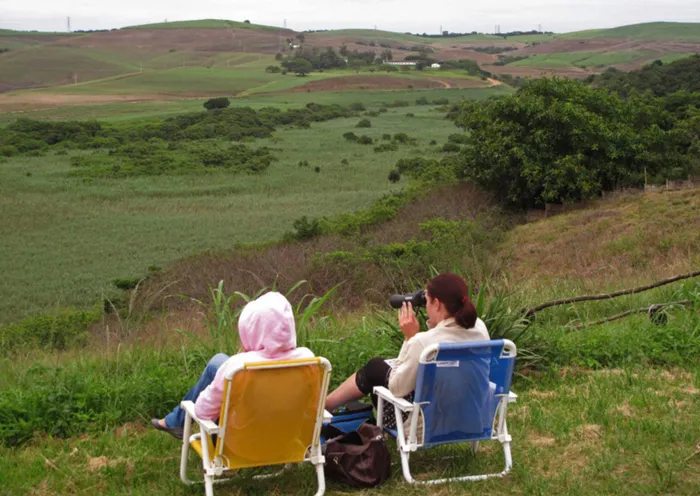
Birdwatchers wait for the arrival of barn swallows in a wetlands area on the outskirts at Mount Moreland, north of Durban. Picture: AP Birdwatchers wait for the arrival of barn swallows in a wetlands area on the outskirts at Mount Moreland, north of Durban. Picture: AP
This is an appeal to the decision-makers of the Mondi Group to consider sustainable alternatives to the development proposal for some of their Hilton plantations. The company is envisaging a project in which professional property developers will convert some of their land in Hilton into medium-density housing, offices, a large shopping mall as well as commercial and industrial facilities.
The land to be converted includes portions along both sides of the N3 between the Hilton and Cedara off-ramps, as well as other sections of land that are owned by Mondi.
The motivation for this development, besides the landowner’s and developer’s profits, will be the transformation of Hilton into “a high quality mixed-use development that will strengthen the uMngeni primary node as the key business hub of the area” (Afzelia BID 2008).
The Midlands are the watershed for the rivers which feed the dams of the Mngeni River system. This is vital for the economic powerhouse of KZN, the greater Durban functional region.
Transformation of the Hilton watershed will have a direct impact on the water flow as well as the quality of water of the Albert Falls Dam, which is the most strategic water resource in the area. The dam is already showing signs of eutrophication, due to the inflow of nutrients from activities in the catchment.
If this trend continues, the cost of treating tap water to safe levels for human consumption will increase. Consequently, the impact on water users’ health will be significant. Paddlers competing in the Dusi Marathon understand the harmful effects (known as Duzi guts) of swallowing untreated water from the Msunduzi and Mngeni Rivers.
The transformation of absorbent surfaces into hardened ones will result in the stormwater run-off during rains increasing. This is a significant issue for the province, not only for residents of the area, as weather patterns are already changing and forecasts include more intense rainfall.
Regardless of how good the engineering is, we cannot continue to fight the forces of nature. Instead we need to find ways to live in harmony with our natural surroundings, so as to ensure a future for ensuing generations.
The SA National Biodiversity Institute (Sanbi) has embarked on a study to ensure that the goods and services derived from ecosystems are fully reflected in SA’s national accounting systems.
These natural assets include the real economic contribution of wetlands and other water resources to human livelihoods and natural water management.
The Hilton area is an important catchment area for water harvesting and run-off generation, supported by the wetlands in the area. Disrupting the integrity of this catchment by changing to hardened surfaces would not only impact on flood damage and catchment degradation locally, but would have a cumulative knock-on effect on downstream users.
The true cost of these developments is thus borne not by the developer, but by local and downstream users such as the Hilton and eThekwini ratepayers. Wetlands are important because they have unique functions and values. Destruction of wetlands can have serious consequences, such as increased flooding, extinction of species and a decline in water quality. This can be avoided by maintaining and restoring wetlands where possible. The Water Research Commission’s Wetland Valuation studies have found a range of values for wetlands ranging from $47 200 to $80 900/ha (one-off) for property value, $159 to $40 440 per hectare per year for tourism value, $1.4 to $378/ha/yr for the value of harvesting resources and $28.35 to $5423/ha/yr for ecosystem goods and services (2010, Turpie et al).
The removal of the plantations from this land is welcomed and will no doubt release additional supplies of good quality water to the Hilton Mngeni River Catchment. If the wetlands can revive, previously dry or intermittent streams will then run continuously into the Rietspruit and this bodes well for this part of the Mngeni River catchment.
What last week’s COP17 in Durban did not deal with is the other threat to our existence from the transformation of natural areas, which provide us with free goods and services. Grasslands, forests, wetlands and streams ensure a clean water supply, and wetlands in particular protect us from the impacts of extreme weather, such as flooding and droughts.
They provide sinks for carbon dioxide, which can mitigate greenhouse gas emissions and filter pollutants to provide us with clean water. Forests and grasslands ensure rainfall catchment, provide good soil to grow our food and help to modulate extreme temperatures.
Our Minister of Finance Pravin Gordhan told the world climate summit recently: “What we need is bold, courageous and moral leadership on the issue of climate change, both from governments and business.” (The Mercury, November 5.)
We appeal to Mondi to use this opportunity to take a bold step and give something back to the area that has supported their business so well.
The removal of the plantations will release water to the Hilton Mngeni River Catchment and revive the water resources to increase flow into the Rietspruit.
Mondi can work with conservation bodies to rehabilitate the mist-belt forests and grasslands which are now critically endangered, and which were replaced by plantations many decades ago.
Sustainable farming could also be considered, where organic food can be produced in harmony with the natural environment. These alternatives will provide employment, as well as training for people to use essential skills to develop food security close to the urban areas.
The residents, ratepayers and other organisations in the Midlands would welcome the opportunity to discuss these issues with Mondi with a view to establishing mutually beneficial alternatives to the development they envisage for our village.
**Judy Bell lives in Hilton, chairs the Winterskloof Conservancy, is a trustee of the Winterskloof and World’s View Conservancies Trust and the Environmental Planning Trust, and is a committee member of the Midlands Conservancies’ Forum and the Hilton Ratepayers’ Association. - The Mercury