
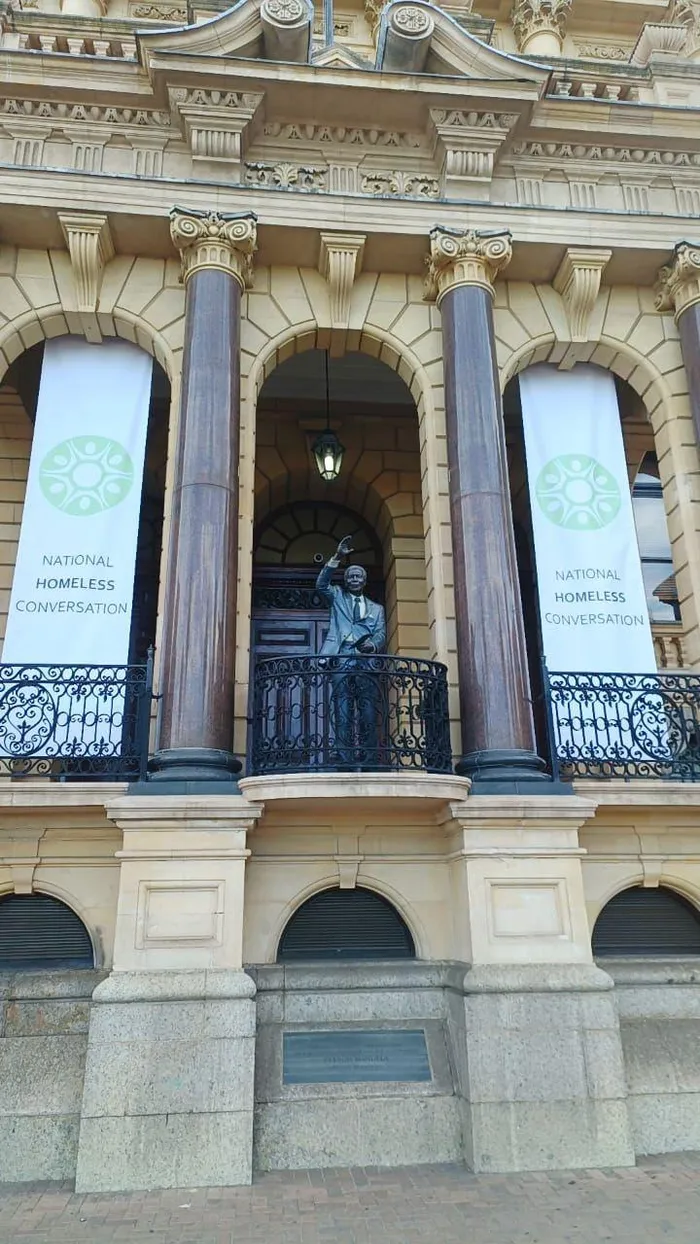
The 9th National Homeless Conversation was held at the Cape Town City Hall
Image: Denis Hurley Centre
Durban's approach to homelessness could be transformed following insights gained at the 9th National Homeless Conversation held in Cape Town earlier this month, where collaboration emerged as the key to effective solutions.
Dr. Raymond Perrier, Director of the Denis Hurley Centre (DHC) in Durban, described the event as a "unique learning opportunity".
Perrier said that 13 people from KwaZulu-Natal attended the conversation. Perrier, who is also a member of the National Homeless Network, said there were over 35 inputs: a mix of presentations, testimonies, workshops and panels. An opportunity, he said, to learn from each other.
Perrier explained that participants could choose to follow one of a number of tracks: partnership, psycho-social support, healthcare and addiction, accommodation and sustainable income. He said that 67 different people gave their inputs, of whom 21 were people with a lived experience of homelessness.
“Delegates had the opportunity to visit different shelters, work projects and drop-in centres in various parts of the city,” he said.
Illa Thompson, who manages the DHC Street Lit programme, said it was brilliant to see the collaboration. “This is an almost unimaginable scenario for so many other regions, including Durban. It reminds us of the huge and frustrating disconnect between the various role players, which inhibits us all from achieving what is necessary,” Thompson said.
During an eThekwini Matters episode in November 2025, the municipality stated that like many other cities across South Africa, eThekwini is also facing the challenge of homelessness, a complex issue that affects lives, strains social systems, and can negatively impact investor confidence and economic growth.
In eThekwini, homeless people have converged around the Albert Park and Umbilo area at the entrance to the Durban CBD from the south, creating a problem for businesses in the area.
A motorist who wished to remain anonymous said the M4 southern freeway offramp to Che Guevara Road, formerly Moore Road, was her worst nightmare. She uses the road at 7:10 am, six days a week, to drop off her spouse at work in Umbilo.
“The drug addicts have no self-respect and defecate on the pavements or roads in full view of the public. You cannot stop at this intersection because they come up to your window and look into your car. I witnessed a car window being smashed once and the person's belongings being removed,” she said.
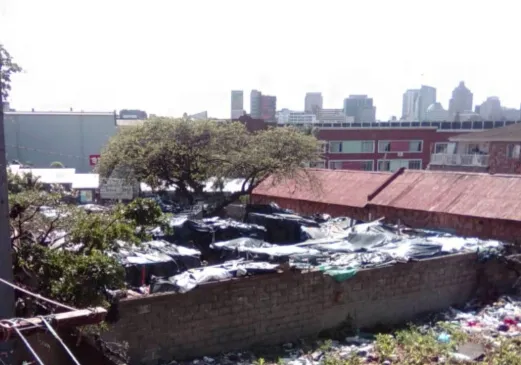
An illegal homeless encampment on Acorn Road and Douglas Lane in Warwick Avenue.
Image: Supplied
Mbongeni Goge, a concerned Durban resident, said there was a mixture of people living on the roadside, including criminals, drug addicts, and thugs. Goge was also worried about young children pretending to be orphans, standing next to the shopping complex doors and roadside, asking for money.
“The municipality needs to engage with police to initiate a project called Operation Go Back Home to clean the city 100%. Police must take decisive action against drug lords, who are harming the lives of people, especially the youth,” he said.
Nomusa Shembe, senior manager of Safer Cities, said that eThekwini leads a bold, holistic programme aimed at restoring dignity, rebuilding lives, and reshaping how the city addresses homelessness.
Shembe noted that, around 2014, a significant number of homeless individuals were found living under a bridge around the Albert Park and Umbilo areas, leading to police involvement. She said the municipality launched the Qalakabusha programme with other stakeholders to address the problem.
Profiling revealed unemployment, drug abuse, and family issues. Shembe said city leadership is actively addressing homelessness with positive interventions. A policy on homelessness is currently being developed and is expected to be completed by December 2025.
She also said the city invested in Sakhithemba, a facility for individuals in recovery and rehabilitation who are already in shelters. Of the 560 people remaining in shelters, some have been reunited with families.
Sakhithemba will provide comprehensive support, including psychosocial services, skills training, health services, and reintegration programmes for families or independent living.
zainul.dawood@inl.co.za