
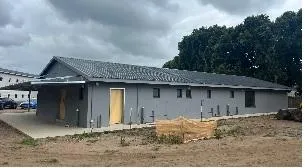
The Sakhithemba Homeless Shelter in Illovo is expected to be completed by November 2026.
Image: eThekwini Municipality
The Sakhithemba Homeless Shelter in Illovo will not resolve Durban’s homelessness if it opens in November 2026.
Dr Raymond Perrier, director of the Denis Hurley Centre in Durban, said that their extensive experience in this sector confirms that none of the homeless on Che Guevara Road should be at Sakhithemba, nor will they want to live in the shelter.
The shelter forms part of eThekwini Municipality’s response to homelessness in the Durban CBD. The project was originally approved on August 26, 2024, as a 400-bed shelter, with a targeted completion by June 2025.
Perrier, who is also a member of the National Homeless Network, believes that the facility would work for those who are already clear of drugs or who have never been addicted.
“It will not work as a rehab site. I am concerned that they are putting 1200 struggling addicts right next door to a primary school. Even if they want to come clean, that is not where you put a rehab centre. Moreover, the municipality has no expertise in running or even overseeing a rehab centre,” Perrier stated.
Residents, businesses, and motorists are concerned about the state of Che Guevara Road (formerly Moore Road) and the lower Warwick Avenue and Umbilo areas.
Drug addicts and homeless people have converged on the area, encroaching on one lane of the road under the M4 southern freeway.
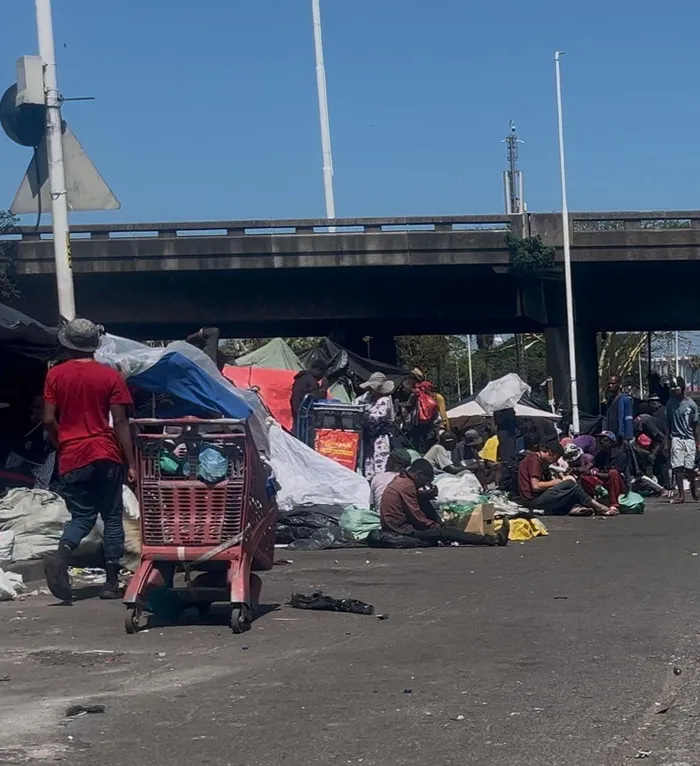
Hundreds of homeless people occupy a pavement under the M4 Southern freeway near Albert Park, at the entrance of the Durban CBD.
Image: Supplied
Businesses were concerned that it was at the entrance to the Durban Port precinct and that customers were being harassed and feared travelling through the area.
Clive Truter, an architect and project manager in the municipality, stated that Sakhithemba was envisioned to be a prototype facility for potential rollout across the municipality.
“During implementation, the project scope was significantly expanded to approximately 1,200 beds, together with the introduction of additional operational facilities like a clinic and an industrial kitchen,” he said.
Truter explained the phased approach adopted to improve implementation efficiency, manage risk relating to contractor capacity, site constraints, and budgetary allowances.
Perrier stressed that there is indeed a problem in Che Guevara Road, but Sakhithemba cannot be claimed as the solution.
“There is no connection between the problem and the solution. Sakhithemba will only work for people who go there voluntarily. It will work if they are willing to stay there and who will behave in what is a small, isolated community. It could work if there is an intense residential training programme for people who have been screened, who have been prepared for training, and are ready for training.”
Perrier added that there are excellent models in other parts of the country for that kind of residential facility.
“They won't stay there. They will not be able to live in a local community. We have seen their behaviour in Umbilo,” he said.
He explained that if it were 200 well-behaved homeless people, it would be alright, but the shelter is now expected to cater to 1,200 people.
“This isn't just six times the problem; it's sixty times the problem.”
Perrier said that the municipality needs to make productive use of the facility on which they spent a few million.
“If someone has a headache, you don't give them a suppository because that is all you have. The Che Guevara group is deeply addicted.”
zainul.dawood@inl.co.za