
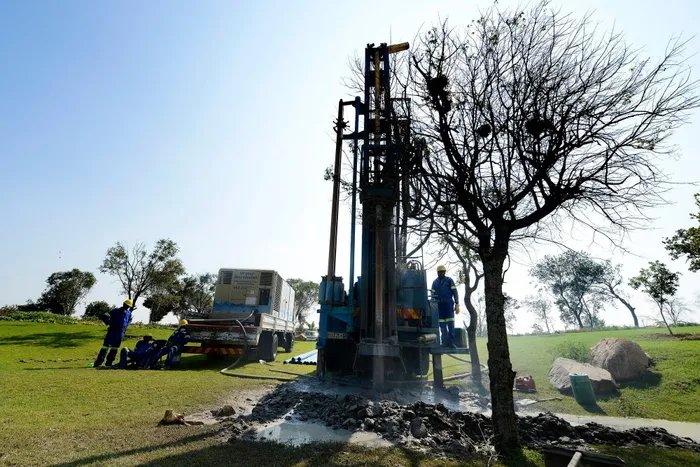
Innovative solutions: The role of boreholes in alleviating water shortages in KZN.
Image: Paballo Thekiso / Independent Newspapers
The KwaZulu-Natal Cooperative Governance and Traditional Affairs (CoGTA) Department has outlined a multi-phased strategy to tackle the province’s persistent water crisis.
KZN CoGTA Deputy Director-General (Development and Planning) Barbara Mgutshini explained that to address the gaps, in terms of municipalities, the Water Services Authorities (WSAs) have outlined their short-term, medium-term, and long-term interventions.
She said each WSA has outlined the wards without water and what they are doing in terms of those wards without water. This is according to the water master plan that they developed.
“In terms of the short-term, municipalities are saying they are going to be drilling boreholes. They are also going to be doing water tankering as a short-term intervention, and in the long term, the acceleration of the programmes that are under way, including your water conservation and demand management programmes and the borehole interventions,” Mgutshini said.
Regarding water access, some municipalities are facing vandalism and theft, demand exceeds supply, illegal connections, imminent water supply due to population growth, water leaks, ageing infrastructure, inadequate bulk water supply, and no existing infrastructure, among others.
Short-term interventions for hotspots per WSA include water shedding, water tankers, borehole drilling, Section 63 interventions, water rationing, and water meter restriction installation, among others. While medium to long-term interventions include water conservation, reservoir construction, and construction of water supply schemes, etc.
In terms of KZN’s water crisis, Mgutshini reflected on what needed to be done in terms of short-term, medium-term, and long-term. This also aligns with the National Water Crisis Committee interventions.
“The highlight is the issue of the need to establish the sub-committee on water, as well as the need to resuscitate war rooms and the deployment of specialists to those weak municipalities that require urgent support,” Mgutshini said about immediate interventions on stabilisation and compliance.
Medium-term interventions include capacity and delivery, such as establishing shared engineering teams, accelerating non-revenue water (NRW) programme rollout: leak detection and metering, and implementing Water Indaba resolutions.
Then long-term interventions for resilience and reform, actions include accelerating the uMkhomazi and uMgeni system augmentation, investing in energy backup at critical systems and institutional reform.
Mgutshini said there are budgets (grant allocations) available in the sector to address the challenges, adding that among others, budgets range from the Water Services Infrastructure Grant (WSIG), the Regional Bulk Infrastructure Grant (RBIG), and the Municipal Infrastructure Grant (MIG).
According to her, there is about R10 billion in the sector to address water.
Mgutshini highlighted that groundwater is not fully utilised.
“We’ve got about 1.38 billion cubic meters per annum of groundwater. What has been abstracted to date is only 34 million cubic meters, and there is a status of 1.34 billion cubic meters that are still to be explored utilising the boreholes.
“Where demand exceeds supply in the water resources in terms of rivers and dams, we do have groundwater exploration that we do.”
Among the recommendations, Mgutshini said there is a need for WSAs to accelerate investment in their own water tankers, with the aim of eradicating the use of hired water tankers in the next two years.
“The municipalities (King Cetshwayo District, Ugu, uMgungundlovu, and Zululand) that are hiring, we are also making a proposal for them to develop a water tankering reduction plan by June 2026 to reduce the high number of water tankering that’s currently in place,” Mgutshini said.
She said to support the use of uMngeni-uThukela Water and uMngeni Water Services, where feasible, for the implementation of a provincial programme to address water losses in hotspots.
UMgungundlovu District Municipality Mayor Mzi Zuma highlighted infrastructure vandalism, saying it borders on economic sabotage.
He said the municipality has seen continuous increases since early 2024. They report cases and engage with SAPS leadership at their level.
“We’re only highlighting so that it becomes a focal point at all levels because it complicates the problem that is already there. When we see deliberate actions of vandalising infrastructure, which in our view borders on economic sabotage,” Zuma said.
thobeka.ngema@inl.co.za