
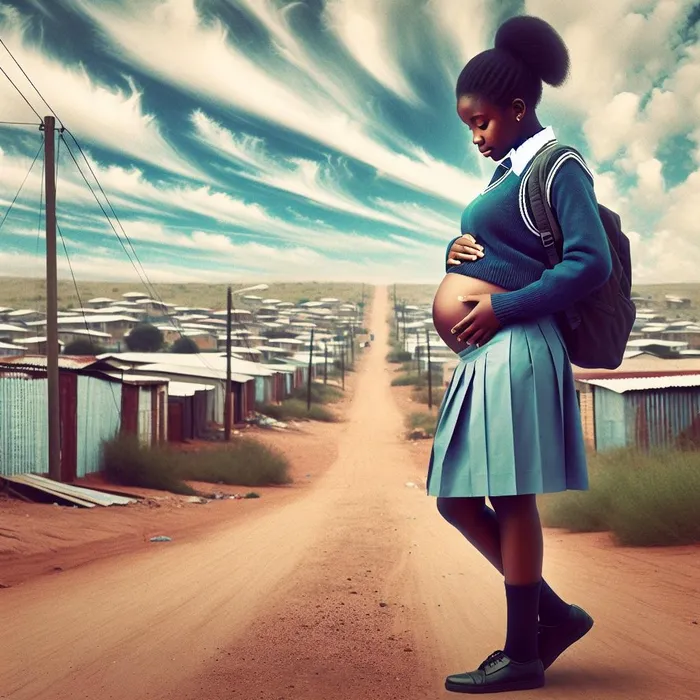
A pregnant schoolgirl in KwaZulu-Natal: A stark reminder of the challenges faced by children in today’s society.
Image: IOL / Ron AI
The KwaZulu-Natal Department of Health has disclosed the causes behind the alarming rates of child and teenage pregnancies recorded during the 2025/26 financial year.
The data shows 421 children aged 10 to 14 became pregnant, the youngest being just 10. Furthermore, a total of 28,108 pregnancies were reported among teenagers aged 15 to 19.
Childline KZN Director Adeshini Naicker previously expressed concern that the statistics indicate issues of abuse, exploitation, poverty, limited contraceptive access, educational gaps, lack of youth support, inequality, unsafe environments, and limited youth-friendly services.
The uThukela Health District Office’s Thabisile Hlatshwayo said there are several causes, and in no particular order, they are:
Experimenting: A growing number of children are experimenting with content they see on social media or in age-inappropriate TV programmes.
“As parents, we do not ensure that our children avoid watching it. They watch it. They even watch things that are old and beyond their comprehension. Sometimes they watch it while we are present, and we end up getting embarrassed in the house. That also has an impact because there are many things they watch there that they should really not be seeing,” Hlatshwayo said.
Peer pressure: It significantly influences young people due to their friendships. Conversations and shared desires often lead individuals to pursue activities simply because their peers are doing them.
Family-related issues: One of which is that parents do not communicate with children.
“I don’t understand why we, as black people, struggle to communicate with our children, especially about sexual matters; we are afraid of them. That is how it is, so they escape us because we do not talk to them about things we should have talked about with them,” Hlatshwayo said.
Lack of communication: Sometimes, children do not have the information. However, it is surprising because they are smart, and can use Google, but the right information they should see, they do not look at.
“The information is often available; there is plenty of information actually. It is talked about in clinics, in the community, the issue of young people getting pregnant, it is talked about, people should really know about it, and our children should know about it,” Hlatshwayo said.
Poverty: Children engage in sex because they need certain things (for entertainment, cellphones, or money) due to poverty.
“Some (parents) really live by being supported by their children, who go and have sex and come back with something, and they live in that house,” Hlatshwayo said.
Alcohol and drug abuse: Children drink and take drugs and engage in sex without planning.
“They are young, and they engage in drug use and drinking. All those things that contribute to them ending up pregnant, sometimes they do not even know who they slept with,” Hlatshwayo said.
Gender-based violence (GBV): There are conversations around GBV, and the department strongly condemns it; it is abuse.
“Some find that they are impregnated by family members, some by older people, some by their peers, and others do not even plan this pregnancy; you find that they are forced into sex in that way,” Hlatshwayo said.
She said that in rural districts, there is still the practice of ukuthwala (abducting children and marrying them off young).
“You find that the child is still young, 17 years old, 16 years old, they have been abducted and placed in a home, they are now a bride, they must now have a child. They are not ready mentally, and they are not ready physically, because of cows,” Hlatshwayo said.
She added that children are encouraged to wait before having sex. However, the department has male and female condoms and family planning tools. There are pills, injections, implants, the loop, and IUDs.
“I strongly urge our community that these children of ours, we as a community, we as parents. Let’s ensure we talk to them because if we do not talk to them, someone outside will talk to them and say the wrong things.
“To the children, I strongly ask that they come closer to the clinics. There are all the resources and counselling.”
thobeka.ngema@inl.co.za