
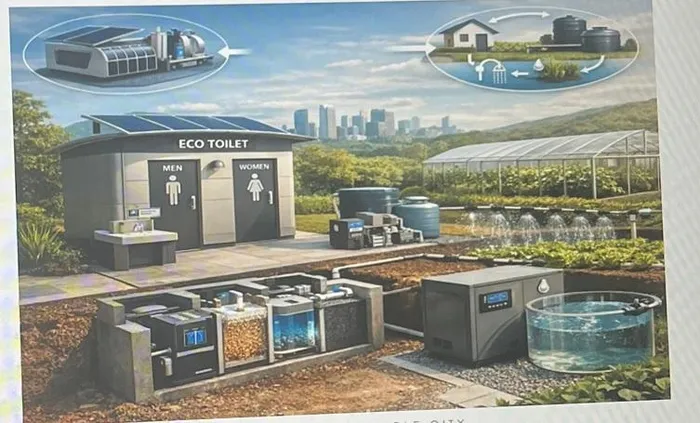
An image of an eco toilet, a proposed non-sewered sanitation and water efficient sanitation solution system in the eThekwini Municipality.
Image: Supplied
The eThekwini Data Intelligent Assistant (EDINA) project could resolve sewer reticulation and water consumption issues once implemented.
The EDINA project is set to revolutionise service delivery in the Water and Sanitation (EWS) Directorate using smart toilets, robots, and Artificial Intelligence (AI). The EDINA also provides municipal management with real-time data for improved decision-making in water and sanitation management.
As part of digital transformation, the EWS introduced EDINA to the eThekwini Executive Committee (Exco) on Tuesday.
EWS's Nedon Ramsuran showcased how the platform provides unified insights to support smarter, more responsive governance.
“Developed by EWS technical staff with assistance from Microsoft, EDINA is an AI-powered executive assistant that gives municipal leaders instant access to integrated, real-time information,” Ramsuran explained.
He added that the platform connects previously siloed systems and presents data through a simple, conversational interface, making it easier for decision-makers to access critical insights when needed. He said it will improve operational efficiency and effectively respond to service delivery challenges.
Ramsuran explained that EWS is implementing technology-driven approaches focusing on both conventional and non-conventional sanitation systems, including Non-Sewered Sanitation (NSS) and Water Efficient Sanitation Solutions (WESS).
“These solutions provide resilient, modular, and low-water-use alternatives designed to meet the needs of diverse communities, particularly in areas where conventional sewer infrastructure is limited or not feasible,” he said.
Ramsuran said this includes robotic cleaning for sewer systems and using recycled effluent for high-pressure jetting. These innovations are expected to improve maintenance efficiency, reduce operational costs, and promote sustainable water use.
Ramsuran explained that this technology will also assist in identifying the composition of blockages and wastewater conditions, enabling faster responses. Since 2017, 19 non-sewered sanitation prototypes underwent field testing in Durban in diverse urban settings, revealing operational and lifecycle insights.
Ramsuran said that around 600 informal settlements and 32 transit camps with difficult constraints make conventional sewer systems unfeasible. Approximately 250,000 dwellings require sanitation services, 70,000 of which can be achieved through NSS and WESS.
Regarding sewer monitoring, Ramsuran explained that a ball-shaped device traverses the sewer system to detect illegal connections, blockage build-up, and pipeline defects.
“We have trucks that take water from a fire hydrant to help clear a blocked pipeline with high pressure. With the new technology, we will not use clean drinkable water to clean a sewer line. This saves us on non-revenue water.”
Sandile Mahlaba from Microsoft South Africa regarded it as a winning solution. Mahlaba said he was assisting the municipality's engineers with the project.
Ednick Msweli, the executive director for the Technical Services Department, reminded the committee that the EWS has sterling employees, including those who helped the city win the 2014 Stockholm Industry Water Award from the Stockholm International Water Institute (SIWI), as the most innovative and progressive water utility in Africa.
Andre Beetge, DA eThekwini councillor, said the internal development was enlightening and refreshing and could save the municipality money.
Beetge hoped the technology would be implemented in the municipality soon.
ANC Councillor Snegugu Sishange, also an Exco member, said that municipal staff must be trained to use the technology
Sibusiso Vilane, acting director for the Water and Sanitation Directorate, said the latest technology would not replace people on the ground, but groundbreaking technology, including the robots in the sewer system, will minimise the health impact of humans.
He said that training workshops would be held.
Musa Mbhele, eThekwini city manager, said the municipality needed to phase out doing things manually in the age of technology and that this will improve service delivery.
zainul.dawood@inl.co.za