
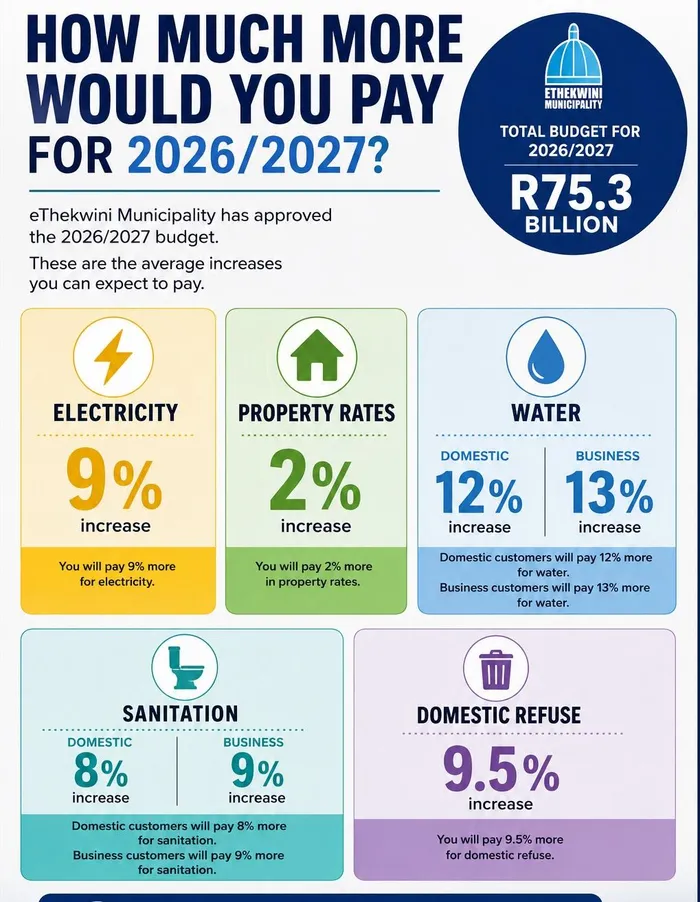
The eThekwini Municipality's budget for the 2026/27 financial year was approved by municipal councillors on Friday.
Image: ChatGPT
The eThekwini Municipality's R75.3 billion budget and tariff increases for 2026/27 were approved during a council meeting on Friday.
The tariff increases include electricity (9%), property rates (2%), water (domestic 12% and business 13%), sanitation (8% for domestic and 9% for business), and domestic refuse (9.5%) from July 1, 2026. Councillors also approved the Integrated Development Plan (IDP).
eThekwini Mayor Cyril Xaba said the budget focuses on the Trading Services Reforms initiated by the National Treasury for the next five years.
He said this will ensure trading services return to profitability and continuously fund non-revenue-generating municipal mandates.
Xaba said the budget was developed within an overall planning framework, including programmes and projects to achieve the city's strategic objectives and address the turnaround strategy for trading services.
Xaba said that amendments to the tabled tariffs for 2026/27 were made after considering comments from budget consultations.
“The municipality noted comments made during public participation, including concerns about tariff unaffordability, poor service delivery, prolonged water and electricity outages, sewer spillages, insufficient youth programmes, and an ineffective informal settlement plan,” he stated.
Also of concern to political parties in eThekwini was the infrastructure surcharge of R1.50 per K/L for water and for sewage disposal until 2029.
The Durban Marine Theme Park will receive R408 million, of which R80.4 million will be for the 2026/27 financial year operations.
Regarding the housing and hostel deficit, the estimated formal and housing deficit of R126.3 million and the new development housing and hostels deficit of R322.3 million should be funded from the rate fund.
Councillor Yogis Govender, DA eThekwini chief whip, said billions vanished from the ledger while projects remain incomplete.
She said residents are bearing the economic strain as municipal losses are forcefully injected into household budgets through unmanageable tariffs.
Dr Jonathan Annipen, IFP eThekwini councillor, said the tariff increases are at a time when ratepayers are receiving less value for money they contribute to the municipality.
“The reality faced by residents is not the reality reflected in glossy budget documents. The lived experience of our people is one of ageing infrastructure, a staggering 59% non-revenue water loss, an ongoing billing crisis that continues to financially cripple households and businesses, and frequent water and electricity outages that have become part of daily life,” he said.
Sunitha Maharaj, Minority Front eThekwini councillor, said she was not convinced the budget would deliver on key service delivery priorities because the municipality has a track record of returning grants due to poor planning.
Zwakele Maxwell Mncwango, ActionSA councillor, said they voted against eThekwini’s 2026/27 budget because it required residents to pay more, while failing to address the fundamental causes of the municipality’s financial and service delivery crisis.
Themba Mvubu, EFF eThekwini councillor, said they will ensure the money is put to good use and that projects are well coordinated through oversight committees.
zainul.dawood@inl.co.za