
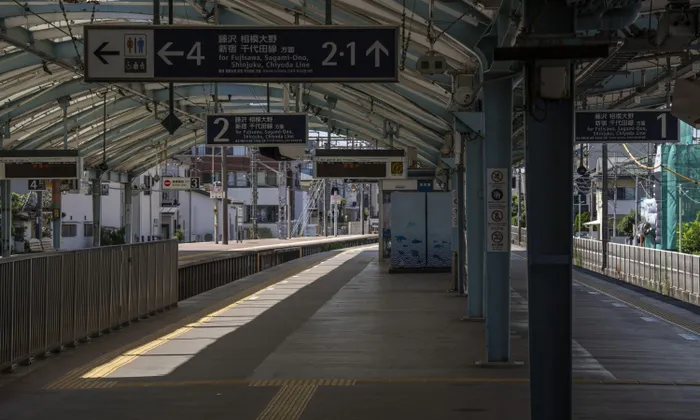
Parts of the Shinkansen bullet train network were suspended following the quake.
Image: YUICHI YAMAZAKI / AFP
A strong 6.2-magnitude earthquake shook western Japan on Tuesday, but no tsunami warning was issued, and no major damage was reported.
The tremor was recorded at 10:18 am (local time) in Shimane prefecture at a shallow depth, the Japan Meteorological Agency (JMA) said.
The US Geological Survey recorded a slightly lower 5.8 magnitude reading, which it then lowered to 5.7.
The quake measured upper-five on Japan's Shindo scale of shakiness in the western city of Yasugi.
At that level, heavy furniture may fall, and drivers can have trouble steering.
The JMA said that the same region was hit soon afterwards by smaller quakes with magnitudes of 4.5, 5.1, 3.8 and 5.4, also with no tsunami alerts.
No abnormalities were detected at the Shimane nuclear plant as of 10:45 am, broadcaster NHK said, citing utility company Chugoku Electric.
Parts of the Shinkansen bullet train network were suspended due to a power blackout, operator JR West said. It was unclear if this was related to the quakes.
The military said it was conducting an aerial damage assessment and had established a disaster response liaison office.
"The government is collecting information on damage... People in the regions that were hit by strong shakes please continue to be careful about more quakes of the same strength," Prime Minister Sanae Takaichi said.
Japan sits on top of four major tectonic plates along the western edge of the Pacific "Ring of Fire" and is one of the world's most seismically active countries.
The archipelago, home to around 125 million people, experiences around 1,500 jolts every year.
The vast majority are mild, although the damage they cause varies according to their location and depth.
Japan is haunted by the memory of a massive 9.0-magnitude undersea quake in 2011, which triggered a tsunami that killed around 18,500 people.
In 2024, the JMA issued its first special advisory of a possible "megaquake" along the Nankai Trough.
This 800-kilometre undersea trench is where the Philippine Sea oceanic tectonic plate is "subducting" -- or slowly slipping -- underneath the continental plate that Japan sits atop.
The government has said a quake in the Nankai Trough and subsequent tsunami could kill as many as 298,000 people and cause up to $2 trillion in damages.
The JMA lifted the 2024 advisory after a week but it led to panic-buying of staples like rice and prompted holidaymakers to cancel hotel reservations.
It issued a week-long second "megaquake" advisory in December 2025 after a magnitude-7.5 tremor struck off the northern coast.
The December 8 quake triggered tsunami waves of up to 70 centimetres (28 inches) and injured more than 40 people, but no major damage was reported.
A Japanese nuclear plant operator said it may have presented data underestimating earthquake risks to regulators, as Japan moves to revive nuclear power nearly 15 years after the Fukushima disaster.
Chubu Electric Power's Hamaoka plant - located in an area of central Japan at risk of a potential "megaquake" - is undergoing regulatory safety checks, with the aim of restarting two reactors.
But the company's president said late Monday that the estimated maximum seismic ground motion that the plant could experience during a quake "may have been underestimated".
"This incident could seriously affect the (safety) review process and undermine the trust of local communities and other stakeholders in our nuclear business, and potentially shake its very foundation," he told reporters during an emergency press conference.
Japan pulled the plug on nuclear power after a colossal earthquake and tsunami sent three reactors at the Fukushima atomic plant into meltdown in 2011.
However, the resource-poor nation now wants to revive atomic energy to reduce its heavy dependence on fossil fuels, achieve carbon neutrality by 2050 and meet growing energy needs from artificial intelligence.
The world's biggest nuclear plant, Kashiwazaki-Kariwa, is expected to restart operations later this month, pending final approval from the Nuclear Regulation Authority (NRA).
The estimate of maximum seismic ground motion is important for the earthquake-resistant design of nuclear plants.
In September 2023 the NRA approved Chubu Electric's estimate of 1,200 gal, a unit of acceleration used to measure the intensity of quakes.
But in February last year the NRA received information from a whistleblower that the utility "may have used data different from what was presented" to the nuclear watchdog, NRA official Keiichi Watanabe told AFP on Tuesday.
Since then, the watchdog has been conducting its own probe, he said.
The NRA suspended its safety review process for the Hamaoka plant in late December, and the issue "will be discussed in meetings open to the public", the first of which will be held on Wednesday, he said.
The Hamaoka plant is located in Omaezaki, Shizuoka prefecture, near a seismic fault line where a massive Pacific earthquake is expected to occur in the coming years or decades.
In 2024, the Japan Meteorological Agency issued its first special advisory for a possible "megaquake" in the area, known as the Nankai Trough, before lifting it a week later.
The government has said a quake in the 800-kilometre undersea trench and subsequent tsunami could kill as many as 298,000 people and cause up to $2 trillion in damages.
Chubu Electric said it had set up a panel of lawyers to look into the matter.
AFP