
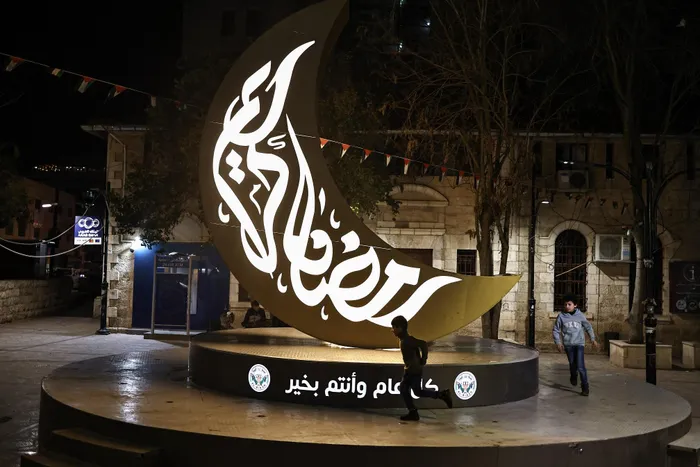
Children play near a lit decoration in the shape of a crescent moon installed at the City Walk during the Muslim holy fasting month of Ramadaan, in Ramallah, West Bank.
Image: AFP
Palestinians in Gaza and the West Bank were preparing to mark the Muslim holy month of Ramadaan, to begin yesterday or today, amid ongoing violence and rising tensions.
Many describe it as another “sad Ramadaan” as humanitarian conditions in Palestine worsen.
Although a ceasefire has been in place in Gaza since October 2025, Israeli strikes have continued. At the weekend, 11 Palestinians were killed across the enclave, according to medical officials and local authorities, in what they described as the latest violations of the truce.
In Gaza City, the once-bustling Zawiya market in the Old City was largely empty, with goods left unsold on shop shelves.
Sameh al-Bitar, 40, who owns a spice shop, said he misses the festive atmosphere of past Ramadaans.
“We used to decorate our homes, streets, and markets,” he said. “Now everything in Gaza is sad.”Al-Bitar said he lost two sons in an airstrike. “The war has not ended,” he said. “Every day there are violations, deaths, and injuries.”
He said he expects this year’s Ramadaan to be limited to basic religious observance, without the family visits and communal iftars that once marked the month.
Gaza’s health authorities say 603 Palestinians have been killed and 1 618 wounded since the ceasefire began on October 10, 2025, bringing the total death toll since October 2023 to more than 72 000, with over 171 000 wounded.
In the West Bank and East Jerusalem, Palestinians fear Ramadaan could bring tighter security and possible clashes.
Israeli forces have continued raids and arrests across cities and refugee camps, while military checkpoints have been reinforced at the entrances to towns and villages, affecting daily life ahead of the holiday.
Cities including Nablus, Jenin, and Tulkarm have seen sporadic confrontations between Palestinian youths and Israeli forces. Residents report frequent nighttime raids, arrests, settlement expansion, and land confiscations.
Tensions are especially high around sensitive religious sites.
In the southern West Bank city of Hebron, residents say access to the Ibrahimi Mosque is already restricted due to a heavy Israeli military presence and its location near Jewish settlement enclaves. Checkpoints around the mosque, which typically tighten during Ramadaan, limit entry for worshippers and sometimes impose age restrictions.
“All indications point to a very difficult Ramadan,” said Saeed al-Awiwi, 50, who lives near the mosque. He cited fears of increased settler attacks under army protection.
In Jerusalem’s Old City, 22-year-old Abdul Rahmaan al-Alami said he worries that young people could be barred from praying at Al-Aqsa Mosque.
“Only a few days remain, and people our age may be prevented from entering,” he said near Damascus Gate. He added that authorities often erect barriers, install electronic gates, and conduct searches during Ramadaan.
Xinhua