
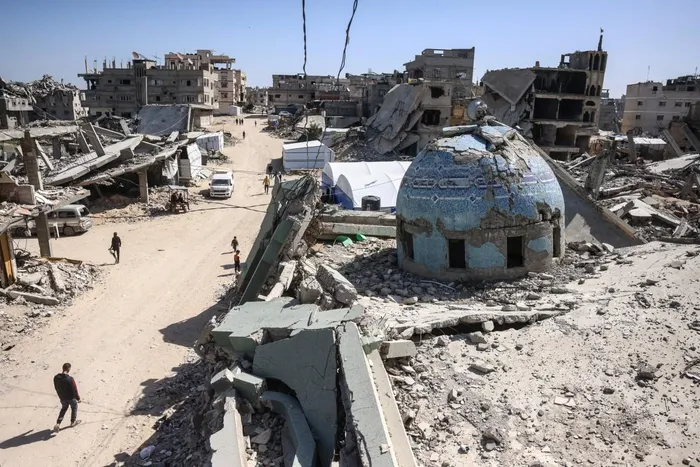
Displaced Palestinians walk past the destroyed Al-Huda Mosque on the first Friday noon prayers of the holy month of Ramadan, in Khan Yunis in the southern Gaza Strip.
Image: Bashar Taleb/AFP
Since October 2023, tens of thousands of Palestinians have been killed in Gaza, with the latest death toll being over 75,000 according to a new study.
Lancet Global Health research suggests more than 75,000 killed during the first 16 months of the war, which is 25,000 more than initially estimated.
According to the Gaza Ministry of Health, several victims are still under rubble and on roads, with ambulances and medics unable to reach them.
Now, a major investigation by Al Jazeera, drawing on data from Gaza’s Civil Defence teams, has revealed that at least 2,842 cases of Palestinian victims have "evaporated" during Israeli strikes.
Rescue teams officially classify individuals as "evaporated" only after a method of elimination is applied: if exhaustive searches of the rubble, hospitals, and morgues yield no intact bodies, and only biological traces like blood spray, scalps, or small tissue fragments are found, the victims are determined to have been obliterated by the blast.
So how can this happen, and more importantly, why is it allowed to happen?
How does a human body simply disappear? The answer lies in the extreme temperatures generated by specific munitions and the biological makeup of the human body, which is roughly 80 percent water.
According to Dr. Munir al-Bursh, the director general of the Palestinian Ministry of Health in Gaza, the reaction is absolute. "When a body is exposed to energy exceeding 3,000 degrees combined with massive pressure and oxidation, the fluids boil instantly. The tissues vaporise and turn to ash. It is chemically inevitable," he explains.
Unlike conventional explosives that simply detonate, these weapons operate in a devastating multi-stage process.
1. Dispersion: The weapon first releases a cloud of combustible fuel in the form of gas, aerosol, or fine powder into the surrounding air.
2. Ignition and vacuum: This fuel cloud mixes with atmospheric oxygen and is subsequently ignited, creating an enormous fireball and a vacuum effect.
3. Extreme heat: To artificially prolong the burning time, chemical powders such as aluminum, magnesium, and titanium are added to the mixture. This raises the explosion temperature to between 2,500 and 3,000 degrees Celsius (4,532 to 5,432 degrees Fahrenheit).
These weapons are particularly devastating when used in confined spaces like buildings and underground structures, where the reflected pressure waves multiply their force.
Investigations have identified several specific US-manufactured munitions used by Israeli forces in Gaza that are linked to these disappearances:
The MK-84 ‘Hammer' is a massive 900kg unguided bomb. It is packed with tritonal—a mixture of TNT and aluminium powder—that allows it to generate heat up to 3,500°C.
GBU-39 Precision Glide Bomb is packed with AFX-757 explosive and was notably used in the deadly al-Tabin school attack.
It is believed that the GBU-39 is engineered to keep a building's outer structure relatively intact while destroying everything inside. This is because it kills via a pressure wave that ruptures lungs and a thermal wave that incinerates soft tissue.
BLU-109 Bunker Buster was used in an attack on the al-Mawasi "safe zone," and evaporated 22 people. It features a steel casing and a delayed fuse, burying itself in the ground before detonating. This creates a massive fireball inside enclosed spaces, incinerating everything within reach.
Despite how inhumane it is and the damage it does, thermobaric weapons are not specifically banned under international law.
Unlike chemical weapons or cluster bombs, which are outlawed under treaties such as the Chemical Weapons Convention and the Convention on Cluster Munitions, thermobaric weapons are classified as conventional explosives. There is currently no international treaty that prohibits them outright.
Instead, their use is governed by the broader rules of war set out in the Geneva Conventions and their Additional Protocols.
Under those rules:
In short, thermobaric weapons are not illegal by default. Whether their use is lawful depends on how and where they are deployed — particularly in densely populated areas, where civilian risks are higher.
No international court has ruled that thermobaric weapons are inherently unlawful.
IOL