
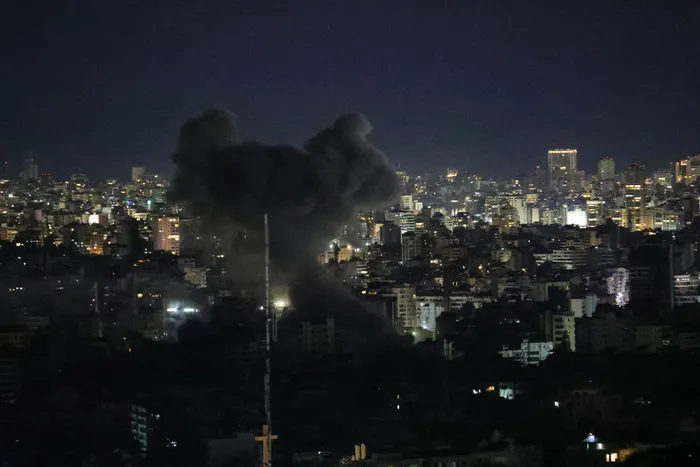
Smoke rises from the site of an Israeli airstrike that targeted an area in Beirut’s southern suburbs late on March 10, 2026.
Image: AFP
Iran unleashed a wave of attacks against Israel and Gulf nations on Wednesday, including targeting a Saudi oilfield, as reports of a proposed record release of oil reserves helped calm markets and prices.
The war sparked by US-Israeli strikes on Iran has spread across the region and beyond, causing spiking energy costs, fuel rationing, and even school closures.
G7 leaders will meet by video conference later Wednesday to discuss the war's economic consequences, particularly the "energy situation," the French presidency said, and the International Energy Agency will decide on a proposal for its largest-ever oil reserve release, the Wall Street Journal reported.
The United States on Tuesday said it was hitting Iranian ships capable of mining the Strait of Hormuz, the crucial passageway for oil that has been effectively closed by Iranian threats.
The US military posted video footage of Iranian boats blasted apart, saying it had destroyed 16 minelayers near the strait through which one-fifth of the world's oil passes.
"If for any reason mines were placed, and they are not removed forthwith, the Military consequences to Iran will be at a level never seen before," President Donald Trump wrote on social media.
Iranian authorities warned against dissent at home, with the country's police chief saying protesters will be be viewed and dealt with as "enemies".
"All our forces are also ready, with their hands on the trigger, prepared to defend their revolution," said national police chief Ahmad-Reza Radan in comments aired by IRIB.
Tehran also intensified its assault on targets in the region, with the government announcing it carried out its own "most intense and heaviest" salvo, firing missiles for three hours at cities across Israel.
AFP journalists heard air raid sirens and explosions in Jerusalem. Emergency services reported no immediate injuries, although Channel 12 said several people were hurt in Tel Aviv. New salvos were reported early on Wednesday, with no reports of injuries.
Iran's Revolutionary Guards said they also fired on Bahrain and Iraqi Kurdistan, both of which have a heavy US presence, and also targeted a US air base in Kuwait, Iranian media said.
Kuwait said it had downed eight drones, without offering further details.
Drones and ballistic missiles were also intercepted elsewhere in the Gulf, including multiple drones heading to the Shaybah oil field in Saudi Arabia, its defence ministry said.
Earlier, Iranian parliament speaker Mohammad Bagher Ghalibaf, a former top commander in the elite Revolutionary Guards, said in an English-language post on X: "Certainly we aren't seeking a ceasefire."
"We believe the aggressor must be punished and taught a lesson that will deter them from attacking Iran again," he added.
A container ship was hit off the coast of the United Arab Emirates by an unidentified projectile, a British maritime security agency reported on Wednesday, adding that the extent of the damage was unknown but all crew members were safe.
Saudi Arabia said it had intercepted six ballistic missiles launched on Wednesday toward Prince Sultan Air Base and a seventh missile headed towards the country's east.
It said it had also intercepted seven drones heading towards an oil field in the southeast of the country and eight more in the country's east.
Iran's Revolutionary Guards said that at least two missiles targeted a United States base in Kuwait, according to Iranian news agencies Fars and Mehr.
Kuwaiti authorities have not yet commented on the reports.
The US military said it had destroyed 16 mine-laying Iranian boats near the Strait of Hormuz, after President Donald Trump warned of a drastic escalation if Iran moved to mine the pivotal waterway.
Iran accused Israel of killing four of its diplomats in a weekend strike on a seafront Beirut hotel in what it called a "terrorist attack".
The Israeli military previously said it had "conducted a precise strike targeting key commanders" in the Iranian Revolutionary Guards' Quds Force, its foreign operations arm.
Fresh Israeli strikes hit Beirut's southern suburbs and south Lebanon after the Israeli army warned people to evacuate, with Lebanese authorities saying nearly 760,000 people had been registered as displaced.
Lebanon was drawn into war last week when Iran-backed militant group Hezbollah attacked Israel in response to the killing of Iranian supreme leader Ayatollah Ali Khamenei in US-Israeli strikes.
The United States has not escorted any oil tanker through the Strait of Hormuz, the White House said, after the energy secretary's social media account posted and deleted a claim that it did so.
The shift in narrative caused markets to swing, with oil dropping sharply after Energy Secretary Chris Wright's initial post.
Iran's intelligence ministry announced the arrests of 30 people accused of spying "on behalf of two Persian Gulf countries in the name of the American-Zionist enemy".
Those arrested included one foreigner, whose nationality was not revealed.
One of the world's biggest oil refineries, the Ruwais facility in the United Arab Emirates, halted operations as a "precaution" following a drone attack on the industrial complex housing it, a source told AFP.
AFP