
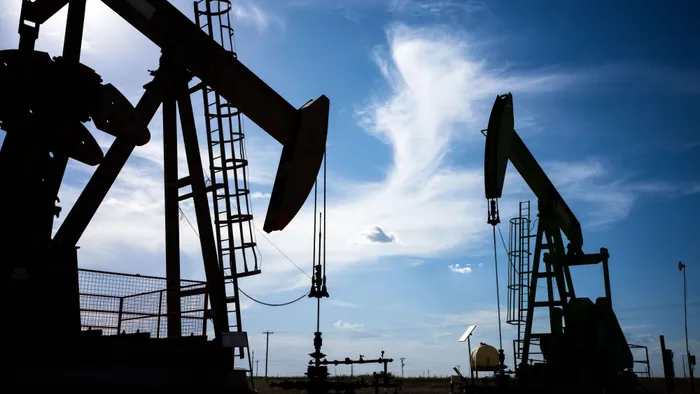
Rising international oil prices are a serious threat to the global economy.
Image: AFP
Oil prices soared back above $100 on Thursday as Iran's fresh attempts to hit supplies in the Middle East and threats to bring down the global economy overshadowed a record release of strategic crude by the International Energy Agency.
As the US-Israel strikes on the Islamic Republic approached their third week, the conflict showed no signs of letting up, with Tehran responding with more retaliatory attacks across the Gulf.
The IEA said Wednesday that its members had agreed to unlock 400 million barrels of oil from their reserves — their largest release ever — with 172 million coming from the United States.
However, the move was unable to overcome fears about the choking of energy supplies from the Middle East, with the Strait of Hormuz — through which a fifth of global crude passes — effectively shut down.
As Iran steps up attempts to disrupt supplies across the region, two tankers in Iraqi waters were reported to have been struck on Thursday. Baghdad had already said it was cutting output because of the crisis, with Kuwait and kingpin Saudi Arabia following suit.
Also, on Thursday, Bahrain reported Iran had carried out an attack on fuel tanks in the country, while Saudi Arabia said it had intercepted drones headed to the Shaybah oil field.
ALSO READ: R6 diesel hike now on the cards: Latest fuel price prediction for April
Both main crude contracts soared. Brent jumped more than nine percent to hit as high as $101.59 a barrel, while WTI spiked at just short of $96.
And with hostilities showing no sign of ending, analysts warned $90-$100 a barrel could be the new normal for a while.
Iran said it was ready for a long war of attrition that would "destroy" the world economy, after firing on two commercial ships and threatening any vessels from the United States or its allies.
The Revolutionary Guards warned on Wednesday they would strike "economic centres and banks" linked to US and Israeli interests.
The United States and Israel "must consider the possibility that they will be engaged in a long-term war of attrition that will destroy the entire American economy and the world economy", Ali Fadavi, an adviser to the Guards' commander-in-chief, told state television.
Analysts warn that a prolonged disruption to shipping through the strait — which also carries roughly a third of the fertiliser used in global food production — would deliver a severe economic shock, particularly in Asia and Europe.
Among those badly hit are airlines, with many having to rethink flights through the Middle East, while the rising cost of fuel hits their bottom line. Air New Zealand said Thursday it would cut 1,100 flights over the next two months.
The surge in oil prices has fanned fresh fears about another spike in inflation and warnings that central banks might have to hike interest rates again, having been contemplating cuts just last month.
That has weighed on equities, which resumed their retreat Thursday.
A projectile struck a container ship near the United Arab Emirates on Thursday, causing a small fire onboard, the UK maritime agency said, adding the ship's crew had been reported as safe.
Three crew members believed to be trapped aboard a Thai bulk carrier hit by projectiles while travelling through the crucial Strait of Hormuz were yet to be rescued on Thursday, the vessel's owner said.
Bahrain told residents to stay home after an Iranian attack on fuel tanks on Thursday in Muharraq Governorate, one of the country's four administrative governorates.
Saudi Arabia's defence ministry said it had intercepted and destroyed two drones headed toward the Shaybah oil field in the southeast of the country.
Earlier Thursday, the ministry said it shot down one drone approaching a district housing foreign embassies, and another in the eastern region.
Kuwait's defence ministry also said it had intercepted several drones.
State media reported a fire in a residential building, resulting in two injuries.
The Israeli military said a new wave of missiles was heading for Israel, following an earlier wave of strikes that coincided with Israeli strikes on Tehran and Beirut.
It said it had deployed air defences to intercept them.
In response, Israel said it was carrying out "wide-scale" strikes on Tehran and a Hezbollah stronghold in Beirut.
An air strike targeting a base in northern Iraq killed at least two fighters, several sources told AFP.
The Lebanese health ministry said that seven people were killed and 21 injured in an Israeli strike on the seafront area of Beirut, where some displaced people have been sleeping out in the open, hours after another attack in the heart of the capital.
President Donald Trump reiterated his insistence that US strikes on Iran had already practically defeated the Islamic Republic.
"They are pretty much at the end of the line," Trump told reporters, after delivering a speech to supporters in which he declared: "We've won...We won -- in the first hour it was over."
Two oil tankers were attacked off Iraq's coast, government officials told the INA news agency, as state television broadcast images of a ship engulfed in flames.
At least one crew member of a ship was killed and several were missing, while 38 people had been rescued, port authorities said.
Iran's Revolutionary Guards said they had carried out a joint missile operation with Lebanese ally Hezbollah against targets in Israel.
The statement came after Hezbollah said it had launched dozens of rockets and advanced missiles at northern Israel.
The opening week of the war against Iran cost the United States military more than $11.3 billion (R187bn), lawmakers were told in a Pentagon briefing, according to a New York Times report.
Israeli drone strikes killed several members of the Iranian security forces stationed at checkpoints in Tehran, the Fars news agency said, in the first such attacks since the outbreak of the war.
The UN Security Council adopted a resolution calling for Iran to halt its attacks on Gulf states, while not mentioning the US and Israeli strikes on Iran.
The vote was 13-0, with veto-wielding China and Russia both abstaining.
Yahya Rahim Safavi, a senior military adviser to Iran's Ayatollah Mojtaba Khamenei, lashed out at US President Donald Trump in remarks on state television and reiterated threats to eradicate Israel.
"Trump is the most corrupt and stupid American president," he said. "He is Satan himself."
Lebanon said the death toll in 10 days of fighting between Israel and Hezbollah during the Middle East war was above 630 people, while more than 800,000 have registered as displaced.
AFP