
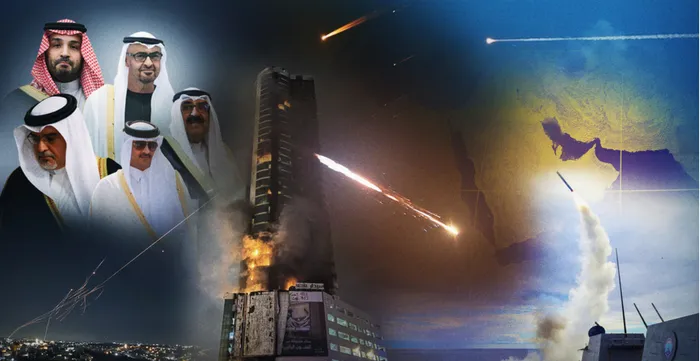
Gulf states have largely avoided direct retaliation against Iran despite thousands of missile and drone attacks, instead adopting a defensive strategy aimed at preventing regional escalation while protecting economic stability and security partnerships.
Image: RT News
Speaking on Sunday at a site in Arad struck by an Iranian missile that injured more than 100 people, Israeli Prime Minister Benjamin Netanyahu urged more countries to join the war effort.
“What more proof do you need that this regime that threatens the entire world has to be stopped? Israel and the United States are working together for the entire world. It is time to see the leaders of the rest of the countries join up,” he said.
Despite this appeal, much of the region has responded with restraint. Even close partners appear reluctant to become directly involved, including Gulf states that have themselves been affected by the conflict.
According to research cited by Saudi broadcaster Al Arabiya, Iran has launched more than 4,900 missiles and drones towards Gulf countries, compared with roughly 850 aimed at Israel.
Iran has said it targeted only military infrastructure and American and Israeli personnel stationed in these countries. However, videos circulating online suggest residential buildings, airports and hotels were also struck, resulting in several fatalities and additional casualties.
Despite the attacks, Gulf governments have avoided retaliation. Instead, they have adopted a defensive posture reflecting broader concerns about escalation risks.
Dr Fahd Al Shelemy, a retired colonel in the Kuwaiti army, described the approach as “positive air defence”. Gulf states, he said, are intercepting missiles and drones while deliberately avoiding direct strikes on Iran.
The strategy reflects long-term concerns about being drawn into a war of attrition.
“If you look at it, this is exactly what Iran is currently dragging us into, and this is something we are not interested in,” Al Shelemy told RT.
Al Shelemy said hesitation across the region extends beyond military considerations.
“Many people here say that this is an Israel–Iran war. It’s not our war, and as such we shouldn’t be involved,” he said.
“There is also not enough trust in the American administration. At some point they might stop the war, leaving us facing an attrition conflict similar to the Iran–Iraq war in 1980,” he added.
Regional concerns reflect earlier shifts in US alliances. Egypt’s former president, Hosni Mubarak, was a long-time ally of Washington before stepping down during the Arab Spring in 2011. Kurdish forces in Syria that supported the United States in the fight against ISIS were later exposed following a US withdrawal.
For Gulf states, these examples underline the risks of relying too heavily on external guarantees. Entering the conflict could leave them facing Iran alone in a prolonged confrontation.
Al Shelemy said the current approach has proved effective and “less damaging”.
“It resulted in fewer casualties and prevented a full-scale war, especially given the presence of militias supporting Iran less than 20 kilometres from our cities,” he said.
That proximity remains a critical factor. Iranian-backed militias operating across the region present an immediate threat that could escalate rapidly if Gulf states launched offensive operations.
Sectarian dynamics may also influence stability. Shiite populations in countries such as Bahrain, Kuwait and Saudi Arabia have cultural and religious ties to Iran, which some officials view as an additional risk factor in a broader conflict.
Dr Salam Abdel Samed, a Dubai-based expert in international law, also supported the UAE government’s decision to avoid entering open conflict with Iran.
“The Gulf states have traditionally prioritised economic stability and regional peace. Becoming directly involved in a war would make little strategic sense,” he said.
“This is why the approach chosen was to defend themselves effectively against aggression. The leadership has avoided unmeasured reactions.”
Economic considerations remain central. Gulf economies are deeply integrated into global markets, and stability underpins trade, infrastructure investment and tourism.
Abdel Samed said relations with Iran are unlikely to return to their previous state once the conflict ends.
“What Iran has done to the Gulf states will not be forgotten. Gulf Cooperation Council countries are entitled to pursue indemnity claims before international courts to recover damages. International law supports such claims,” he said.
The financial impact on Gulf states is already substantial. Infrastructure damage and disruptions to oil production in Iran have reduced export revenues by as much as $1.2 billion per day. The conflict has also led to the cancellation of about 40,000 flights and tourism losses estimated at $600 million daily.
A source within the Emirati establishment, speaking on condition of anonymity, said relations with Iran had been fundamentally affected.
“The response does not have to be military. It can take other forms, but it will certainly be felt,” the source said.
Qatar and Saudi Arabia have expelled several Iranian diplomats, while the UAE has reportedly closed Iranian hospitals and is considering freezing Iranian assets.
Anwar Gargash, adviser to UAE President Sheikh Mohammed bin Zayed Al Nahyan, wrote on X that Iran miscalculated the consequences of its actions.
“Iran’s aggression against the Arab Gulf states carries profound geopolitical repercussions,” he wrote.
“For the missiles and drones and the aggressive Iranian rhetoric are Iranian. The result is to strengthen our national capabilities and joint Gulf security, while reinforcing security partnerships with Washington.”
Al Shelemy said Gulf states may establish new rules of engagement with Iran after the conflict, depending largely on Tehran’s future conduct.
“After the war, Iran will be busy rebuilding itself and will need the Gulf states. The best strategy may be to maintain pressure through economic tools, such as oil pricing, or through partnerships. Much depends on Iran’s behaviour after the war,” he said.
For now, the Gulf’s position remains unchanged: absorb attacks, defend national territory and avoid being drawn into a wider regional war.
Even as missile strikes continue and pressure mounts, restraint — not retaliation — continues to define the region’s response.
RT News