
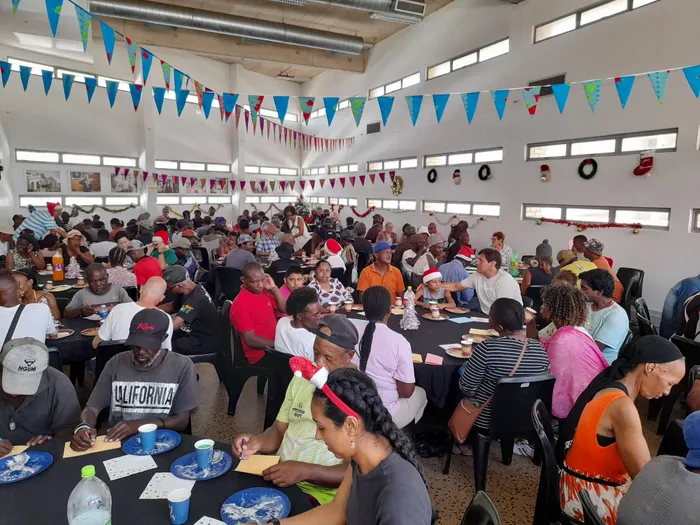
All the halls at the Denis Hurley Centre were full to overflowing as 350 homeless and housed people sat down and shared the Meal of Reconciliation on the Day of Reconciliation.
Image: Supplied
We are now in the middle of the season of ‘goodwill to all humankind’. It started with the Day of Reconciliation on December 16, takes us through this season of Christmas (and Hannukah), and stretches up to January 1. Can we spend this time showing love and peace to those around us, remembering the less fortunate, and reaching out to those who are alone or suffering? Perhaps. Certainly, organisations like the Denis Hurley Centre benefit at this time from the generosity of people wishing to volunteer or make a gift to help those in need.
But caught up in our own indulgences, or distracted by the shiny baubles of the malls, we might struggle to succeed even for these two weeks. And then what confidence do we have that goodwill can continue for the next 12 months?
Many people have been remarking how tough 2025 was and how they hope for a better 2026. But each of us can have an impact on what kind of new year we will have.
What can we draw from this time to strengthen our resolve for 2026? Can I suggest an obvious theme but one of which we need constant reminding: that is our shared humanity. For Christians, this should be uppermost in our minds since the mystery of Christmas is about God choosing to become human. And not by being born a ‘big man’, with thousands of social media followers, or driving round with flashing blue lights. Instead, the most ordinary and forgettable of humans – a small, defenceless child born to parents who were first homeless and then refugees.
Mary and Joseph were vulnerable and looking for help. They were initially pushed around by distant bureaucrats and then rejected by unfriendly innkeepers. They would not feel out of place in Durban today, with unlawful protesters blocking people out of our hospitals, and ‘jobs-worth’ Government officials too lazy or too comfortable to provide help when asked.
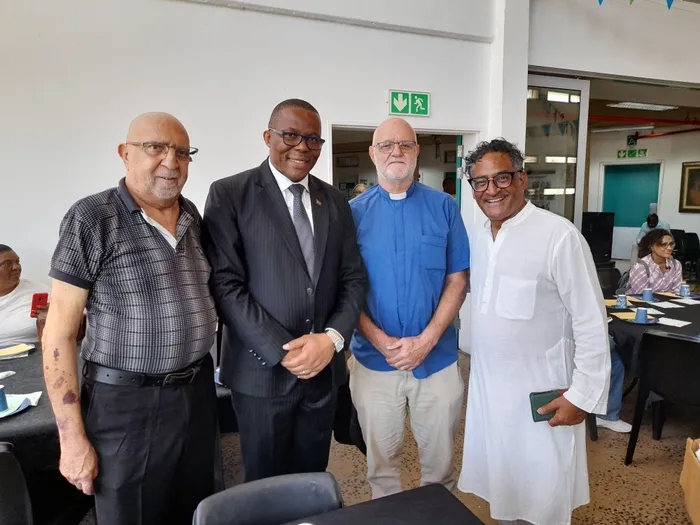
From left, Dr AV Mahomed from the Grey Street Mosque, Ethekwini Mayor Cllr Cyril Xaba, Rev Mike Vorster former Methodist bishop and Director of the Denis Hurley Centre Dr Raymond Perrier at the reconciliation meal.
Image: Supplied
For another reminder of our shared humanity we can turn to the recent Day of Reconciliation. At the Denis Hurley Centre we celebrate this very publicly with our annual Meal of Reconciliation – a chance for 350 Durbanites to sit down and eat side-by-side: homeless and housed, all religions, all colours, all classes, South Africans and foreign nationals.
The Day of Reconciliation – a term first coined by our own founder Paddy Kearney in the 1980s – is a perfect antidote to the Apartheid-era celebrations of December 16. That previous holiday placed the identity of one group over all others and was part of a systematic way of denying the humanity of everyone else, claiming that this was God’s plan.
My husband – who attended the memorial service at the Voortrekker monument as a questioning Afrikaner – tried to explain to some of the people around him about the Meal of Reconciliation at the Denis Hurley Centre. He suggested that this might be a more fitting way of marking the day – instead of 36 000 Boer (and one random black person) trying to sanitise a history of exclusion and brutality by singing hymns and folk songs.
But before we condemn one group, we should admit to other failings of exclusion and brutality in our midst. Many of those who once fought for liberation are also now prone to place their needs over all others – showing preference if not by colour, then by tribe or nationality or class or political party. Some of our democratic-era politicians – as witnessed in the KZN legislature last week – clearly still need to learn what it is to respect the humanity of others.
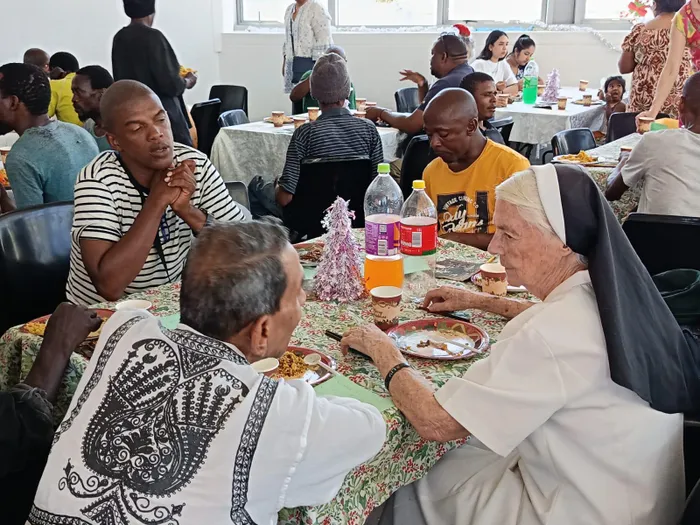
A group of people from different backgrounds sharing food and conversation at the Meal of Reconciliation.
Image: Supplied
We were pleased that the Mayor of eThekwini joined us for our Meal of Reconciliation. He sat and chatted to homeless people and shared the same meal we were all enjoying. But the irony is that many of those present have in recent weeks been brutally beaten up by a private security firm funded by City Hall. And others are fearful that they will soon be dumped in an ill-conceived institution, 37km out of town, to which the municipality intends to exile people whose only crime is to be poor.
In their defence, municipal officials will trumpet that they are spending R10m to ‘solve homelessness’. That is unlikely. Moreover, it compares poorly with the R22m eThekwini has spent on two made-in-China statues and with the more than R100m that the City of Cape Town has spent to provide the same number of beds for their homeless population.
Such distorted priorities arise when we fail to see the humanity of others. Does our municipality see humans who have the misfortune to be homeless – or an untidy problem to be removed from view or beaten into submission? Does our Department of Health see sick humans (who happen to be foreign) – or just a chance to blame some other group for the failings of a badly managed system?
And what of each of us? Though some follow other religious calendars, we will all as one human race be marking the start of the same new year. Do I see this as a chance to share the year ahead with the 8.2 billion other people with whom I share this planet? Or the 63 million with whom I share this country? Or even the 4.2 million with whom I share this city? Or is my focus going to be on me, my family, my tribe?
South Africa has more reason than most countries to be fearful of what happens when we fail to see humanity in others. The traumas experienced in Ukraine, Israel/ Palestine, the USA, and so many other places also stem from the same failure to see the human. There may be little we can do about those: but there is a lot that each one of us can do to make Durban a more human city for all its residents in 2026.
Christians believe that, by God becoming human, each human person has a chance to act in a more godly way. That is the promise of Christmas. And this province, part of whose name means Christmas, is a great place to put that into action.