
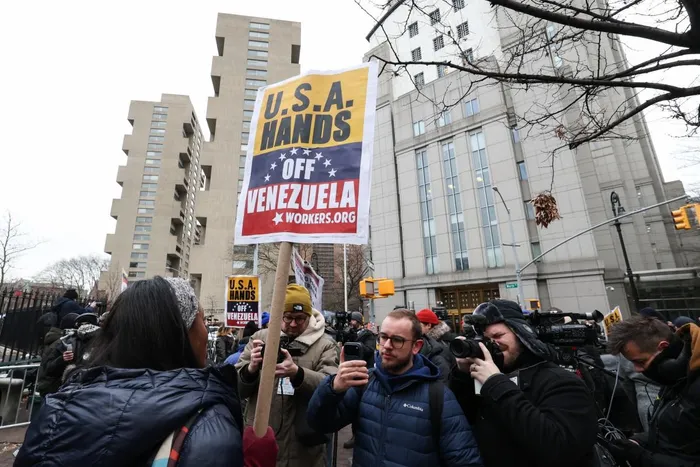
Demonstrators gather outside the Daniel Patrick Moynihan United States Courthouse as ousted Venezuelan president Nicolas Maduro awaits his arraignment hearing. The violation of Venezuela’s sovereignty represents the culmination of a prolonged campaign of regime change initiated in response to Hugo Chávez’s Bolivarian Revolution, says the writer.
Image: Timothy A. Clary/AFP
Dr. Reneva Fourie
On January 3, 2026, the United States launched an unjustified and unprovoked military attack on Venezuela, culminating in the abduction of the sitting president, Nicolás Maduro, and his wife, Cilia Flores.
The aggression followed weeks of escalating pressure that shifted from nominal concerns over narcotics trafficking to explicit statements regarding the need to secure Venezuela’s strategic resources. The impetus underlying the attack had little to do with democracy, human rights, or counternarcotics. Trump’s declaration that the United States would take control of Venezuela’s oil reserves constituted an overt admission of motive.
This was a direct resource grab, echoing older colonial practices in which military power is used to seize what cannot be obtained through economic pressure or political manipulation. Executed without a mandate from the United Nations Security Council or the authorization of the United States Congress, the action constitutes a fundamental assault on the principles of international law.
This dynamic demonstrates that when military coercion is established as the ultimate arbiter, national sovereignty becomes contingent, perpetually vulnerable to negation by those who wield superior force.
The violation of Venezuela’s sovereignty represents the culmination of a prolonged campaign of regime change initiated in response to Hugo Chávez’s Bolivarian Revolution. Drawing on tactics associated with the Cold War, the United States has pursued a coordinated strategy of economic sanctions, financial blockades, and support for internal opposition.
These measures were designed to force political capitulation or state collapse, not because Venezuela posed an external threat, but because it pursued an independent development model centred on social inclusion and state control over key industries. The intended outcome was a fundamental reorientation of Venezuela’s political economy towards privatization and corporate accumulation.
Regime change efforts also sought to divert control of the country’s immense material wealth, including the world’s largest proven oil reserves alongside lithium, gold, and rare earth minerals, away from domestic development and into channels governed by foreign capital. From mid-2025, the Trump administration intensified this campaign. Travel restrictions on Venezuelan nationals were reinstated under the guise of national security.
By December, these actions escalated into overt economic warfare, including the blockade of oil tankers at Venezuelan ports and the seizure of commercial vessels in nearby waters. Simultaneously, the United States conducted a conspicuous military build-up in the Caribbean, deploying troops, warships, and aircraft.
Although publicly justified as counter-narcotics operations, this mobilization aligned closely with earlier statements regarding resource acquisition, revealing the intervention’s economic foundation.
Despite years of crippling sanctions, consistent disinformation, and diplomatic isolation, these measures failed to erode popular support for the governing United Socialist Party of Venezuela or to fracture the armed forces' loyalty. Instead, external pressure reinforced internal cohesion. This outcome exposes a recurring contradiction within capitalist expansion: economic warfare intended to cripple noncompliant states often consolidates domestic resistance and institutional resolve.
When imperial power is unable to achieve its objectives through economic coercion, proxy interference, or political subversion, it predictably turns to open violence. This pattern is well established, from Iraq to Libya to Syria. In Venezuela’s case, having exhausted its indirect tools, Washington defaulted to crude force.
The January 3 attack killed soldiers and civilians, damaged military and social infrastructure, and forcibly removed the country’s elected leadership. The abduction of President Maduro represented the violent resolution of a strategic stalemate through overwhelming military power.
The subsequent public appearance of President Maduro and the First Lady in a New York court on 5 January, facing charges of money laundering and drug trafficking, functioned primarily as an act of humiliation rather than a genuine effort to address narcotics trafficking. This was underscored by President Trump’s recent pardon of former Honduran President Juan Orlando Hernández, who faced comparable charges. The selective application of justice further discredits the stated rationale for the intervention.
International reactions were significant.
Within Venezuela, mass demonstrations condemned the attack and demanded the release of the president, and an acting president was installed rather than allowing the US to govern directly or via a proxy. This stance reflects a popular defence of national self-determination against foreign imposition. Protests across the United States and in numerous global capitals indicated widespread recognition of the action’s illegality and the dangerous precedent it established.
However, these responses unfolded within an international framework increasingly incapable of enforcing accountability. The architecture of international law and multilateral institutions, often described as a rules-based order, has consistently failed to restrain the actions of dominant states when their strategic interests are at stake.
At the United Nations Security Council meeting on Venezuela on January 5, the Non-Aligned Movement and the Group of Friends in Defence of the Charter of the United Nations presented detailed arguments outlining multiple violations of the UN Charter by the US, warning of the precedent being set. These interventions produced no tangible outcomes, confirming that the system primarily serves to regulate weaker states while preserving the prerogatives of stronger ones.
The attack on Venezuela aligns with the US’s broader foreign policy pattern. Military strikes on Iran during negotiations in June 2025, the December 2025 intervention in Nigeria while their government was negotiating with Boko Haram, and the operation against Venezuela while Trump was negotiating with Maduro demonstrate an approach that treats diplomacy as a tactical instrument rather than a genuine pursuit of resolution.
Negotiations have become intervals for intelligence consolidation and military preparation, while crises are deliberately provoked through actions such as escalating arms shipments to Taiwan. Subsequent threats against Venezuela, Colombia, and Mexico indicate the bully tactics applied against any state perceived as obstructing the US’s unilateral access to resources and markets.
The consequence is a world re-entering an escalated phase of kinetic warfare. The devastation in Gaza, the attack on Venezuela, and the targeting of other independent states are interconnected manifestations of a single underlying logic, the pursuit of control over resources, labour, and strategic geography through force. Appeals to an abstract international consensus are insufficient in the face of this reality.
The necessary response must therefore be material and collective. This requires moving beyond declaratory solidarity towards integrated defence arrangements, alternative financial and trade systems insulated from unilateral coercion, and shared development of productive capacities.
For over two years, we have been mourning the Gaza genocide; today, Venezuela's sovereignty lies shattered; tomorrow, Iran faces renewed bombardment; will South Africa or another Global South state follow, targeted for defying US dictates on resources or alliances?
The defence of Venezuela is not symbolic but a practical imperative for collective survival in an international system where restraint is increasingly absent. It is vital that peace-loving countries forge an unbreakable coalition to counter such unbridled aggression, or they will inevitably face it alone.
* Dr Reneva Fourie is a policy analyst specialising in governance, development, and security.
** The views expressed do not necessarily reflect the views of IOL, Independent Media or The African.