
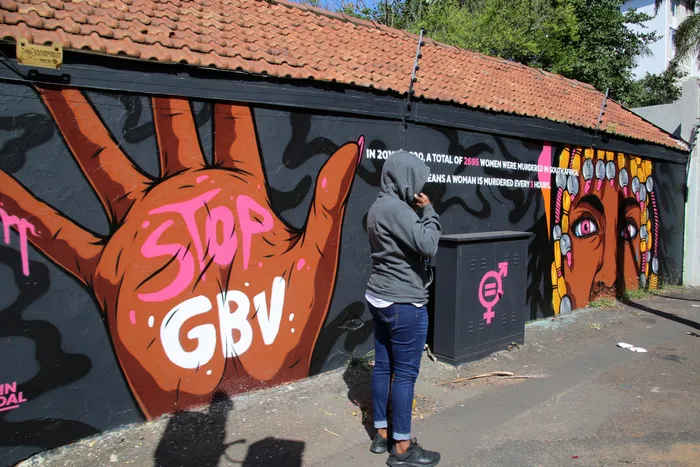
The fight for women's safety transcends mere statistics — it demands a collective moral awakening. The writer says toxic masculinity and male entitlement perpetuate this crisis, and require cultural change that can protect and empower women.
Image: Tumi Pakkies/ Independent Newspapers
As reported by United Nations Women, South Africa has some of the highest GBV rates worldwide, with women’s killing rate five times the global average.
Although the country has made constitutional progress since 1994, it remains a hotspot for violence against women, especially Intimate Partner Femicide, the murder of women by current or former partners, which is a particularly tragic and still an ongoing issue, post 30 years into democracy.
To effectively address this crisis, we need to go beyond crime statistics and challenge the deep-rooted socio-cultural beliefs that drive it, including toxic masculinity, a set of "unspoken rules" that tell men they must be dominant, aggressive, and emotionless to be a "real man”, and the male entitlement that sustains it.
Although overall violent crime in South Africa decreased in the second quarter of 2024, incidents of gender-based violence (GBV) increased. The Human Sciences Research Council (HSRC) reported in its first South African National GBV study that between July and September 2024, 957 women were murdered, 1,567 survived attempted murders, and 14,366 suffered assaults causing grievous bodily harm. Additionally, 10,191 rapes were recorded.
More recent data from the Centre for the Study of Violence and Reconciliation continues to show a grim situation, with 13,453 sexual offences documented from January to March 2025, including 10,688 rapes, 1,872 sexual assaults, 656 attempted sexual offences, and 236 contact sexual offences. The majority of victims and survivors are women and girls from GBV hotspots such as Gauteng, KwaZulu-Natal, and Western Cape.
These figures highlight how unsafe it remains to be a woman or girl in South Africa. A large number of female murders are carried out by intimate partners, underscoring the lethal risks women face in their own homes and relationships. This is a systemic, gendered issue rooted in toxic masculinity and male entitlement. This pattern centres on toxic masculinity, a cultural standard that justifies men's dominance over women and suppresses other male identities.
In South Africa, this ideal often manifests as unquestioning control, emotional restraint, toughness, physical ability, and sexual dominance. Post-apartheid, South Africa, with its history of systemic violence, economic exclusion, and social upheavals, has experienced a "crisis of masculinity" among many men. The shift to democracy, which sought equality, challenged the traditional power structures that supported male authority, particularly within families and other relationships.
For some men, losing traditional sources of power, whether economic, due to high unemployment, or social, due to constitutional equality, threatens their sense of identity. This existential concern often manifests as male entitlement, a risky belief that men are inherently owed obedience, sexual access, respect, and control over women. Therefore, when a woman seeks independence, ends a relationship, or becomes financially successful, it can be seen as a direct challenge to the male ego rooted in entitlement.
In this context, violence, especially femicide, serves as the ultimate way to reassert lost power, acting as the deadly enforcement of patriarchal dominance. These murders are more than acts of rage; they often serve as a final, unequivocal declaration of ownership. The message behind them is hauntingly clear: “If I can't control you, nobody can, and you will no longer exist as an autonomous human being.”
The high incidence of murders following separation or when a woman tries to leave an abusive relationship underscores the possessive nature of this violence. The issue of toxic masculinity is closely linked to this entitlement. Toxic masculinity describes the limiting and damaging traits of the male gender role, particularly promoting violence, sexual aggression, emotional detachment, and the rejection of vulnerability. This emotional illiteracy deprives men of the tools to handle anger, rejection, or stress in healthy ways. Instead of seeking support or undertaking difficult yet necessary emotional labour, the dominant script insists that only anger and violence are acceptable masculine responses to failure or threat.
This is a tragedy for both women and men, trapping men in cycles of destructive behaviour. To effectively combat GBV and femicide, we must go beyond reactive responses. The focus should be on proactively dismantling cultural roots that foster perpetrators, which calls for comprehensive societal re-education. Strategies include challenging early socialisation narratives by teaching boys emotional literacy, healthy conflict resolution, and respectfulness. The notion of a "strong" man should be redefined to emphasise responsibility, empathy, and integrity rather than dominance.
Second, reforming institutions by ensuring the criminal justice system actively works beyond case processing. Police, prosecutors, and courts need ongoing gender-sensitivity training to eliminate victim-blaming and ensure swift, firm action against perpetrators; third, empowering women economically and socially by providing safety nets like shelters and enforcement of protection orders, while engaging men in gender equality efforts; and finally, community and peer interventions are crucial.

Dr Tshanduko Tshilongo is a lecturer in the Department of Sociology at the University of Zululand.
Image: Supplied
Silence from other men signifies complicity; thus, a widespread mobilisation of men to challenge misogynistic behaviours, jokes, and violence is essential. Community organisations and male role models should lead the movement promoting positive, non-violent masculinity. The fight against GBV is more than just a crime issue; it's a moral struggle for South Africa's post-apartheid identity. Combating GBV and femicide requires continuous collective reflection that places women's safety and dignity above destructive masculine stereotypes. The era for debate has passed; immediate action towards profound cultural and behavioural change is essential.
*Dr Tshanduko Tshilongo is a lecturer in the Department of Sociology at the University of Zululand.
**The views expressed do not necessarily reflect the views of IOL, Independent Media or the Independent on Saturday.