
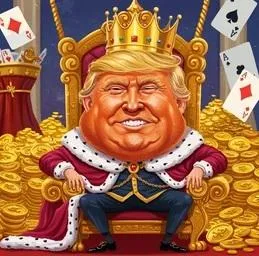
Trump's bizarre politics makes sense seen through a royalist lens.
Image: Supplied
Andreas Kluth
The search continues for a framework to make sense of, or at least label, the baffling state of world affairs since Donald Trump took his second oath of office as president of the United States. And now we have a new contender: Neo-royalism. At first - and even second - glance, I’d say it fits.
First, a recap of some of the “isms” that have clearly failed. Trump is obviously not an isolationist because, for starters, he keeps bombing foreign countries - provided they’re weak enough not to return more than token fire. Currently, he’s considering a second go at Iran.
Nor is he a realist, because too many things he does - from waging random trade wars to insulting allies or letting China have state-of-the-art American microchips - hurt rather than help the national interests of the United States.
Trump definitely is a transactionalist. But that label just implies that he thinks in short-term deals rather than strategy - as one of his former national-security advisors puts it, that his foreign policy is “an archipelago of dots, unconnected by chords of logic.” While the description fits, it has little analytic value.
Some -isms that do pack a punch come from the field of psychology rather than international relations and also have limited utility. Narcissism, for instance.(*) It explains much about Trump’s leadership: his constant projection of grandiosity and need for flattery, among other things. But other world leaders and American presidents have also exhibited signs of narcissism, and we generally don’t name eras after the trait.
Enter Stacie Goddard at Wellesley College and Abraham Newman at Georgetown University with their framing of current world politics as neo-royalist. Their premise is that international-relations scholars are flailing in part because they’re trained to think of their field, as its name implies, as affairs between and among states. They contend instead that the proper unit of analysis in the era of Trump (and his counterparts in Russia, India, Turkey and other places) is the leader and his clique.
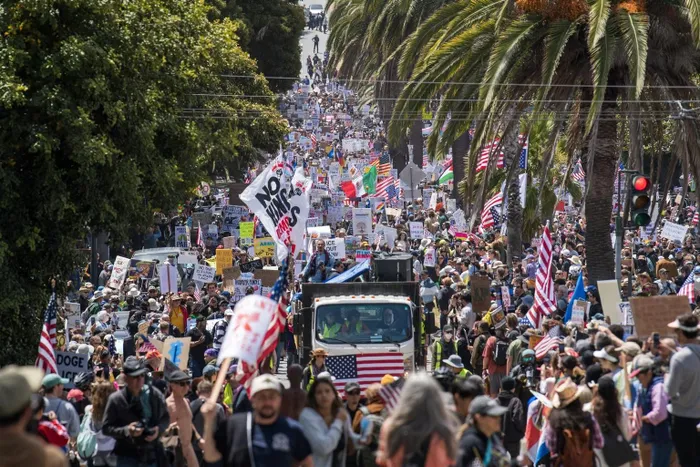
Demonstrators march in San Francisco protesting the Trump administration during the “No Kings” rally in June last year.
Image: Nic Coury / AFP
“Clique” is their word for what historians of the Middle Ages and early modern era call dynasties, houses, khanates and the like. The clique extends to family, supporters (campaign donors, say) and other friends. The foreign policy of the Trump clique, the argument goes, would easily have been recognized by, say, Tudors, Habsburgs, Bourbons, Romanovs or Medicis.
These dynasties, as Goddard and Newman put it, were networks of family and patronage around a leader “seeking to generate durable material and status hierarchies based on the extraction of financial and cultural tributes.”
Suddenly a lot of contradictions make more sense. Trade and commercial policy, for example. Despite his America First rhetoric, Trump does not use tariffs, or the threat of them, as way of mobilizing state power but as “a rent-seeking strategy, a regime based on arbitrary decisions, aimed at extracting maximum wealth for the clique.”
In this regime, the leaders of countries he targets have to offer special access to him or his family and associates. The tithes and tributes can range from gold crowns (South Korea) to fast-tracked Trump-branded golf courses (Vietnam, for instance), luxury jets (Qatar) or crypto-currency deals with the Trump family (United Arab Emirates).
One aspect of explicit tribute-seeking by the neo-royalist clique is of course the accumulation of vast riches. The Trump clan’s businesses apparently made at least $4 billion since he returned to the White House. Non-family members of the clique are also doing well, as Trump re-channels, say, the oil riches of Venezuela, a country that he recently attacked and subdued.
But neo-royalism is about status as much as money. To Goddard and Newman, that explains perhaps the most puzzling aspect of Trump’s foreign policy: the mix of what they call his “collusion” with some of America’s traditional adversaries, notably Russia and China, and his disdain for allies, not least Denmark and Canada.
In a state-centric realist model, that stance is against America’s interests and makes no sense. In a neo-royalist order, it makes perfect sense, because “hierarchy is the point.”
The ruling dynasty “will only recognize rival ‘great cliques’ as peers,” Goddard and Newman argue; “all others are unequal, and not due recognition.” When Trump looks at the Kremlin or Zhongnanhai, he sees other royal courts worth visiting. When he looks at Copenhagen’s Borgen (if he’s even aware of it), he espies a tributary liege.
This view of the states’ system is of course the direct opposite of the one stipulated, at least officially, by the so-called “rules-based international order” which America endorsed between World War II and Trump. It regarded all sovereign nations as formally equal, and respected institutions such as the United Nations or the European Union as forums for co-operation. As a neo-royalist, Trump scorns the UN and the EU.
Neo-royalism also sheds light on Trump’s approach to legitimation. “I don’t need international law,” he recently said; “the only thing that can stop me” is “my own morality, my own mind.” At home and abroad, Trump subscribes to what Goddard and Newman call “legitimation by exception: stories that explain why some actors are uniquely endowed with the right to wield sovereign power.”
In his second inaugural speech, Trump said that he “was saved by God to Make America Great Again,” and in prayer services at the Pentagon he has been praised as “divinely appointed.” Such notions come rather close to the Mandate of Heaven once claimed by Chinese emperors, or the default notion by sovereigns in past centuries that “l’etat, c’est moi.”
I find neo-royalism almost shockingly consistent in explaining American policies that, viewed through other lenses, seem increasingly arbitrary and chaotic. In every other way, nothing is shocking about it, though. Historically, royalism has been the norm rather than the exception, and in some places - Russia, say - still is.
If neo-royalism feels unfamiliar and weird to many of us, that’s because America has spent 250 years - ever since its farewell to George III - presenting an alternative, both at home and abroad. In that worldview, what mattered was the welfare of the governed, not of the governing clique.
With that mental reframing, the American (and then French and other) revolutionaries changed not just their own country, but the world. Similarly, a neo-royalist restoration, if it succeeds, would mark an atavistic turn for the whole world. You may like that or not. I, for one, need to get myself one of those “No Kings” signs.
*Stephen Walt, an international-relations professor at the Harvard Kennedy School, told me that he sometimes, without any commentary, writes the clinical attributes of narcissism on his whiteboard and his students invariably start shifting and giggling, because the traits so obviously describe the US president.