
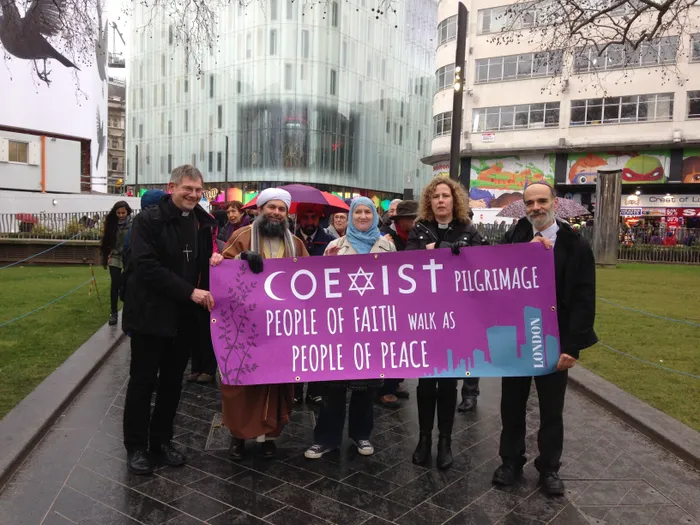
Dean John Witcombe (far left) attends an interfaith event in the United Kingdom.
Image: Supplied
Dr John Witcombe
I am the Dean – the priest in charge – of a cathedral in a medium-sized city in the English Midlands. But, strangely, in that role I have the opportunity to witness and participate in work of reconciliation and peace-building around the world.
That is because the city where I am based, Coventry, was almost destroyed by firebombs during the Second World War. On one fateful night in November 1940 our beautiful mediaeval cathedral – parts of which had stood for over 800 years – was almost razed to the ground. Walking through the ruins the next day, my predecessor as Dean, Richard Howard, noticed that two roof beams had fallen in such a way that they created a cross. And in that, he saw a sign of hope. In the midst of the destruction and the desecration, he realised that the war would eventually end and that then the bigger project of reconciliation would be needed.
So even while Britain was still at war with Germany, he started reaching out to clergy in German cities that had been bombed by Allied Forces and started the long hard conversation of reconciliation. From this emerged what is now known as the international Community of the Cross of Nails (CCN) which brings together organisations that are committed to peace-building in different situations around the world – initially crossing the divisions between different Christian groups, and then reaching out also to people of all faiths. Each member organisation cherishes a symbolic cross made of nails, originally nails that had fallen from the burning roof of the Cathedral.
I am here to visit South African members of the Community of the Cross of Nails. They range from impressive, noble places such as the Cathedral of the Holy Nativity in Pietermaritzburg, to much smaller but no less impressive projects like St Michael’s school in Khayelitsha outside Cape Town.
In Durban, the Denis Hurley Centre is a member of the CCN standing out as a light in the middle of the poverty and decline of the city centre. They are a light because of the safe welcome and life-saving services they provide to homeless people, refugees and other marginal communities. And they are also a light because of the way they bring together people of all faiths to serve those most in need.
I am delighted that I will be there as the sun is setting tomorrow (Sunday 8 March). I will join others to listen to the call to prayer from the Grey Street Mosque – right next to Emmanuel Cathedral – and then to share in a breaking of the Ramadan fast (iftar) that will bring together Muslims and non-Muslims.
The image of bringing light in darkness is one that pervades the CCN’s work of reconciliation. Sometimes all we can see is darkness. I was travelling in Jerusalem recently and it is hard to imagine how and when the conflict there between Israel and Palestine will ever end; just as it was hard for Dean Howard in 1940 to imagine how the Second World War would end.
And then in the last few days it seems that the darkness has become even more intense with violence spreading across the Middle East. Moreover, as one new war emerges, we have to make sure that we do not forget other conflicts – whether in Ukraine, Sudan or Myanmar. And we face every day the impact of violence in our own cities and communities and even in our own families. There is fear on every side.
When the world is in such a dark place, the call is for people of faith not to lose hope. We need to look for new insights, to see the world differently; and in turn we need to help others to see differently. I take comfort from the words of Scripture which unite Jews, Christians and Muslims as children of the same father – Abraham. The promise to him was that his descendants would be as numerous as the stars in the sky. When I am in Africa, I am shocked to see quite how many more stars there are than I can ever see in light-populated England. I realise what a great promise that was.
Each star is a point of light in the darkness. And each star points to the light which comes to every one of us from the Creator of us all. The Creator calls us into the light and then charges us to be bearers of light in the world. The world’s divisions can and should cause us pain, but they are also a reminder to us that we need to be open to God’s light.
I was reminded of this as I was flying down from the UK. It was the middle of the flight, almost everyone in the plane was sleeping, and the place was in darkness. And then one passenger opened his window shutter and suddenly a shaft of light poured into the plane. I confess that I was annoyed that the light had interrupted my sleep – but it also showed me how much impact just one person’s light can have when we are surrounded by darkness.
The prayer of the Community of the Cross of Nails has a refrain which is literally chiselled into the stone wall that remains standing of our ruined cathedral. The words are ‘Father Forgive’ and, in praying those, I am not only asking God to forgive other people but I am asking God to forgive me.
We each have to ask for forgiveness because we each contribute, in large and small ways, to the darkness. Each us is tempted to behaviour that separates nation from nation, race from race and class from class. Each of us is tempted by greed or envy or lust. Each of us can be indifferent to the plight of the homeless and the refugee. Each of us is liable to the pride which means we put our trust in ourselves and in human institutions and not in God. For each of those we can ask for forgiveness. And we can pray to be kind to one another and forgive each other as God forgives us. That is how we can make our light shine out – 2needed even more now when the darkness seems so intense.
When I go back to the UK I will be delighted to share with my colleagues the inspiring examples of peace-building and reconciliation that I have seen at the Denis Hurley Centre and other places in South Africa. I hope that, just as you shone your light during the darkness of Apartheid, you will continue to shine your light in the world today. It is only by working together that we can hope to restore the world as the Creator intended it – one family, one people.