
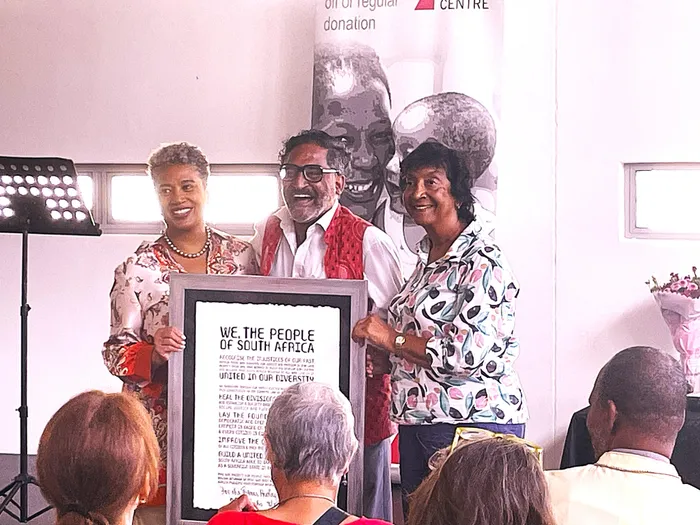
Judge Navi Pillay (right) with fellow DHC Patron Constitutional Court Justice Leona Theron either side of DHC Director Dr Raymond Perrier. They are holding a framed copy of the Preamble to the Constitution which was gifted to the DHC by Justice Albie Sachs.
Image: Supplied
Judge Navi Pillay
As someone who has spent my whole life campaigning for Human Rights, it gives me great joy to know that we have a public holiday in South Africa which specifically celebrates our rights. And we have good reason to celebrate. For many decades, our country was infamous throughout the world for the multiple ways in which the rights of people were violated by the Apartheid government.
The holiday date itself reminds us of the massacre of 69 people, gunned down during a peaceful protest march in Sharpeville on 21 March 1960. And that atrocity was followed by similar human rights violations at Soweto in 1976, Sebokeng in 1991 and many more.
But human rights were not only violated in big public explosions like these. The human rights of almost every South African were also violated by the relentless daily injustices of policies that affected where you lived and worked, who you married or watched movies with, what education and healthcare you received, and how you were treated by the judicial system. Liberation in 1994 over-turned all that and culminated in our extraordinary Constitution, whose 30th anniversary we will be celebrating towards the end of this year.
On paper then we have a lot to celebrate – and we should do so because we owe a huge debt of gratitude to those women and men who gave their time, and sometimes their lives, to bring about that Liberation. Some of them are well known and even have large statues to honour them. Many are known perhaps only to a few people but their contribution and their sacrifices are equally deserving of honour.
But the test of our Constitution – and the Bill of Rights that makes up a core part – is not how good it looks on paper but how it is experienced in the lives of real people. And, if I may paraphrase one of Durban’s most famous residents, Mahatma Gandhi, how it is experienced in the life of the poorest person I know.
From that perspective, we have much less to celebrate. Again, we can worry about the big public violations of rights such as what happened at Marikana in 2012 or during the unrest across the country in 2021. But we should also keep in mind the daily violations. Often, we might not even be aware of them. It is even more shocking when they are revealed and then met with indifference by the very people supposed to be defenders of our rights.
For six years, as United Nations High Commissioner for Human Rights, I saw reports of shocking large-scale human rights abuses from around the world. I am now involved in cases at the International Court of Justice in the Hague in the Netherlands where my focus again tends to be high-profile cases involving genocide, torture and human trafficking. I hope that I can bring my experience of fighting for human rights – honed in the Struggle in South Africa – to the service of those suffering in other countries.
But I am also grateful that in my role as a patron of the Denis Hurley Centre in Durban, I also hear about much smaller-scale examples of human rights violations that nevertheless have a profound impact on the lives of the people affected.
It is shocking to think that for over eight months now, self-appointed vigilantes have been barring sick people from accessing healthcare in Durban and other places. The claim of these so-called protesters is that they are protecting the hospitals from ‘illegal migrants’. The evidence is clear that they have blocked not only undocumented migrants, but also foreign nationals who are in the country entirely legally (on work or study visas or with permanent residence) as well as children born in South Africa and South Africans who do not have ID cards.
Hundreds if not thousands of people have been turned away from basic healthcare, from life-saving medication (like insulin or ARVs), and from emergency treatment. Of course, these protesters have absolutely no right – legally or morally – to decide who should or should not be treated in a Government hospital. Moreover, by their actions they give the impression that this is something which is open for debate.
But one of the reasons that countries have a Bill of Rights is to make it clear what is and is not up for discussion. For example, when we have elections later this year, we will not have to re-start a debate about which citizens are allowed to vote and whether some people are disallowed because of gender or skin colour or being in prison. The Constitution is clear that every citizen over the age of 18 has an equal right to vote.
Comparably, the Constitution makes it clear that a wide range of rights are enjoyed by everyone who lives in South Africa regardless of their status, and that includes nationality. That is why Section 27 states: “Everyone has the right to have access to healthcare….sufficient food and water….social security.” You might not like the fact that that right extends to non-South Africans. You might also think that men should get preference in education, or that Indians should get preference in jobs, or that Christians should get preference in housing. But the Bill of Rights makes sure that Government policy is set according to agreed moral principles, not the likes or preferences of whoever has the loudest voice.
There can at some point be a debate about whether the Constitution should be amended – but the process for doing that does not involve people taking the law into their own hands. It is, I hope, unlikely that the people will ever argue that the Constitution should be amended so we can return to extra-judicial punishments of the sort that were commonplace under Apartheid. But that is exactly the form of on-going human rights violations that are taking place on our doorstep.
The Denis Hurley Centre has raised the alarm on defenceless homeless people being assaulted by personnel from private security firms contracted by the municipality. The Navi Pillay Research Group at UKZN’s School of Law has been working with the centre to investigate the incidents, and engage with the mayor and his officials. We expect accountability for such unlawful and unconstitutional behaviour, and want to ensure that appropriate policy measures are put in place to protect the dignity and equality of eThekwini’s poorest citizens.
These two examples are linked because the victims are people who are so marginalised that their voices are not usually heard, and the perpetrators expected them to keep silent. They are also linked because, in both examples, the illegal actions of individuals are compounded by the unconstitutional inaction or indifference of government officials. This matters because the state – and the people who are employed by the state – have a particular set of obligations with regard to the Constitution. Section 7 says: “The state must respect, protect, promote and fulfil the rights in the Bill of Rights.”
Thus, it is not enough for an eThekwini official to say that they are satisfied that the private security company has fired personnel who assaulted one homeless person. The city needs to demonstrate what steps they have taken to protect all homeless people from future violence, and to promote an understanding of human rights among security personnel directly and indirectly employed by the municipality. It is not enough for Department of Health officials to say that they do not discriminate inside the hospital; they have to demonstrate what they have done to make sure that patients can access the hospital in the first place. It is not enough that the police say that they have respected the rights of people who want to protest, if they have turned a blind eye to how the same protesters have infringed the right to privacy of patients by stopping them and demanding that they show their IDs.
The last two examples are especially concerning. Health officials and police officers should have already known what their duty was. Yet they did nothing and so civil society organisations had to turn to the courts. But even after a judgment (from the Gauteng High Court) ordered both those groups to actively stop the blockade of clinics three months ago, they have allowed the vigilantes to continue unchecked.
Our Bill of Rights was created to protect “all people who live within South Africa’s borders” from actions that offend against equality and justice. It was an appropriate response to decades of cruel discrimination. But we find ourselves in a city where people continue to face discrimination, where officers of the state do not carry out their sworn duty to uphold the Constitution, and where they are even allowed to ignore the direct instructions of high courts.
I hope, on reading this, that you will feel sympathy. But perhaps you might also reassure yourself that, when needed, you will still be protected by that same Bill of Rights. If so, I offer you a famous warning from a German pastor, Martin Niemöller, during the Second World War:
“First they came for the socialists, and I did not speak out, because I was not a socialist. Then they came for the trade unionists, and I did not speak out, because I was not a trade unionist. Then they came for the Jews, and I did not speak out, because I was not a Jew. Then they came for me – and there was no one left to speak for me.”